

RyeGPT People of Note is a series highlighting individuals who have a connection to the City of Rye. In the series we use artificial intelligence to prepare a biography and explain the individual’s connection to Rye.
Please send feedback and suggestions for other people to profile via our Tips & Letters.
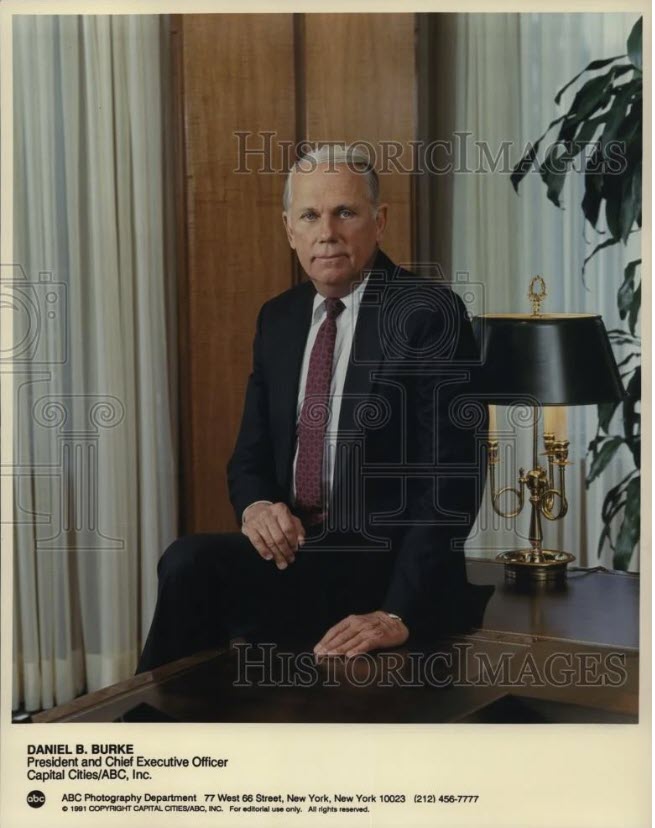
When television industry giant Daniel B. Burke passed away on October 26, 2011, at the age of 82, he left behind a legacy as one of the architects of the modern television industry. Over more than three decades at Capital Cities, Burke rose from managing a local television station in Albany to becoming president and CEO of Capital Cities/ABC. He also called Rye, New York, home, where he died in 2011.
Burke’s connection to Rye was particularly evident at the end of his life. He died at his home in Rye, and following his death, friends and family gathered for a visitation at Graham Funeral Home on Post Road before his funeral in Maine.
A Career Built on Integrity and Innovation
Born in Albany, New York, on February 4, 1929, Burke served in the Korean War before earning his bachelor’s degree from the University of Vermont and an MBA from Harvard Business School in 1955. After spending five years at General Foods, he joined Capital Cities in 1961 as general manager of WTEN-TV in Albany.
Burke steadily rose through the company’s ranks, becoming executive vice president and a director in 1967 and president of its Publishing Division in 1969. In 1972, he became president and chief operating officer of Capital Cities.
Working closely with longtime business partner and Capital Cities chairman Tom Murphy, Burke helped transform the company from a small broadcasting operation into a major media conglomerate with interests in television, radio and publishing.
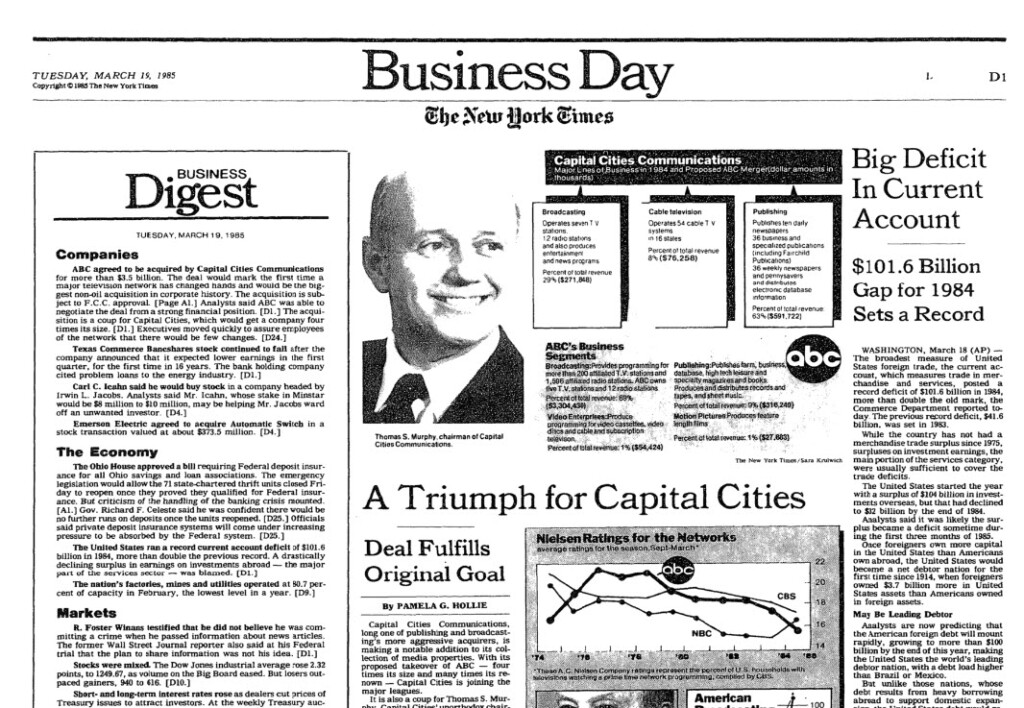
Their most consequential move came in 1986, when Capital Cities acquired the much larger American Broadcasting Company (ABC) for $3.5 billion. Backed in part by legendary investor Warren Buffett, the deal was then the largest non-oil-company merger in American business history. After the acquisition, Burke became president and chief operating officer of Capital Cities/ABC.
In 1990, Burke became president and CEO, a position he held until his retirement in February 1994, on his 65th birthday. Under Burke and Murphy, ABC’s operations were streamlined and its profitability increased. Burke was also known for emphasizing accountability, integrity, directness and involvement in the community.
Disney CEO Robert Iger, who had worked his way up through ABC under Burke, later said in a statement following his passing that Burke was “a gifted executive and natural teacher and a man with a strong sense of right and wrong.” Iger said Burke “stood for integrity and directness in business” while encouraging a balance between work, family and community involvement.
Life in Rye and Beyond
Away from the corporate world, Burke lived with his wife of 54 years, Harriet “Bunny” Burke, and their four children: Steve, Frank, Sally McNamara and Bill.
The Burke family also made its mark on the media industry. His son Steve Burke later became CEO of NBCUniversal, while his son Bill held senior positions in the television industry.
After retiring from Capital Cities/ABC, Burke turned his attention to one of his lifelong passions: baseball. He helped bring professional baseball back to Portland, Maine, where the Portland Sea Dogs began play in 1994, and remained the team’s owner for many years.
Burke was also active in civic and philanthropic organizations. He served as chairman emeritus of NewYork-Presbyterian Hospital and as a director of the Partnership for a Drug-Free America. His contributions to the television industry were recognized in 2008, when he was inducted into the Television Academy Hall of Fame alongside Tom Murphy.
Daniel B. Burke’s career took him from an Albany television station to the top of one of America’s most influential media companies. Yet his story also has a distinctly local connection: for years, the broadcasting executive lived in Rye, and the community was where his family gathered to remember him at the end of his life.