

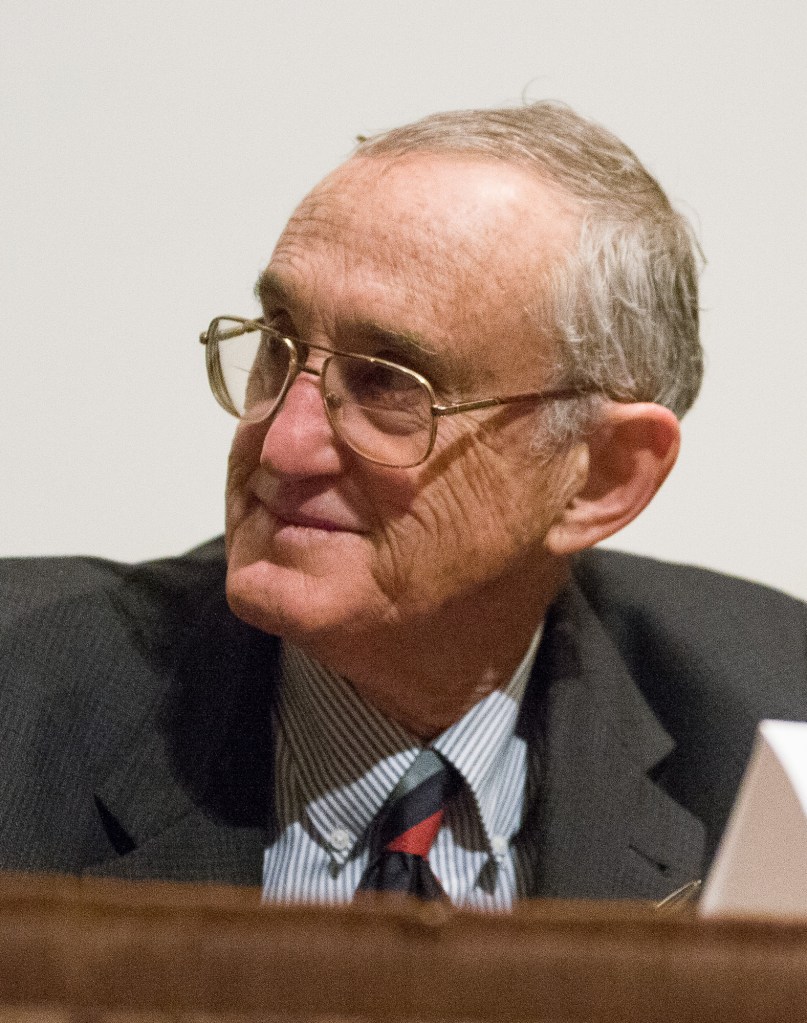
RyeGPT People of Note is a series highlighting individuals who have a connection to the City of Rye. In the series we use artificial intelligence to prepare a biography and explain the individual’s connection to Rye.
Please send feedback and suggestions for other people to profile via our Tips & Letters.
This year’s Nobel Prize in Physics will be announced on October 6, and while this piece looks back at a laureate from three decades ago, David M. Lee’s story is a reminder that Rye’s ties to the world’s most prestigious scientific honor run deep.
Early Life in Rye, New York
David M. Lee was born in Rye, New York, on January 20, 1931. He grew up in Rye and attended Rye High School, graduating in 1948. His father, Marvin Lee, was an electrical engineer, and his mother, Annette (Franks) Lee, was a teacher.
Raised in Rye during the 1930s and 1940s, Lee went on to develop an interest in physics that would eventually lead him to one of the most significant discoveries in modern low-temperature physics.
Academic Journey and Military Service
After graduating from Rye High School, Lee attended Harvard University, where he earned a Bachelor of Arts degree in physics in 1952. He then served for two years in the United States Army during the Korean War era.
Following his military service, Lee continued his education at the University of Connecticut, earning a master’s degree in 1955. He subsequently enrolled at Yale University, where he pursued a Ph.D. in physics under the direction of Henry A. Fairbank. At Yale, Lee began his research in low-temperature physics, studying the properties of liquid helium-3 (3He), work that would ultimately shape his career.
Academic Career and the Nobel Prize
In 1959, after completing his doctorate, Lee joined the faculty at Cornell University in Ithaca, New York. There, he helped establish the Laboratory of Atomic and Solid State Physics and began a decades-long career as an experimental physicist.
At Cornell in the early 1970s, Lee worked with fellow physicist Robert C. Richardson and graduate student Douglas D. Osheroff to investigate the behavior of helium-3 at temperatures only a few thousandths of a degree above absolute zero.
The researchers used an apparatus known as a Pomeranchuk cell to study helium-3 at extremely low temperatures. Their experiments revealed unexpected phase transitions. At first, the team believed they had observed a new phase of solid helium-3. Further experiments, including nuclear magnetic resonance measurements, demonstrated that the transition was actually occurring in liquid helium-3.
The discovery showed that liquid helium-3 could enter a superfluid state, in which it flows without viscosity and exhibits remarkable quantum-mechanical behavior on a macroscopic scale. The finding opened a new field of research into quantum fluids and the behavior of matter at temperatures approaching absolute zero.
In 1996, Lee, Richardson, and Osheroff were jointly awarded the Nobel Prize in Physics “for their discovery of superfluidity in helium-3.”
Legacy and Later Years
Lee’s scientific career extended well beyond his Nobel Prize–winning discovery. His research included work on nuclear spin waves in atomic hydrogen, antiferromagnetic ordering in solid helium-3, and the behavior and phase separation of helium mixtures. His research helped advance scientists’ understanding of matter under extreme conditions and contributed to the broader field of low-temperature physics.
At Cornell, Lee became the James Gilbert White Distinguished Professor of Physical Sciences and later professor emeritus in 2007.
In 2009, Lee joined the physics faculty at Texas A&M University, where he moved his research program and laboratory from Cornell. He continued conducting research and mentoring students while maintaining his connection to Cornell.
David M. Lee’s career ultimately took him from a Rye childhood to the laboratories of two of the world’s leading universities and, in 1996, to Stockholm to accept the Nobel Prize in Physics. Yet his story began here in Rye, where he grew up and graduated from Rye High School before embarking on a career that helped reveal the extraordinary quantum behavior of matter at temperatures near absolute zero.