

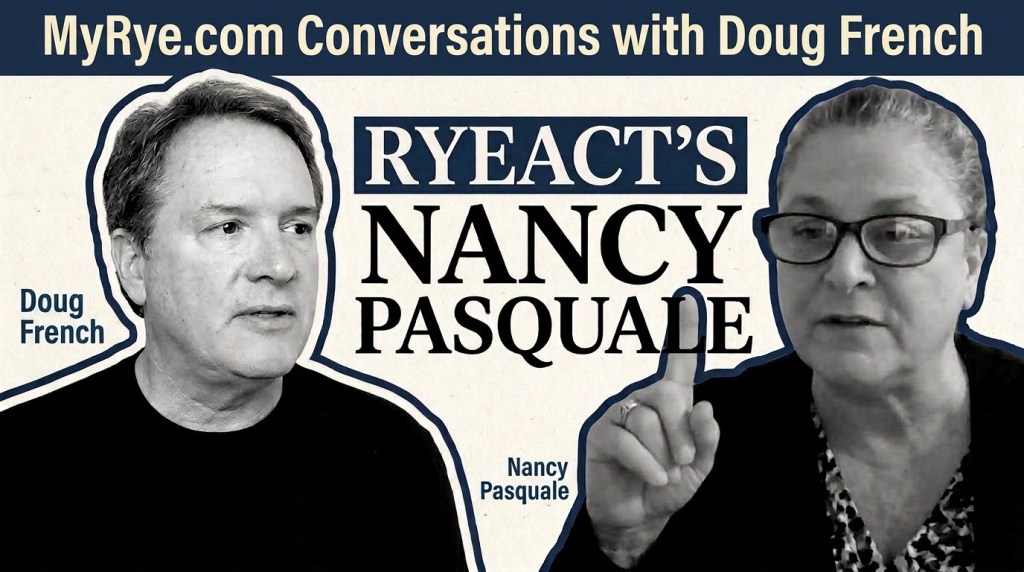
MyRye.com is now in the podcasting business with a new weekly podcast hosted by former Rye Mayor Doug French. Available on all major podcasting platforms, MyRye.com Conversations with Doug French will tackle the larger and sometimes intractable issues impacting the City of Rye through interviews with local, county and state officials and business leaders.
In Episode 24 of Season 1, French speaks with Nancy Pasquale, coalition coordinator and co-founder of RyeACT, about how a local coalition model can reduce youth substance use by centering youth voice, community collaboration, and data-driven prevention. The conversation covers RyeACT’s origins, the trends in its long-running student survey, and how mental health, family communication, and early prevention all connect.
Pasquale also explains why coalitions work differently than committees, how RyeACT’s youth action teams shape the work, and why the group is now focused on sustaining momentum as federal funding ends.
This episode of MyRye.com Conversations with Doug French was produced by MyRye.com. Feedback and story ideas are welcome.
Main Topics Covered:
- In this episode, Doug French introduces RyeACT as a community coalition focused on promoting long-term health and wellness and reducing substance abuse among youth.
- Nancy Pasquale shares how RyeACT began in 2014, with she and Julie Killian bringing together parents, schools, the Rye YMCA, and other local partners after seeing substance use concerns emerge in the community.
- She explains why RyeACT uses a coalition model rather than a committee model, emphasizing that each partner keeps its identity while working toward a shared goal.
- The coalition now meets about every six weeks, with smaller working groups meeting separately as needed, and the youth teams meeting much more frequently.
- Pasquale says youth leadership is now the “beating heart” of the organization, with 245 students involved this year across middle school and high school programs.
- The group’s survey data shows decreased use across every tracked substance and every grade since the work began, including a 71 percent reduction in nicotine vaping among ninth graders since 2016.
- RyeACT is now below Pasquale national averages for nicotine vaping for the first time, though Nancy notes that 14 percent of twelfth graders still reported vaping in the past month.
- Marijuana and THC use has also dropped sharply, including a decrease in ninth-grade past 30-day use from 9.3 percent in 2014 to 1.3 percent in 2025.
- Pasquale cautions that while fewer students may be using, those who do are using more frequently and in riskier ways, especially with today’s more potent and less regulated drug supply.
- She and French discuss the relationship between substance use and mental health, including the value of youth mental health first aid, teen mental health first aid, and co-occurring disorders awareness training.
- Pasquale explains how prevention starts early, even in elementary school, through open communication, emotional regulation skills, goal setting, and clear expectations from parents.
- The episode closes with a discussion of RyeACT’s funding challenge as 10 years of federal support ends, and Pasquale stresses that the work must continue to preserve the gains already made.
Timestamps:
(00:00) Podcast intro and why RyeACT matters for Rye and the Sound Shore
(01:23) Why RyeACT was founded and why coalition work was needed
(04:01) Defining a coalition and how it differs from a committee
(07:10) How often the coalition meets and how the youth teams are structured
(08:44) Youth leadership and how student involvement grew from one student to 245
(10:18) Red Ribbon Week and how middle school and high school teams differ
(11:15) Why youth voice is central to RyeACT’s strategy
(13:07) How RyeACT connects with other Westchester coalitions and learns from them
(15:37) Why survey data matters and what RyeACT measures
(17:34) The biggest positive trends in the latest student survey
(18:44) Nicotine vaping declines and how Rye compares with national averages
(20:48) Marijuana and THC trends and what remains a concern
(23:32) Why riskier use patterns matter even when overall use is lower
(25:08) One Choice prevention, the opioid crisis, and why alcohol still matters most
(29:22) The adolescent brain, pruning, and myelination
(31:25) Why alcohol use raises the risk of later nicotine, marijuana, and opioid use
(33:38) Mental health, co-occurring disorders, and youth self-medication
(35:34) Training adults, school staff, and the community in prevention and mental health
(36:11) Signs adults should watch for and how to respond
(38:06) Prevention advice for elementary school parents
(41:09) The end of federal funding and why RyeACT cannot ease up
(43:26) How to support RyeACT through donations and community involvement
(44:15) One-word closing answers: learn, action, influence, partner, magic
(46:14) Other local groups Doug should invite, including pRYEde Community Group and IRL Rye
Watch:
Full Transcript [edited for clarity]:
Speakers
- MyRye.com, Doug French
- Nancy Pasquale, RyeACT
MyRye.com, Doug French (00:12) Welcome to the MyRye.com podcast, conversations with Doug French. I’m your host, Doug French, former mayor of the City of Rye. This podcast is about the issues and the people that impact Rye, the Sound Shore, and the Westchester region. Our goal is to inform you about what’s happening, who’s deciding, why, and what’s next on the local issues that matter to you. We are here every week. In fact, we’re coming up next week on our 25th. Episode. Who believes, right?
Nancy Pasquale, RyeACT (00:41) Congratulations.
MyRye.com, Doug French (00:42) Thank you. This week in conversation, Rye Action for Children and Teens, or better known as RyeACT. Today we’ll cover how our community has come together to foster healthy behaviors. What are the youth voices and trends telling us? And what programs and solutions are in place. Joining the conversation is Nancy Pasquale, Coalition Coordinator and Co-Founder of RyeACT and youth advisor for the group, a coalition of local organizations and individuals committed to promoting long-term health and wellness by inspiring youth parents and community leaders to foster healthy behaviors and reduce substance abuse. Nancy, welcome to MyRye.com.
Nancy Pasquale, RyeACT (01:22) Doug, thanks for having me. It’s nice to see you here.
MyRye.com, Doug French (01:25) Well this is a important topic and I think to get our conversation started, I just really want to know and our audience wants to know what what was the impetus to start the organization and why a coalition?
Nancy Pasquale, RyeACT (01:34) So RyeACT started in January ish of twenty fourteen. I am the co-founder along with Julie Killian Many of you may know Julie as well. At the time When RyeACT was getting started, Julie and I were both serving in official capacities as elected officials in the community. I was serving on the school board at the time. Julie was serving on the city council, like yourself, Doug. and and in our official capacities, we both were were chairing our our health and safety committees, right? We were so we were sitting in a lot of rooms together where conversations about health and safety were coming up. and one of those happened to be, and this is relatively important because they’re also a a very significant kind of founding partner, one of those rooms happened to be the Rye YMCA’s used to convene a healthier sound shore Committee that that worked on health and wellness topics across the Sound Shore area. And folks like Julie, myself, and others from our local towns got together. and that particular year we were focusing on teen. wellness. We had spent a lot of time focusing more on like sort of early elementary school, younger kid wellness stuff. And that year we were starting to focus on on teen wellness. And Julie and I were both also, in addition to being elected officials, we were also both moms, right? With kids in the schools. And so we were seeing what was going on with substance use. We had friends who were talking about it. we had colleagues who were talking about it. And so we went out and started talking to people, attending events, learning as much as we could about how people do this work. And then we pulled together a small group again. It was the Rye Y, it was Rye Youth Council, it was a few, parents. parents who were active parents in a couple of our POs and PTOs. It was Julie, it was myself. And we got ourselves together and started to do the work of organizing. I’m also gonna share with you that I love that you asked me the question why a coalition and not a another committee. And the reason I say that is for anyone who was there in our early days back in 2016 when we first really launched the coalition, shared our first set of data and talked about forming the coalition. One of the things we did on that night was that I gave a definition because I’m a dictionary girl. I kinda like words a little and we gave a definition of coalition and what it means and I’d love to read it for you because I think
MyRye.com, Doug French (04:11) Absolutely.
Nancy Pasquale, RyeACT (04:12) it answers the question, right? So Webster’s says, and the OED also says, that a coalition is an alliance or union of distinct Parties, groups, or people, or organizations in this case sometimes, who join together to work toward a common goal. It comes from a Latin word, coalitio, which means grow together. And one of the things about coalitions that I think is a little different than committees per se, committees tend to come together and they are the committee. The whole point of coalition is that each individual or group that is represented there doesn’t stop being that group that’s represented there, right? It’s it comes with all of the things that it means to be its individual self or entity. It brings all of that to the table, but the point is that the group grows together, learns together, works together, typically to solve a problem that any one of those individual organizations couldn’t do as well or maybe couldn’t do it all on its own. And one of the two goals, obviously one of the goals of the drug-free communities program that supports our work is to reduce use substance use, right? That’s what we’re here to do, where that’s our primary outcome goal. But the way that we do it is the other goal of the DFC, which is to increase collaboration, right? So why coalition? That’s the answer, because that’s what coalitions do. They help increase collaboration among groups that are already operating and bring all of their strengths to bear. It doesn’t ask them to be something different. It asks them to be exactly what they are and to bring that to bear on a problem or an area of focus that is common to us all and that. And in this case that’s our young people, right?
MyRye.com, Doug French (06:03) Well that’s terrific. I actually I should have had you on as my first guest because that was really why we’re here. Is the way you build community, community development is through a all hands-on approach with the community of of all stakeholders working together to collaborate. And we we’re having a longer conversation here on all the issues around the local community. How do we now bring those together and solve them across all groups? And that’s brilliant. No, I love that. anything in particular about the structure, how often you the coalition meets, you know, who are the partners,
Nancy Pasquale, RyeACT (06:32) Sure.
MyRye.com, Doug French (06:32) that type of thing.
Nancy Pasquale, RyeACT (06:33) Sure. So the coalition in early days we used to meet monthly. What we find now is that we can do about every six weeks-ish. we tend and that’s the coalition as a whole. Various subgroups of the coalition, like little working groups that are working on particular projects or things, or directing committees or steering committees around certain topics, will get together differently, but the coalition as a A whole now we find it’s really helpful to get together about every six weeks or so. We tend to take the summers, you know, July and August off. so we tend to follow the school year about so about six meetings a year typically. again, sometimes meet a little more frequently if we need to, or in subgroups if we need to to tackle a particular problem or project or or do some planning. The one exception to that. and I think this is really important is our youth. They meet really frequently. So we have one of the sectors that is represented, and it’s a super important sector, right? The the the coalition model relies on bringing together various sectors of the community, you know, businesses, healthcare, law enforcement, local government, folks with expertise in substance use, you know, civic organizations, parents. But also youth, right? And all of those are represented. Our youth are represented specifically in what we call our youth action teams. And one of the outcomes that I’m really so incredibly proud to talk about because we’re now at the end of 10 years of official federal funding for our work. we started with one student. Because the DFC says you have to. When you apply, you have to have at least one kid on your group. We started with literally one kid in 2016. this year we worked with 245 students who were directly involved either once or many, many times in our work across both our middle school and our high school. Our high school group meets every other week. It it functions like a like any of our student clubs. at Rye High School. it happens to be the biggest student club at Rye High School. second only to or or it close second to that is Peer to Peer, which is a group that we work together with often. Does mental health stuff. That’s right, youth councils. Yep. And and as you might imagine, we we work
MyRye.com, Doug French (08:51) Is that the youth council? Is that the yeah okay, okay. That’s an upcoming guest, so that’s good. Perfect. Yep.
Nancy Pasquale, RyeACT (08:57) we work with them on on projects often. But our our group is really large. again meets every other week and our middle school group works on a project basis. So they do four to five projects across the school year. And they have two to three meetings that are very focused on A project or an initiative, right? So those are often aligned with things like national observances. Like we have one coming up in October that nationally many folks in prevention recognize. It’s called Red Ribbon Week. and it’s really about helping, you know, bringing to the forefront, sort of helping youth make the the commitment to to being drug and alcohol free and the reasons why. So that’s one of the one of the things that like our middle school group typically does some activities around Red Ribbon Week, for example. Our
MyRye.com, Doug French (09:47) Right, okay.
Nancy Pasquale, RyeACT (09:48) high school group meets a little more often and more regularly so they can do a little bit more frequent stuff, typically sometimes even two or three things a month. and what’s what I love about that is that, and and I think this is a little different for us than for some coalitions. Our youth leadership really is the beating heart of the work. They drive everything we do. And that was not how it was at the beginning, right? It was a bunch of concerned adults coming together. And by the way, those concerned adults continue to come together. But our youth drive the work and the adults support. those youth led efforts, which I just love. And I’m really fortunate it is in fact the best part of my work that I get to be with those students as often as I do. I do that in in collaboration in the high school with Sandy Degenhardt, who is one of the high school social workers, and with Kristen Quintano in the middle school, also the social worker there. So
MyRye.com, Doug French (10:45) Well that is a huge differentiator because I’ve been involved in community work for forty years since I’ve been in Rye. It that was not the case. It was always the adults dictating what they thought the the youth wanted. So getting the youth voice is central to the success of a program. Yeah.
Nancy Pasquale, RyeACT (10:59) Essential. It’s everything.
MyRye.com, Doug French (11:02) And especially your role as a as youth advisor as well as the program coordinator, you’re able to get those insights and and be able to really drive from the bottom up and coordinate,
Nancy Pasquale, RyeACT (11:10) It
MyRye.com, Doug French (11:11) right?
Nancy Pasquale, RyeACT (11:11) It and again it it’s unusual in my field for those two things to exist in the same person. They’re often two different roles that are filled by different people. I’m very lucky that or or maybe it’s just that that’s my favorite part. I’m lucky that I get to do both because I do think it really helps put youth and youth voice at the center of the work. And I think that that’s That’s been instrumental in the in the impact that we’ve had.
MyRye.com, Doug French (11:36) Are there other communities in the area that have a similar group that you connect with or this or nationally?
Nancy Pasquale, RyeACT (11:41) So so we are part of a number of different organizations that bring prevention leaders and coalitions together. One of those and and it’s an important one here locally for us is Westchester has the Westchester Coalition for Drug and Alcohol Free Youth. That is
MyRye.com, Doug French (11:57) Is that part of their youth bureau? Or is that separate? Okay.
Nancy Pasquale, RyeACT (11:59) It is it’s connected to the youth bureau, but it’s not part of the youth bureau, but they work together. the
MyRye.com, Doug French (12:05) Right.
Nancy Pasquale, RyeACT (12:05) co the coalition has actually existed for quite a long time and used to do all the prevention work sort of globally, and then we started having individual coalitions apply for funding and organize themselves. There have been 20 plus in Westchester over time. So interestingly, it’s such a great question. Again, I’m thinking back to those early days. one of the things we did was that we got together with Port Chester had the Port Chester Cares Coalition and Larchmont Mamaroneck had Larchmont Mamaroneck radar. we got together with their leaders who were already doing the work and picked their brains, right? four or five of us who were trying to figure out how to do the work well. We really sat with them, we talked to them, they invited us to their events and activities, and we really learned from them about how to use this coalition model and the framework that goes with it to have to achieve really, good results. And it showed us that it’s different, community to community right? That each community has its own sort of flavor.
MyRye.com, Doug French (13:07) Well it has to be relevant to the community. Yep. Right. Right.
Nancy Pasquale, RyeACT (13:11) for how it implements and that’s part of the goal, right? Part of what
MyRye.com, Doug French (13:15) Yeah.
Nancy Pasquale, RyeACT (13:15) the drug free communities program says is local problems need local solutions, right?
MyRye.com, Doug French (13:19) Exactly, exactly. But there is a way to connect them, right? ‘Cause there is some common thread that connects them but also the relevance of the local
Nancy Pasquale, RyeACT (13:27) One hundred by the way, our youth leaders also get to have that connection through that coalition also has a Westchester Youth Leadership Task Force that brings representatives from various coalitions and school prevention groups together on a monthly basis to do shared projects and shared work, to share ideas, to learn together. and and the fact that we have that is really
MyRye.com, Doug French (13:47) Yeah, that’s great.
Nancy Pasquale, RyeACT (13:51) valuable, right?
MyRye.com, Doug French (13:52) So so in addition to being a dictionary and a word person, you’re also a data person. So
Nancy Pasquale, RyeACT (13:58) I am
MyRye.com, Doug French (13:59) let’s get into what the trends are showing us, what the data is showing. And so you’ve
Nancy Pasquale, RyeACT (14:02) Sure.
MyRye.com, Doug French (14:02) done a survey every two years since what twenty fourteen, twenty sixteen, something like Okay.
Nancy Pasquale, RyeACT (14:07) We actually did our first survey in twenty fourteen, which was before. We were it was when we were initially getting started and there was an opportunity for us to be part of a statewide and New York State happened to be doing a survey that year and we had an opportunity as we were getting ourselves organized to to jump on that opportunity. It it did take some work. We brought that request to the school board at the time to ask for for permission for Rye High School. and Rye Middle School to be a part of that survey. Which we did we were able to get. And it was tremendously helpful because the the thing about that about that survey information is that it helps us understand not just what we think the problems are, but what they actually are by the numbers, what and some of the attitudes and beliefs that are going behind those behaviors and some of the conditions, like risk and protective factors, right? Things that are happening in the environment that contribute to increased use or that help reduce it, right? And both of those things are kind of measured. It’s not just use trends that get measured, it’s also, you know, attitudes, beliefs, environment, school climate, community beliefs and attitudes, parental beliefs and attitudes and norms.
MyRye.com, Doug French (15:29) So you now have a community pack you put together to take out to show the headlines and the highlights of what this survey says and the trends since twenty fourteen. So so tell us, let’s get the inside scoop.
Nancy Pasquale, RyeACT (15:40) Well, the really good news is that since before we started our work really technically in twenty fourteen to now, we’ve actually seen decreased use across every single substance that we track and across every grade from when we started. So right. So we look at we we survey students in grades seven through twelve. and again, part of why we don’t survey sixth graders is because that first survey that we did, and often in New York State and in other places, sixth grade in some places, is still part of elementary school. It’s not it’s not middle school for everyone.
MyRye.com, Doug French (16:19) Right.
Nancy Pasquale, RyeACT (16:20) So we survey students in grades seven through twelve. So so just a few highlights to give you an example. we’ve actually seen reductions in in nicotine use of 71%.
MyRye.com, Doug French (16:33) Mm-hmm.
Nancy Pasquale, RyeACT (16:36) From twenty sixteen, especially because we really track vaping of nicotine. We also track cigarettes, but vaping is more the trend and and vaping was not tracked in twenty fourteen. But from twenty sixteen to our most recent survey in twenty twenty five, which is the data that we’re sharing right now, we saw a 71% decrease among ninth graders. We saw a 67% decrease. And we’re now in in terms of nicotine vaping. we’re actually below national averages, right? So we also sort of look at how we compare to peers nationally. And part of how we do that is through our our ability to access things like monitoring the future, which are big national data sets. And we’re actually below national averages for the first time in the history of our time doing the work this past year on nicotine and vaping, which is really great
MyRye.com, Doug French (17:31) That’s great.
Nancy Pasquale, RyeACT (17:32) news. so that but for example that’s there are still fourteen percent of our of our twelfth graders who have who have used a vape in the last months, right? So we track both lifetime use. We track year, you know, any time use. And then we track what we call monthly or past 30 day use. This is the one that most folks in prevention look at very, very specifically because it really that’s the data point that helps us understand regular use as opposed to like I tried it once ever. That that’s really kind of like what’s happening regularly. and they’re often lower than people think they are, right? There’s kind of a perception by both kids and parents that youth are using more than they actually do. And closing that perception gap is an important part of our work. another great example, we’ve reduced in ninth grade, for example, reduced marijuana and THC use past 30 days from 2014 to 2025 from 9.3% in 2014 to 1.3% in 2025. which is great news. Our twelfth grade use in 2014 of marijuana was 36.2%. Over a third of our students had used marijuana in the past month or THC in the past month, and that’s now down. It’s still too high, though, right? So, so there’s always, always when we look at our data, we look at what’s the good news. The good news is our overall trends, and I will share that those overall trends are also nationally. Those trends are happening nationally. Lots of folks are talking about that, right? There are some really great. Trends around sort of self-care and and thinking about and less use among young people than when you and I, for example, were teenagers, right? That’s something that we’ve seen over over decades. So our trends are mirroring national ones. But this is a case, for example, where our 12th graders are still using marijuana. 20% are still using marijuana on a monthly basis. What we’re also seeing, and this is another sort of when you start to think about data in a granular way, it’s great news that we’re seeing reductions. But what we’re also seeing simultaneously is that those who are using, and there are still more of them than we want to see, right? because any of them using substances. Is harmful for their brains, and we’ll talk about that in a sec. Harmful for their development, puts them at really elevated risk, very different kind of risk than the risk for adults, right? Use has different impact on that developing adolescent brain than it does if I wait or delay until I’m a little bit older and my brain is a little more developed, right? puts me at much greater risk for addiction. But but part of what we’re seeing is that those who are using are using, first of all, we know the drug supply. Is different than it’s ever been before. It’s more potent, it’s less regulated, it’s much more dangerous than it was when, again, when I was a teenager, for example, right? or even 20 years ago. And
MyRye.com, Doug French (20:41) Right. Right.
Nancy Pasquale, RyeACT (20:44) And they’re using in ways that are riskier. They’re using more frequently, right? So the kids who are using marijuana THC, there’s a higher number that are using daily or near daily. That’s something that we need to look at because even if it’s fewer kids, we need to be worried about that those use patterns because they’re they’re riskier and more dangerous, right? And
MyRye.com, Doug French (21:07) Yeah.
Nancy Pasquale, RyeACT (21:07) and with more potent substances.
MyRye.com, Doug French (21:09) Alright, so that’s great. I’m gonna take a a pause You can look at your date if there’s anything else you want to highlight when we come back, let me let me remind our audience if you have a topic or a person that you want to hear on the MyRye.com podcast, Conversations with Doug French, just email me at French at MyRye.com. Or just tell me around town. We’re here every week on Apple Podcasts, Spotify, iHeart, and YouTube. You’ll also find every episode on MyRye.com with links to those platforms and full transcripts. And the good news is these conversations do not expire. A lot of the local issues are the same everywhere. And if you have a topic that matters to you, such as our guest today, the archive will get you up to speed with the people who actually do the work on the issue. Please share and subscribe this podcast. Even better, send a question for a past guest and we’ll follow up and bring it back in our after-the-conversation segment. So that will turn back to you, Nancy. Any other data points you want to close out this segment on?
Nancy Pasquale, RyeACT (22:08) So I think another big one and this is an important one to talk about, I think, for our community, and I guess there are there are kind of there are kind of two. The first I would say is just wanting to drive home and share with members of the community. One of the great partnerships that we’ve formed in the time since we started the work is with an organization called the Institute for Behavior and Health. and what we call our one choice prevention community. It’s a really important one for our community specifically. and I’ll share with you why. it was founded by the first ever head of the The National Institute on Drug Abuse, or NIDA, and this who also then became the second ever head White House drug chief. and my friend Dr. Bob DuPont, who came here and was a speaker in our community. And the reason that I brought him to our community is many of you will remember that at the time, or folks who were around at that time will remember that there was a lot of very very devastating loss that happened in our community around the time that RyeACT was first getting started. we lost a lot of young people. they are part of my reason why. they’re part of my reason why every day their names are in my mind and in my thoughts. And a lot of folks were very, very worried. And at that time we were in the midst of the opioid epidemic, was was all the news. It was taking up all the oxygen in the room in terms of the prevention conversation. And parents still to this day are very, very worried about things like fentanyl, which by the way they should be. And back then fentanyl wasn’t even the thing that was in the picture. It was just Opioids, not even fentanyl, which is now sort of complicating that picture in an even bigger way, right? because it means the risk of using even once is so much higher. But what we were finding is that typically where our biggest problems were according to our data and that data is not just the data that we get from surveys. It’s also what we see, what we hear. It’s all the anecdotal data that we that we capture. It’s not just survey data, right? Is that our biggest single problem was youth alcohol use, right? Underage drinking was the biggest substance problem.
MyRye.com, Doug French (24:17) Ba back in twenty fourteen. Back in twenty fourteen. Yeah. Yeah.
Nancy Pasquale, RyeACT (24:20) In 2014. And that persists to this day, right? And that it and that is still and we’re not alone in that. That is true for most communities. And part of the reason for that is because alcohol is a legal drug. It’s a legal drug. It’s in homes, and when things are easy to access and easy to find. They’re easier for kids to find than when they have to work harder to find those things, right? and they’re normalized, their use is normalized, adults use them, so it seems like it should be okay. It also seems exciting if I’m a kid and I want to feel a little grown up, right? So it was interesting and hard to have a conversation about alcohol use, but What was interesting about when we think about the the the work we’ve been doing with OneChoice and that work has allowed our teens and our coalition to work nationally with partners nationally, not just locally. and what we find is that first of all, when when young people use any one drug The likelihood and the and the three that they use the most are those three that are legal, right? Alcohol, marijuana, nicotine. They’re easy to get, they’re easy to find, adults use them, so they’re they’re readily socially available. and the perception of risk is less because adults use them. So we we had to start talking about That the adolescent brain is different, right? So one of the big things we talk about is that when it the adolescent brain is going through the second biggest, second only to birth to three, biggest time of brain development. And part of what’s happening in that brain is that you’re all that input and all those neurons that you’re building when you’re when your child is young, right? There are just millions and millions and millions of connections. What happens as kids hit adolescence is that their brains start to undergo what’s called pruning and myelination. Right. So what we like to say is they’re they’re sort of pruning away the things that they’re not gonna use as much, which is why often if we learn Spanish when we’re four, but we don’t use it when we’re fifty, we you know, or even if we learn Spanish in high school, we tend to lose it if we don’t keep using it, right? So pruning is about getting rid of what we’re not using. And myelination means we’re sort of hardwiring in, right? We’re we’re taking all those big connections and turning them into super highways. We’re kind of building the brain that we carry with us into adulthood. And that particular brain is much, much more sensitive to the impact of or the stimulus on those dopamine pleasure pathways that drugs hit. Right? So
MyRye.com, Doug French (26:55) Mm-hmm.
Nancy Pasquale, RyeACT (26:57) There’s that piece, right? This brain that’s at greater risk. The other piece is that when we use one, we’re much more likely to use others. So one of the ways in a community, and and to this day, this is still the thing we have to talk about. If you’re worried about fentanyl, you need to be worried about the drinking party in the den. Because The likelihood of using other substances, right? So, just for example, even youth who report some use of alcohol, and this is based on huge national data sets that my friend Dr. Bob is responsible for bringing to our prevention field, right?
MyRye.com, Doug French (27:36) Yeah.
Nancy Pasquale, RyeACT (27:36) Even youth who report some alcohol use are seven times more likely to vape or use nicotine or tobacco. They’re ten times more likely to use marijuana. They’re 10 times more likely to use other illicit drugs, including opioids, than their peers who don’t drink alcohol. If that alcohol use increases, it’s even those numbers go up.
MyRye.com, Doug French (27:56) Right.
Nancy Pasquale, RyeACT (27:57) The other thing we know is that young people who start using before the age of 18 have a 1 in 25 chance of developing problem substance use later in life. If they delay until after the age of twenty one, that goes down to a four percent chance.
MyRye.com, Doug French (28:14) Okay. So the brain is formed, right? And that’s the keys. Yep. Yep.
Nancy Pasquale, RyeACT (28:16) It’s because of all that stuff that’s happening in that brain, right? So it’s it’s really helpful to think about it in that way. This is a conversation about delay and because of brain science, and those things really resonate with young people. They care a lot more than any generation before us about their brains, their mental health, their behavioral health. They care about these things. So leveraging, providing them with that. information and also with the information that more and more of their peers are not using. So even
MyRye.com, Doug French (28:49) Yeah.
Nancy Pasquale, RyeACT (28:50) alcohol, which we’ve had tremendous decreases, we’re still way above national averages. Double.
MyRye.com, Doug French (28:56) Wow, okay.
Nancy Pasquale, RyeACT (28:58) And that’s with reductions in the double digits. So there’s work to do. We got work to do still.
MyRye.com, Doug French (28:59) Yes, right. Yeah, okay. Well you you you you putting it in context like that makes a ton of sense. So
Nancy Pasquale, RyeACT (29:09) Yeah.
MyRye.com, Doug French (29:09) let’s let’s talk mental health. Substance use and mental health really travel together. And I know you and Lisa Dominici have done some training of a few hundred individuals on mental health. Tell
Nancy Pasquale, RyeACT (29:20) Yeah.
MyRye.com, Doug French (29:20) us about that.
Nancy Pasquale, RyeACT (29:21) So so again, I talked to you before about all those sectors that come together. Rye Youth Council is a tremendous important partner in our work and in particular around this, right? Because we know that typically about 50% of youth who have a substance use disorder also have or or have substance pro you know, problems substance use have coexisting or what we call co-occurring mental health. Issues. What we also know from our own data is that mental health is an area where a lot of our young people are feeling a lot of pressure, right? They feel a lot of pressure and not just day to day regular anxiety, but the kind of which all of us feel, right? Like and a little bit of that, it helps us grow and learn and become more resilient, right? But when there’s too much of that, it can lead to substance use and often young people try to self-medicate, thinking that it will help them, you know, helps get rid of some of those feelings that are hard for them to manage, right? So again, focusing on ways to help with emotional self-regulation, finding healthy coping skills, which is, for example, it’s why so many of those programs that partners like Rye Youth Council provide are so helpful and beneficial to our work, right? And we want them to keep doing those because they create protective factors, those learning those social, emotional, like building those muscles, right?
MyRye.com, Doug French (30:50) Yeah, and I’ll be having Lisa on on a future episode to talk about the Rye Youth Council. Yeah.
Nancy Pasquale, RyeACT (30:54) But yes, tons of youth mental health first aid, teen mental health first aid, co-occurring disorders awareness training that we’ve done through a pilot study, like tons of it, like we’ve trained youth, adults. youth facing adults. So and and that’s something that folks for example, we have one coming up for the Rye City School District in October where we’re doing a training for school staff specifically. we have another one coming up for the community on November 5th and that is open to anyone. there’s a small registration fee but we also it is open for scholarship. If you can’t pay the fee you can let us know and we will waive that fee because we want to make those available to everyone. Yeah.
MyRye.com, Doug French (31:34) So what would a trained adult notice that maybe an untrained adult may miss? Is there an example?
Nancy Pasquale, RyeACT (31:40) So a lot of what things like youth mental health first aid but also the the the prevention programming like prevention let’s talk programs that we do are really about sort of recognizing signs and symptoms for what they are, right? And then building because sometimes they show up as things that just feel, you know, like parenting’s hard work, man. It’s no joke that parenting job. Right. And sometimes things that feel like you know anger, frustration, defiance, whatever are really masking that there’s something going on for a young person.
MyRye.com, Doug French (32:15) Right.
Nancy Pasquale, RyeACT (32:16) changes in attitude, sleep, changes in friend groups, right? And learning how to recognize signs and symptoms for what they are is a skill that we try to build in those sorts of programs. and then we also try to build skills for how do you approach once you once you recognize or notice that something’s going on, how do you approach what do you do? and then we also try to look at how do we connect people? Because sometimes the thing to do is to recognize that you need support and that you need help and that there’s tons of that available. We’re very fortunate in our community to have a lot of tremendous resources for youth and families in the mental health and and behavioral health space. but helping people know how to connect to those and how to access them, critically important. So that’s kind of the the trifecta of what those sorts of programs try to develop, both for adults and for teens,
MyRye.com, Doug French (33:13) Okay.
Nancy Pasquale, RyeACT (33:14) which is amazing.
MyRye.com, Doug French (33:15) so just advice for parents if you’re in elementary school, should you be thinking about this already, or how does that work?
Nancy Pasquale, RyeACT (33:21) I think we should be thinking about this from the moment that our kids are old enough to talk and think. And the really good news for elementary parents is that so much of what is just good solid parenting is also really good solid prevention, right? In in for elementary school kids, it’s all about, there are there are little kid conversations that you can have about. For example, I have a friend who has a a five-year-old and she has conversations with him about he takes his vitamins. He doesn’t take her vitamins. He doesn’t take the vitamins that her the grown-up in the house takes. He doesn’t even take the same vitamin that his 12-year-old brother takes, right? He takes a different vitamin because his body’s different. That we put that we don’t ever put things in our body that can harm us. We can talk about those sorts of things with young people. Also, again, so critical to be building those social emotional muscles, right? Those social emotional skills. Things like how to recognize what our feelings are and what to do when they when when feelings come up that feel hard. Right? Because the there are little kid versions of those and there are big kid versions of those. The big kid versions tend to lead to the kinds of things we were just talking about. But if we build those skills, if we start to build those when kids are young, they can carry those with them and we can keep showing them how to apply those same sort of emotional self-regulation, things like mindfulness, things like and again the the big frame for our students with all of their messaging for peers has two pieces. Show up for yourself and show up for your friends, right? That we always frame prevention is about taking care of yourself so that you can be your best self. things like goal setting. Right, which helps kids practice thinking about if I do this now, I might be able to do this later, or I really want to be able to do this thing. And if I do this, it’ll get in the way of that, right? Those kinds of skills that we can talk about in elementary school ways also become really valuable to talk about. with substances, right, as they get older. I would say those are the big ones. And building that open communication, curious, listening, open communication with your kids, sharing information, helping them, and being clear about your expectations and your why, right?
MyRye.com, Doug French (35:43) Right, right. All right. Well I mean this is this has been unbelievable the information and and the passion that comes through and your expertise. So what else do we need to cover when you talk about your organization and the issues you’re facing? So what what else you want to cover? What what’s next?
Nancy Pasquale, RyeACT (35:58) I think the big what’s next is that after 10 years of of federal funding that we have been so incredibly fortunate to have 10 years, $1.25 million of federal funding that came through to help support this work in our community. that is ending on the twenty-ninth of September in five days. we have been doing some work to to raise some funds to sustain that. But this work that we are doing, and I will just read a quote from our evaluator who helps us evaluate our data. She says, the positive findings emerging from this data have resulted from focused, sustained efforts, particularly those empowering and highlighting youth voice and agency regarding substance use prevention. She also says The notable changes don’t happen if we take our foot off the gas. Right? Because there will always be a new trend, there will always be a new drug, there will always be new threats and new circumstances in the environment. And there will always be new kids and new families emerging who need the information, the education, the skills, the policies, right? The all the things that we’re doing together. We can’t take our foot off the gas, or we will risk losing those gains that we’ve made. And as I mentioned, there’s lots of good. News, but there’s also still lots of areas of concern, and we want
MyRye.com, Doug French (37:26) Mm-hmm.
Nancy Pasquale, RyeACT (37:26) to keep our our our foot on the gas with that. So folks can Check out our website. They and when they do, they’ll be prompted to say, Yes, I’d like to be on the mailing list for newsletters. I try not to clutter your inbox with those, but we’ll be trying to do those regularly, about quarterly. folks can reach out to me if they’re interested in supporting or getting involved with RyeACT. we definitely do need some combination of ways to, you know, different funding streams, including private donations. So we encourage folks. Do that. I will mention here that RyeACT has been fortunate to operate with a fiscal agent of the Rye YMCA which is such an incredible and important. they were there from the beginning, and they are our fiscal agent for our grant, and they have agreed to continue to do that for us, which I’m incredibly grateful for. So donations that would come in for the benefit of RyeACT specifically, are still, you know, operate through Through the auspices of the YMCAs. They are a charitable 501c3. So that’s helpful for folks to know.
MyRye.com, Doug French (38:30) Yeah.
Nancy Pasquale, RyeACT (38:31) but definitely reach out, definitely reach out, check out our website, check out our Facebook page, check out Rye Moms. We frequently put stuff in there if you’re a mom here in Rye, or reach out to me and get involved. Ryeact.com.
MyRye.com, Doug French (38:39) Let’s just search Rye Act, Rye Act, and your your website will come up. All right, so we usually end our podcast with a one-word question, one word answer. And I know this will be difficult
Nancy Pasquale, RyeACT (38:49) I hear I
MyRye.com, Doug French (38:51) for you, but give it your best shot, right? I can see the anxiety. So
Nancy Pasquale, RyeACT (38:54) Do I do I seem like a one word kind of a girl?
MyRye.com, Doug French (38:57) if I were to say advice, what would you say?
Nancy Pasquale, RyeACT (39:00) Learn.
MyRye.com, Doug French (39:01) Concern.
Nancy Pasquale, RyeACT (39:01) Action.
MyRye.com, Doug French (39:02) Yes.
Nancy Pasquale, RyeACT (39:02) Everything. To me, everything.
MyRye.com, Doug French (39:04) Parents. Yeah, parents. Parents.
Nancy Pasquale, RyeACT (39:08) So this is more than one word.
MyRye.com, Doug French (39:09) Okay, okay.
Nancy Pasquale, RyeACT (39:10) Important influence. You are an important influence. I know it doesn’t feel that way, but you really are. You really are. 80% of kids say the biggest influence. You are right there with their friends, even when it doesn’t feel like it. Sorry, that was a lot of words, but influence. You have it. Use it. Use it for good.
MyRye.com, Doug French (39:25) No, that’s great. I wish I had known that. Yeah. schools.
Nancy Pasquale, RyeACT (39:30) Partner.
MyRye.com, Doug French (39:31) And finally, Rye Act.
Nancy Pasquale, RyeACT (39:32) Magic.
MyRye.com, Doug French (39:33) Love it. Well, Nancy, I can’t thank you enough. This is exactly why we put this podcast together, is to have a longer conversation on the issues with the people that impact Rye. You’ve had a great impact. your passion and your expertise, your expertise is is really just unbelievable how much you know and can share. And that’s why we do this. is there a guest or a topic other than the Rye Youth Council who we’re having on that you would suggest we have on this podcast?
Nancy Pasquale, RyeACT (39:57) I I have so many great partners. I feel like the folks from pRYEde Community Group, they’re an incredible partner to us. We do a lot of work with them as well. They’re they would be great to have on. Rye Youth Council. Have you had the Y yet? Need to have the why? Those are
MyRye.com, Doug French (40:10) Not yet. On the list. Okay.
Nancy Pasquale, RyeACT (40:13) the all all my good friends. I know you’ve had some school folks because I’ve seen some of those.
MyRye.com, Doug French (40:16) Yes. Right.
Nancy Pasquale, RyeACT (40:19) they’re a tremendous partner as well.
MyRye.com, Doug French (40:21) Okay, good. All right, well Nancy, thank you again.
Nancy Pasquale, RyeACT (40:23) And students.
MyRye.com, Doug French (40:24) And students. Okay, well y yeah, well see if we can work that in somehow. Maybe one of your youth action team members, right? Okay.
Nancy Pasquale, RyeACT (40:32) Yes. The other thing I will say, IRL Rye. IRL Rye, like one of the things that we’re doing a lot of work around is screen time and its impact on mental health, on on substance use, on kids. And they’re doing a lot of great work. Love them, they’re they’re a newer group to the community and some folks may not know as much about
MyRye.com, Doug French (40:52) Very good.
Nancy Pasquale, RyeACT (40:53) what they’re doing. They’d be another great one.
MyRye.com, Doug French (40:54) Okay, perfect. Well, that’s excellent. Thanks again, Nancy. And to our listeners, you can find this full podcast transcript on MyRye.com along with local news and more. please subscribe wherever you get your podcasts. Please spread the word as we build our audience. Thank you again for listening to the MyRye.com podcast Conversations with Doug French. We are here weekly, and we’ll see you next week.
Nancy Pasquale, RyeACT (41:18) Thanks so much, Doug. It was a pleasure.
