

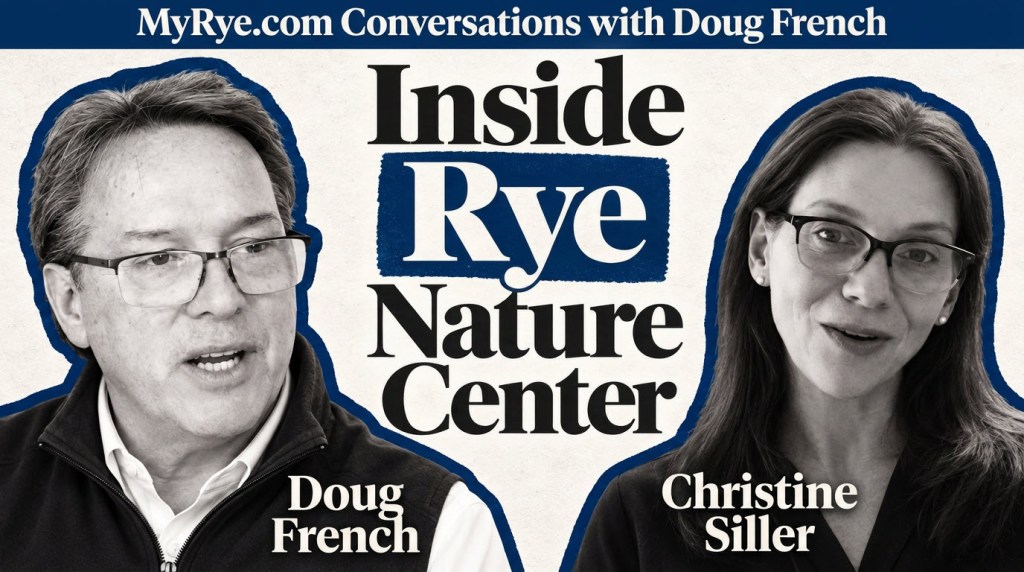
MyRye.com is now in the podcasting business with a weekly podcast hosted by former Rye Mayor Doug French. Available on all major podcasting platforms, MyRye.com Conversations with Doug French will tackle the larger and sometimes intractable issues impacting the City of Rye through interviews with local, county and state officials and business leaders.
In Episode 29 of Season 1, French speaks to Christine Siller, executive director of the Friends of the Rye Nature Center since 2009. She covers what visitors can do at the 47-acre park, how the nonprofit is funded, and three major projects planned for 2027.
This episode of MyRye.com Conversations with Doug French was produced by MyRye.com. Feedback and story ideas are welcome.
Main Topics Covered:
- First-visit tips: Walk the park, check the kiosk and map, stroll to the pond, and explore the trails. The park has a nature playground, a giant slide in the woods, a bird blind, and a small visitor center with resident animals, including a snake named Popcorn.
- Who runs it: The center was established in 1959 and is city-owned. After the city issued an RFP in 2002, the Friends took over operations. The current license agreement runs through 2056, and the city retains authority over major infrastructure.
- Three pillars: Conservation, education and community. A corporate volunteer group recently planted over 100 trees and shrubs and protected them from deer.
- Education: A team of 20 educators, a forest preschool operating since 2011, and the Nature Access Fund, which serves schools that cannot afford field trips and organizations serving underserved communities.
- Wind phone: A disconnected phone where people can speak into the wind to loved ones who have died. Christine also discusses nature’s potential relevance to mental health.
- Trends: Environmental education is especially popular with younger children, but Christine sees a drop-off as families worry about academic readiness. Summer camp stays popular, especially for grades three through five. Adults are also embracing quiet walks and “nature bathing.”
- Funding and scale: 72% of the budget is earned income and 28% is fundraising, gifts and grants. About 25-26 staff work during the school year, and 50-60 local high school and college students are hired each summer. A 19-member board provides governance. Christine estimates roughly 50,000 annual “touches.”
- 2027 projects: A Blind Brook restoration, a new two-way entrance driveway, and the 4,500-square-foot Wachenheim Center for Environmental Education.
- Blind Brook restoration: The project is expected to cut sediment entering the brook by 70%, about 228 tons a year. It will stabilize banks, remove invasive ground cover, plant natives, restore wetlands, and modify the streambed to slow water.
Timestamps:
(0:12) Doug introduces the MyRye.com podcast and the Rye Nature Center
(0:43) Topics ahead and who Christine Siller is
(1:04) First visit and park features: trails, pond, slide, bird blind
(3:35) City ownership, Friends operations and the agreement through 2056
(6:58) Mission pillars: conservation, education and community
(9:58) How the outdoor forest preschool works and why it helps
(13:09) Environmental education trends, summer camp and nature bathing
(16:00) Podcast reminder and where to listen
(16:40) Funding: 72% earned income, 28% gifts and grants
(18:23) Staff, summer youth employment, board and 50,000 annual touches
(20:28) Planned projects and the new entrance driveway
(22:38) Wachenheim Center for Environmental Education and future learning spaces
(25:31) Blind Brook restoration and flood resilience
(28:44) One-word wrap-up
(29:32) Final invitation and website
(30:10) Podcast closing
Watch:
Full Transcript [edited for clarity]:
Speakers
- MyRye.com, Doug French
- Christine Siller, Rye Nature Center
MyRye.com, Doug French (00:12): Welcome to the MyRye.com podcast. Conversations with Doug French. I’m your host, Doug French, former mayor of the City of Rye and this podcast is all about the people and the issues that impact Rye, the Westchester region, and the Sound Shore. Our goal is to inform you, our listeners, on what’s happening, who’s deciding, why, and what’s next. All in 30 minutes. We are here every week from the MyRye.com studios. This week in conversation is nature and the Rye Nature Center. What it can do for you and what it does for the community. We’ll cover the footprint, the operation, the funding, trends in nature, and future development plans. Joining the conversation is Christine Siller, executive director of the Friends of the Rye Nature Center since 2009. Christine, welcome to MyRye.com.
Christine Siller, Rye Nature Center (01:01): Thanks, Doug. It’s great to be here.
MyRye.com, Doug French (01:04): So let’s get started. So Carrie and I took a walk to the Nature Center the other day. What was one of the first things we should do?
Christine Siller, Rye Nature Center (01:10): Well, that’s kind of a interesting question because when you come to this park, the first thing you should do is continue to walk through the park. and maybe take a look at the kiosk, get an eye for the map, and take a take a stroll down out to one Nanderwhere Pond, explore the trails, really feel what it’s like to have right close to your doorstep 47 acres. of natural forest. A lot of times when we think about recreation, we think about actively participating, maybe with a team, a group of people. I think when you come to a nature preserve or a large park with a, point of taking a walk, the idea is to be immersed in nature, allow your mind to just wander. And find quiet space. So normally when people call on the phone, they’re like, well, what is there to do there? we often say, get a map, take a walk. Along the way, you’re going to see certain features we’ve added to the park experience over the years. So Rye now, if you came with young kids, you would find a nature’s playground, you would see as you came up. the hill to the main area of the of the nature center. a giant slide tucked into the woods for the family to go down together. if you have some kids who are good observers, you could encourage them to go out to the bird blind on the top of the ridge and just listen for birds. Some people immediately come inside and that’s great. We have staff available during the weekdays and on Saturdays to answer questions. If you come inside, you will see in our very tiny visitor center a few of our resident animals. and that’s that’s also something just fun to do no matter what the age you are. our longest resident is a snake called Popcorn. And we can touch on how Popcorn is used in programs when we get to that part. But the main thing you want to do is know that this is a place for leisure, walking, and relaxation.
MyRye.com, Doug French (03:35): Okay, great to hear. So the Nature Center i is in the middle of town. And it’s city owned but it’s run by the friends. Can you talk about the public-private relationship?
Christine Siller, Rye Nature Center (03:46): Absolutely. So dating back into the first few decades when the Nature Center was established, it was established in 1959. At first it was run by the city, similar to like Rye Rec in 2002, the city decided that that was not something they could sustain. And so they cut the funding, issued an RFP. The Friends of Rye Nature Center, like many other grassroots fundraising arms of parks, was always present in the early days with the establishment of the nature center, but they really stepped it up under Bob Clyatt’s leadership to take over operations. And so those early years of transition, so say from two thousand and two through two thousand and six, were most nonprofits who have this type of journey where funding is just cut and then they have to rebuild, it was a little bit like trial and error here. So starts and stops with programming. I came on in 2009. at that point the friends group still had an operating agreement with the city that renewed every five years. but we worked with the city in 2020 to really isolate like who’s doing what for the park. And in doing so it allowed the friends to get a longer agreement with the city. So currently our license agreement lasts through 2056. you can see if you read through it there’s aspects of the park that will always remain under the city’s purview for authorities. So say like massive infrastructure like the electric lines, the water line, et cetera. But the work of taking care of the park itself and stewarding the land and running the programs and funding those things is on the friends. And I think that’s really beneficial because it allows us a the freedom of opportunity to do interesting projects that you may not be able to do if you’re, tied to a municipal budget.
MyRye.com, Doug French (06:03): Yeah, and I think that was some of the emphasis back then was to look at having user groups really drive their own innovation versus a city government trying to to drive trends in innovation.
Christine Siller, Rye Nature Center (06:15): I agree and I think there’s I agree. I think there’s, places where we can definitely still, lean on the city to support certain aspects of like the park infrastructure, but things like bigger projects like at scale, like what we’re accomplishing, and you were here this morning for that workshop on the Blind Brook Restoration. That’s only possible with having, a team that can really focus on the project, which we have as a nonprofit, because we’re not busy running like six other things for the municipality. and I think that’s where you see these opportunities when there’s an independence in a public-private partnership for some real impact.
MyRye.com, Doug French (06:56): is there a typical week?
Christine Siller, Rye Nature Center (06:58): No. Yes and no. so we have a mission that has three pillars. so the first is conservation. So that’s just stewarding the park. In a typical week for conservation, well, we had Regeneron here on Tuesday for a whole day. Their team came and planted over a hundred trees and shrubs and put deer protection around them. Today there was the workshop about the big conservation project. The other pillar is education. So currently we have a team of 20 educators that are both on site and working off site to deliver environmental education. On site, we have a really robust forest preschool that’s been around since 2011. It’s very important piece to what we’re doing here and I think a real important piece of what we want our next generation to be like. But we also have a whole other arm of off-site programs that we deliver through something called the Nature Access Fund. So essentially we raise funds every year and we go to schools that can’t afford field trips or organizations that are supporting underserved communities. And we bring that environmental education to them. the third pillar of our mission is community, and a lot of that is tied to just accessing the park, promoting the park within Rye that this is it’s a free public space, creating elements where you can take that short walk, but maybe you want to sit down someplace and and just enjoy. a book or have a conversation with a friend. So we’ve we’ve we create like places within the park to do that for reflection, for for getting together with friends. we’re one of the only places in Westchester that has a wind phone, which is a disconnected phone that allows adults or young adults, children to talk into the wind to loved ones that have passed away. And this is actually like one of these pieces of what nature can bring to us that I think is really important right now in these times. I know you spoke with the executive director of the youth council on mental health and the challenges there. I think having the experience of something like a wind phone set in a natural park, but the journey to get to it and being immersed in nature is is part of that. So we really look for ways to make what is at the nature center like relevant to all different user types.
MyRye.com, Doug French (09:58): Sounds great. I just when I was there the other day, like you said, you could do your your nature walk but also the the nature center was buzzing with the school kids and the parents and you say the kids are outs outside most of the time, correct? If not all the time.
Christine Siller, Rye Nature Center (10:11): Yeah, so so we were we got away from this idea that a school trip or a preschool class has to be set up in an indoor space. we were actually of that thought way before COVID. It was just a slower it took a little longer to get parents on board with that idea because They’ll they’ll be worried my child will be cold, my child will be too hot. but what we found after the pandemic, everybody wanted their children outside. And we haven’t stopped pushing that place for education. And forest schools have a long history in Europe, in Switzerland is especially especially. There’s a a long tradition, a small child’s their preschool kindergarten experience is in an outdoor woodland. It’s not in a space designed with plastic toys and such. And the philosophy there is that, an outdoor school allows for a young child to use their imagination. So you may have read that book to your kids long ago called It’s Not a Stick. And that a lot of that happens here where the kids are just taking what’s around them naturally and using it for imaginative play. It also teaches, resilience, so and being uncomfortable when the elements change. So these kids are, outside in rain, snow, and they’re allowed to come in, and get warm,
MyRye.com, Doug French (11:42): right
Christine Siller, Rye Nature Center (11:42): but mostly they have to look out their gear and before they go out. Well, what will we need? what what
MyRye.com, Doug French (11:48): Yeah.
Christine Siller, Rye Nature Center (11:48): should we put on? And it fosters this independence that you just don’t get if your kid is at a very early age put into a very contained space. the other thing we see is that it accelerates gross and fine motor skills because they’re moving all the time and picking things up all day long. So it’s a beautiful program. we’ve seen participation just creep up year over year. And we’re lucky that we have a great relationship with the preschools across the street to either pick up or drop off their children from the two programs. So you can come here in the morning and we’ll bring your kid across the street for their afternoon program. And vice versa, we can pick them up from their morning program across the street and then they’re here for the day.
MyRye.com, Doug French (12:39): Well, the kids’ faces are any guide, they were so happy. I tell you, they was they love it. And it looked great.
Christine Siller, Rye Nature Center (12:42): They’re happy. They’re happy. They love it. And I have to tell you that the teachers with them also love it. Like they just to be outside working with young kids all day, moving, not sitting at a desk, not in a stuffy classroom. it’s good. It’s good for their health. It’s good for the way they teach. It makes Them more creative, so we’re very lucky that we have this program.
MyRye.com, Doug French (13:09): Absolutely. so, you touched on a couple of of trends. What are the other trends in nature that you’re seeing that people are embracing and and starting to really take off?
Christine Siller, Rye Nature Center (13:18): Yeah, so I think the environmental education piece is really popular for early years. And then and this is nationally; environmental education is not consistent in the way we educate kids. So, what we see here in Rye and the surrounding communities is an interest early. So, like from pre-K through grade three. And then a little bit of a drop down. There’s a panic within the parenthood of will my kid be ready for, higher math, this, language arts, a second language. and so really having more education to the parents and as well as to school systems that outdoor learning is a lifelong process. It’s not something that’s just for a short period of time in early childhood. So that’s that’s a bit of a challenge. We are lucky in that our summer camp remains very popular. So uh particularly in the grades three through five, because suddenly parents realize like, wow, the kids have been in school all year. They’re not outside. They’re not learning about the natural world. And yes, they’re gonna go to do a week of soccer camp or tennis, etc., but they really want them to be outside learning about the natural world, how to identify it. we do a tremendous STEM curriculum here in the summer camp. So they are learning science skills and concepts that will translate back into the elementary years. we align with state curriculum that way, but they do it in in what I call edutainment. So it doesn’t feel like it’s formal learning and
MyRye.com, Doug French (15:08): But be beyond just youth, it seems like even adults are appreciating appreciating nature more and embracing it more. Are you seeing that?
Christine Siller, Rye Nature Center (15:17): for sure. I think nature bathing is very popular right now and people just walking through nature quietly reflecting. I think people even in their home spaces are looking for ways to make it feel like a more natural environment, either by planting or bringing plants inside. I think just again to connect back to the mental health piece, it’s a refuge from stress to be in nature. And the more that you have challenges as an adult and you use that as a reset, I think, it becomes more and more important for for all of us.
MyRye.com, Doug French (15:57): All right well, thank you. I’m going take a quick pause here and let you catch a
Christine Siller, Rye Nature Center (15:59): Perfect.
MyRye.com, Doug French (16:00): break. And just remind our audience: if you have a topic or a person you want to hear on the MyRye.com podcast, Conversations with Doug French, email me at French at MyRye.com or just tell me around town. We’re here every week on Apple Podcasts, Spotify, iHeart, and YouTube. You can access us directly via those formats or find us at MyRye.com. All formats, transcripts, and local news. local issues travel and these conversations like the one we’re having today today don’t expire. So please share, subscribe, or send a question for a past guest, and we’ll bring it back here. So let’s get into how it all gets done. This all sounds
Christine Siller, Rye Nature Center (16:39): Yeah.
MyRye.com, Doug French (16:40): great, but how does it all get done in terms of funding, gifts, fundraising, grants, budget? How does how does this all get paid for?
Christine Siller, Rye Nature Center (16:48): so it’s interesting. so I kept my background so everyone could see. It’s a very messy office here. So managing program revenue and fundraising revenue, you never have time to clean up your your desk space. 72% of our budget is from earned income, so program fees, tuition for the forest preschool, but 28% is from fundraising, and that’s direct gifts with some grants. this morning we had that workshop about the big restoration. When we’re doing larger scale projects, is particularly in the property, we have to grant them. it’s it’s hard to raise that level of funding for something very, very specific. But we’re fortunate when I when we look at that 28% each year that we have to raise in contributions, we have a generous community here with a lot of support. uh We have two fundraisers a year that are well attended. One is an Oktoberfest that just occurred a couple of weeks ago. We had about 450 people come And the other event is our spring fundraiser for our nature access fund. And that’s usually a dinner. And and people like that because they know that that donation is going directly to help support education for an underserved member in the Westchester community. a lot of camp scholarships happen that way. we have a staff that is around twenty five of us, twenty-six of us during the school year, and then we really balloon over the summer. I would say one of our biggest programs is employment. so we make a a choice to employ as many of the local high schoolers and college students as we can. So typically we we are onboarding between 50 to 60 kids in that age range each summer and that’s pretty important to continuing that environmental literacy that we were talking about because while they’re here they’re they’re learning the skills to teach environmental education and the values of it and what it means and that’s something we feel is really important. We have a board of directors. Currently there’s 19 of them. And they’re from Rye, a couple are from Rye Neck, Mamaroneck most have been on average stay for six years. It’s a three year term. They typically renew for a second term. and we’ve been lucky with our board. They’re very supportive, very engaged and, do their diligence and act as as strong fiduciaries. And I don’t know how other nonprofits in Rye can are faring with their boards, but I feel
MyRye.com, Doug French (19:45): Yeah, and there’s a lot of expertise in Rye that that you absolutely can tap into. Yeah, did I get the number right? You have about fifty thousand users. Not not unique, but probably fifty thousand
Christine Siller, Rye Nature Center (19:55): Well
MyRye.com, Doug French (19:55): people come through. Correct. Yes, yeah, Rye. Okay.
Christine Siller, Rye Nature Center (19:56): It’s like fifty thousand touches is this away. Yes. So when you take our camp enrollment, our casual visitors, the volunteer groups, the forest preschool, the workshops, the school study tours, all the outreach. We have a traveling exhibit called Nature Station. So that’s a really fast way to see five hundred people in an afternoon. It’s hitting the fifty thousand mark. And um
MyRye.com, Doug French (20:23): Yeah, sure.
Christine Siller, Rye Nature Center (20:25): yeah, we we’re quite proud of that.
MyRye.com, Doug French (20:27): Yeah, that’s that’s it’s huge volume and I’m telling you, when I was there it was buzzing. so where you have got some big projects, the one I look I was there there today and you’ve got a building that’s coming forward. Talk us about those those bigger projects that people can the residents can expect that are coming down the road. When and what’s it gonna look like?
Christine Siller, Rye Nature Center (20:44): Sure. So we have three major projects planned and All three will be executed within, some somewhere in the calendar year of 2027. the first one that we were just speaking about this morning in our workshop is a restoration project along the corridor of the Blind Brook that is within the Nature Center. that work will begin late spring, early summer of 2027. at the same time or the projects will like they’ll work a little bit on the brook, but then come back over to what what we need to do is create a new entrance driveway to the nature center. So that project will be happening simultaneously with the Brook Restoration. We’re hoping to have like one team who can do both projects assist with this. So so
MyRye.com, Doug French (21:32): And that’ll go through the snow field, correct? yeah.
Christine Siller, Rye Nature Center (21:34): for those who are living in Rye who may not be aware, we have an entrance issue in that our only entrance into the park, into the Nature Center is over a very narrow mason bridge from it’s early 1800s and it is it’s just not ready for the future and it’s in the floodway it’s in the flood plain and with these types of flooding events that we’re having we need to be very proactive about ensuring access to this park. So we are we’re creating this new driveway. out of the snow lot. It will run adjacent to the neighbor’s driveway that also starts out of the snow lot and then cut across the nature center and connect with our current driveway. And it will be wide enough for two-way traffic. That’s something we don’t have right now. And you know we’re excited about that because it will alleviate a lot of the challenges of maintaining operations during just even a very heavy rain event. And then after the driveway is completed and the restoration work is underway in the brook, we have just closed our quiet phase of a campaign to build a new education center. the current facility, though most of our programs we’re pushing them outside, our current facility is an old carriage house and it was not intended to be a nature center.
MyRye.com, Doug French (23:03): right
Christine Siller, Rye Nature Center (23:05): And so we’re we have now a very generous contribution from the Wachenheim Foundation. And we will be building a 4,500 square foot education center called the Wachenheim Center for Environmental Education. And it will have a proper visitor center. So when you come in, you can learn a little bit about the history of the place, the ecosystems here within this property, as well as enjoy the animals. animals that we have here because seeing those animals is very popular with families and casual visitors and then it will also have in in the back area Two classrooms that can be opened into one larger meeting space so that we can service the adult population with the education they need on pertinent topics, anything from biodiversity to flood resilience to what can I do in my own garden to make it better, or what’s happening with all our amphibians in this area. so just a range of oh of new opportunities. Opportunities can come to fruition just because we have this space. This morning when we had the workshop, we had a push a couple of classes aside. Um it’s
MyRye.com, Doug French (24:23): right right
Christine Siller, Rye Nature Center (24:23): great on a great day, and they are for forest preschool. But you know, we want to always be able to give education to multiple groups at once. So this this project really will make that come true.
MyRye.com, Doug French (24:36): And can you see the schools coming over, the high school, the middle school coming over and doing a class there, as part of this?
Christine Siller, Rye Nature Center (24:42): Yeah, they They do already, I think with the with a newer space, and even the surrounding outdoor spaces that will be created as a result of this project, there’s just more of a reason to to come out and just learn up here. we have a beautiful pavilion that we just installed last year. we had a private donation they were so generous and allowed us to create this. I Could see a high school class on a nice day saying, you know what, let’s go do English under the pavilion. And that would be a dream come true, to be honest with you. it doesn’t have to be a science class. I think kids get, kids, students, young young, young people need that time outside. and it it’s good for the teacher as well.
MyRye.com, Doug French (25:31): Sure. I also think though as you look towards the trend of workforce development and getting people interested in other topics, using that space to educate the next generations about science and nature and those types of things, it’s a great opportunity with the center. I think you s you sold yourself short though on the restoration project because as the city’s going through its comprehensive
Christine Siller, Rye Nature Center (25:49): Mm.
MyRye.com, Doug French (25:50): planning process and it’s looking at sustainability and open space and flooding, you’ve really pulled together really tight, well funded, well thought out program for your piece of the brook that is gonna retain water, it’s gonna help water flow, it’s gonna restore some of the the forestry, right? So explain that.
Christine Siller, Rye Nature Center (26:12): Yeah, so this restoration has been underway for many years. I think the first grant came in in late 2021. so it’s a five year process. But even before that, we had wanted to do something to stabilize the brook, the banks of the brook, and do some more extensive planting in the area. and we kept failing because we didn’t have the right data collection. And so we finally were able able to get a grant to just collect the data we needed. And so what we’re we’re about to do is it’s going to reduce the sedimentation into the brook by 70%, which is huge. If you’re somebody who’s familiar with dredging the boat basin, this is this is going to impact that. We’re going to stop the soil from getting into the brook at this point here at the Nature
MyRye.com, Doug French (27:06): I you said
Christine Siller, Rye Nature Center (27:06): Center.
MyRye.com, Doug French (27:06): two hundred and twenty eight tons a year or something like that.
Christine Siller, Rye Nature Center (27:09): 228 tons a year. It’s a lot. It’s a lot. And and when you look at the brook, you can just see like, yes, the banks are getting the the whole channel is getting wider and wider. You’re just dumping the soil. but we’ll stabilize that, we’ll restore wetlands that exist, but not really, because we have an invasive ground cover that’s preventing the prevailing seed bank of wetlands. Plants from actually thriving. So removing the invasives, planting the natives we need in these enhanced wetlands, and doing some streambed work so that it’s less of a channel that moves quickly, will slow the water down, and just make it a natural solution to an ongoing problem here in Rye which flooding exasperates. So you mentioned being part of the the comprehensive plan, so that project is something that Ramble Engineering did a study of different interventions Rye could do to to impact flooding. And if you look at the study, nature-based solutions along the brook were one of the interventions. So we’re hoping to model this so that other entities along river areas can can also learn how to do this. Because it does help over time for communities. if you can make your wetlands and your riparian healthier.
MyRye.com, Doug French (28:44): Okay. All right, well let’s get to go to our last segment and this is our one word question, one word answer. So I’ll give you a word and you just give me your one one word immediate reaction. Uh
Christine Siller, Rye Nature Center (28:54): Okay.
MyRye.com, Doug French (28:54): and these are all the themes we’ve talked about, so it’s kind of a summary of our conversation. So the first word is conservation.
Christine Siller, Rye Nature Center (29:01): so people
MyRye.com, Doug French (29:04): Education.
Christine Siller, Rye Nature Center (29:06): next generation
MyRye.com, Doug French (29:08): community.
Christine Siller, Rye Nature Center (29:09): friendship.
MyRye.com, Doug French (29:11): Outdoors.
Christine Siller, Rye Nature Center (29:13): Childhood.
MyRye.com, Doug French (29:15): Brook.
Christine Siller, Rye Nature Center (29:16): Bane of my existence now. Habitat, brook habitat.
MyRye.com, Doug French (29:20): Everyone’s uh nature.
Christine Siller, Rye Nature Center (29:25): Nature, love of my life.
MyRye.com, Doug French (29:28): And Rye
Christine Siller, Rye Nature Center (29:30): fantastic.
MyRye.com, Doug French (29:32): Well Christine. thank you very much. It’s great to speak with you and get your insights. If somebody wants more information, is there a website to go to?
Christine Siller, Rye Nature Center (29:40): www dot ryenature center dot org.
MyRye.com, Doug French (29:43): And any final thoughts?
Christine Siller, Rye Nature Center (29:45): We would love to hear from everybody in Rye and surrounding communities. Email us, come up, take that walk, explore, be outside.
MyRye.com, Doug French (29:55): and is there a guest or topic you’d like to see on the podcast?
Christine Siller, Rye Nature Center (29:59): I would love to hear from Sabrina at the YMCA if you haven’t or Adam
MyRye.com, Doug French (30:03): On the list. Great, great request.
Christine Siller, Rye Nature Center (30:05): at the Arts Center.
MyRye.com, Doug French (30:07): also on the list. So stay tuned. So you have to subscribe.
Christine Siller, Rye Nature Center (30:09): Okay.
MyRye.com, Doug French (30:10): all right well thank you again Christine to our listeners you can find all podcast episodes transcripts local news and more at MyRye.com please subscribe wherever you get your podcast and please spread the word as we build our audience thank you again for listening to the MyRye.com podcast conversations with Doug French we are here weekly so we will see you next week thank you
Christine Siller, Rye Nature Center (30:35): Thank you.