

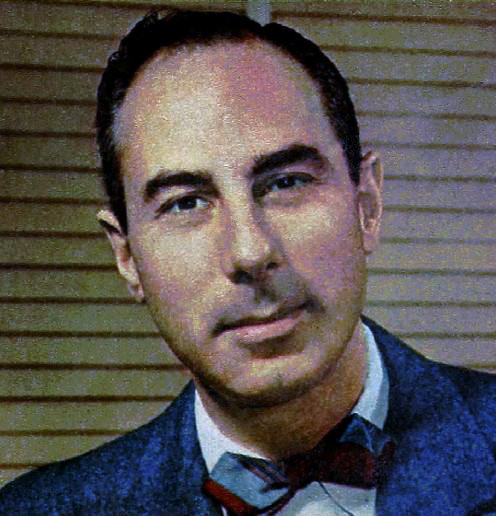
RyeGPT People of Note is a series highlighting individuals who have a connection to the City of Rye. In the series we use artificial intelligence to prepare a biography and explain the individual’s connection to Rye.
With the NFL season kicking off this week, we look back at Bill Stern, a pioneering sports broadcaster who spent the later years of his life in Rye and whose voice helped define the golden age of American sports broadcasting.
Bill Stern was one of the most recognizable voices in American sports broadcasting during the mid-20th century. A pioneering radio commentator known for his dramatic delivery and theatrical storytelling, Stern helped transform sports broadcasting into a form of entertainment that captivated millions of listeners. He also had a longstanding connection to Rye, New York, where he lived with his family during the later decades of his career.
Early Life and Rise to National Prominence
Born on July 1, 1907, in Rochester, New York, William “Bill” Stern developed an early interest in both sports and show business. He attended Pennsylvania Military College, graduating in 1930, and later worked at Radio City Music Hall, where he became its first stage director.
Stern had begun announcing football games as early as 1925 at Rochester radio station WHAM. His national broadcasting career took off during the 1930s, when he joined NBC. He became particularly well known for his Friday-night boxing broadcasts and for Bill Stern’s Sports Newsreel, a nationally broadcast sports program that later became The Colgate Sports Newsreel.
Over the course of his career, Stern covered some of the country’s most important sporting events. He broadcast the Olympic Games, the Rose Bowl, championship boxing matches, and numerous other major sporting events. He was also the announcer for the first televised baseball game, a 1939 game between Columbia and Princeton, and later called the first televised football game.
Stern’s distinctive style was unlike that of many sports announcers of his era. Rather than simply describing what was happening on the field, he told stories with a highly dramatic, theatrical delivery. He became particularly famous for his “sports myths”—colorful anecdotes about athletes and sporting history that were sometimes embellished or even invented for entertainment.
Stern and Rye
Stern had a longstanding connection to Westchester County and spent the later part of his life in Rye, New York. His son, Peter Stern, later recalled that the family had moved to Purchase, New York, when he was a child. By the final years of Stern’s life, however, the family was living in Rye.
Stern continued his broadcasting career while living in Westchester, maintaining a demanding schedule that took him regularly into New York City and around the country for sporting events. His career brought him considerable national fame, making him one of the better-known sports personalities of his generation.
His personal life was marked by significant challenges. In 1935, Stern was seriously injured in an automobile accident. The injury to his left leg eventually led to an above-the-knee amputation after complications developed. During his recovery, Stern became addicted to morphine and other painkillers, a struggle that he later overcame while returning to his broadcasting career.
Broadcast Legacy and Later Years
Stern remained an influential figure in American sports broadcasting for decades. In addition to his radio work, he appeared in films, worked in early television, and wrote books about sports and the colorful personalities he encountered throughout his career.
His career helped establish many of the conventions of modern sports broadcasting, particularly the idea that a sports announcer could be both a reporter and an entertainer. His highly recognizable voice and dramatic storytelling made him one of the defining broadcasters of the radio era.
Stern died of a heart attack at his home in Rye on November 19, 1971, at the age of 64.
In 1984, he was inducted into the inaugural class of the American Sportscasters Association Hall of Fame. He was later inducted into the Radio Hall of Fame in 1988, recognizing his lasting influence on American broadcasting.
More than half a century after his death, Stern remains an important figure in the history of American sports media—and a notable connection between Rye and the golden age of radio.
Listen to Bill Stern’s Sports Newsreel about Babe Ruth from August 10, 1945:
Here Bill Stern narrates a 1950 film short called King of the Pins featuring bowling great Joe Wilman demonstrating some of the game’s fundamentals. The short also features comedian Buddy Hackett.