

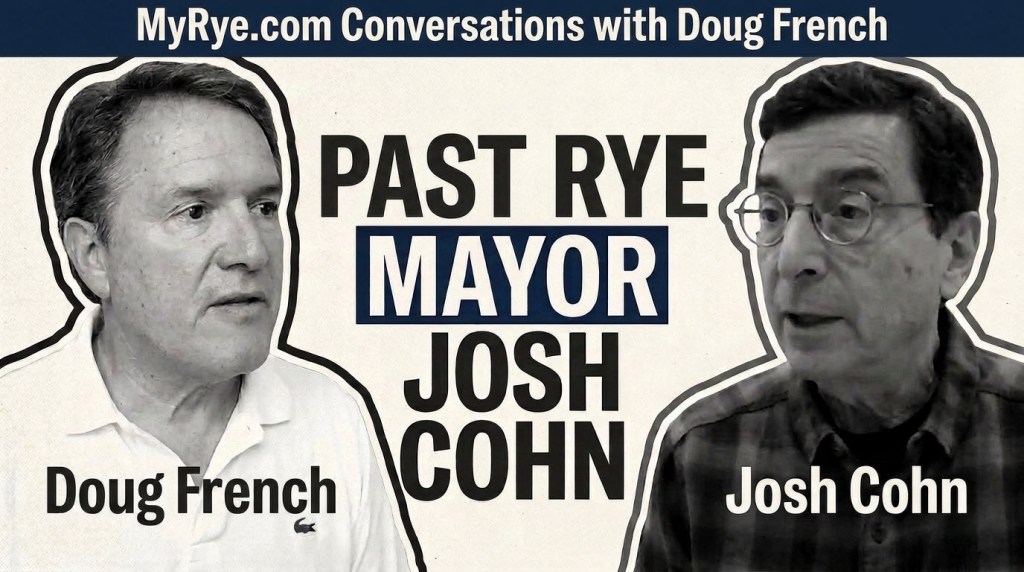
MyRye.com is now in the podcasting business with a weekly podcast hosted by former Rye Mayor Doug French. Available on all major podcasting platforms, MyRye.com Conversations with Doug French will tackle the larger and sometimes intractable issues impacting the City of Rye through interviews with local, county and state officials and business leaders.
In Episode 26 of Season 1, French speaks with speaks to the immediate past and former Rye Mayor Josh Cohn. The conversation focuses on what the mayor of Rye actually does, how the city manager system works in practice, and the major issues that shaped Cohn’s two terms.
They also revisit the most consequential challenges of his tenure, especially COVID, flooding, infrastructure, cell service, the comprehensive plan, and a disputed ethics matter that Cohn says still needs reform.
This episode of MyRye.com Conversations with Doug French was produced by MyRye.com. Feedback and story ideas are welcome.
Main Topics Covered:
- In this episode, French opens by framing the mayor’s job as the head of city government in a small city, with responsibilities that stretch across downtown, parks, schools, public safety, and community events.
- Josh Cohn says the mayor’s role is fundamentally a team effort, requiring constant coordination with the city council, the city manager, staff, and the public.
- Cohn explains Rye’s hybrid mayor-council-manager structure, noting that the mayor presides over the council, has one vote and no veto, and works within a system where the city manager controls staff and prepares the budget.
- Cohn describes the public-facing demands of the office, including speeches, meetings, and responding to unexpected crises, from routine holiday ceremonies to the large George Floyd protest during COVID.
- Cohn says COVID was a “black hole” for city energy, forcing major operational changes such as split shifts, remote access, and rapid adjustments to public services and rules.
- He discusses Purchase Plaza as a difficult but important COVID-era experiment, saying it helped outdoor dining and social activity but also generated lasting anger from some storekeepers.
- Cohn points to Nursery Field as a major accomplishment, describing it as a resident-driven project that survived political resistance and eventually reopened for public use.
- Flooding and the Blind Brook watershed take up a major part of the discussion. Cohn says Rye’s flooding problems are generational, tied to bridges, culverts, channels, and the city’s paved watershed.
- He cites progress made through grants, studies, and planning for projects like the Locust Avenue Bridge, Oakland Avenue Bridge, and Playland Parkway bridges, while warning that old studies and delays make future funding harder.
- Cohn calls sewer renewal another major shift, tracing it to the Save the Sound settlement and saying the city ended up with roughly $14 million in sewer work.
- He says the capital plan revealed how many long-delayed projects affected worker safety, productivity, and environmental compliance, but that inflation and slow execution have made the backlog more expensive.
- He flags cell service as unfinished business, arguing that Rye needs generator-supported infrastructure to keep phones working during outages.
- Cohn also says work on the comprehensive plan was delayed too long because of staff capacity and process decisions, pushing the start later than he wanted.
- In the final segment, Cohn returns to the Board of Ethics and says the city still needs to address what he views as legal and procedural failures.
- He closes by saying residents should remember that much of what happens in City Hall is good work done by people acting in the best interests of Rye.
Timestamps:
00:00 – Why the 25th episode matters and what this conversation covers
01:24 – Rye’s mayor as head of government, but not a solo operator
02:28 – The mayor-council-manager system and who does what
03:26 – Public-facing duties, speeches, and the George Floyd protest
05:19 – Why Rye’s government structure is a hybrid, not a pure council-manager model
06:47 – The myth of the “mayor wand” and the real work behind decisions
08:35 – How COVID forced the city to reinvent operations
10:02 – The Monsignor Dwyer basketball story and local rule enforcement
11:47 – Where COVID mandates came from and why county communication mattered
12:36 – Purchase Plaza, outdoor dining, and merchant backlash
14:52 – Nursery Field and the politics of getting a field built
16:42 – Flooding, Drainage, and the Blind Brook watershed problem
17:39 – Ida’s damage and the generational scale of Rye’s flood risk
20:05 – Bridges, culverts, and the long list of flood mitigation projects
23:26 – Sewer renewal, the Save the Sound settlement, and the capital plan
26:20 – Delayed projects, aging infrastructure, and rising costs
27:53 – Cell service, mini towers, and outage-proof infrastructure
30:32 – Why the comprehensive plan was delayed
32:02 – The Board of Ethics dispute and Cohn’s criticism
35:10 – What Cohn wants residents to remember about City Hall
36:36 – Would he do it again? Cohn reflects on term one and term two
37:23 – Closing thanks and episode sign-off
Watch:
Full Transcript [edited for clarity]:
Speakers
- MyRye.com, Doug French
- Former Rye Mayor Josh Cohn
MyRye.com, Doug French (00:12)
Welcome to the MyRye.com podcast, Conversations with Doug French. I’m your host, Doug French, former mayor of the City of Rye. This podcast is about the issues and the people that impact Rye, the Sound Shore, and the surrounding Westchester region. Our goal is to inform you about what’s happening, who’s deciding, why, and what’s next on local issues that matter most to you. We are here every week, and this one is a milestone.
It is our 25th episode. A special thanks to Jay Sears and the team at MyRye.com. This week in conversation, the head of city government in a small city, as stated by our charter, will cover the overall role of the mayor, demands, responsibilities, and the operating rhythm. Insights from the late last eight years, the accomplishments and the challenges, and the unfinished business with Josh Cohn.
And specific issues that are in the headlines during his term. Joining the conversation, as mentioned, is Josh Cohn, former mayor of the City of Rye, who served two terms, eight years through 2025. Mr. Mayor, welcome to my MyRye.com.
Former Rye Mayor Josh Cohn (01:14)
Thanks very much, Doug. Thanks for having me and particularly for the twenty fifth the the marked twenty fifth episode.
MyRye.com, Doug French (01:23)
Exactly. It it it could not have worked out better as far as timing. and it is in the city charter. It says the mayor is the head of the city government. And let’s kind of flesh out what it means what it meant to you. on a good weekend, I mean just even most a couple of weekends ago, Rye still looks like the brochure. It’s a full downtown. It’s parks, it’s field, it’s the library lawn, it’s schools, it’s it’s Rye Town Park.
After eight years in the chair, that’s the point of the job, isn’t it?
Former Rye Mayor Josh Cohn (01:49)
I th I think very much so. I appreciate that that holistic picture. If I think back on all the things that I was involved in in my eight years, those involvements would have been in every part of the picture that that you you mentioned, to a greater or lesser degree. But I think it’s really important to point out
That the effort is very much team effort. There’s the mayor, the mayor has to be embedded in the work of the council. The mayor has to work hand in hand with the city manager. The city manager, of course, is the administrative chief of the city and directs the staff. So the mayor is there.
Presiding over the council but embedded in the council with one vote and no veto, and works with a city manager who has sole control of city staff and is responsible in the first instance instance for producing the city budget that of course the council has to approve. So the mayor works within that environment.
And the mayor, of course, acts as the face of the city in many circumstances, has to meet with the public frequently. is the good news and or should be the good news and bad news person of the city, gives speeches, regular speeches. You addressed operating rhythm and
a calendar. So there are the Memorial Day speech, there’s the Veterans Day speech, there’s the nine eleven speech, and then myriad other occasions where the mayor shows up and hopefully has something worthwhile to say. The most challenging and un unexpected for me was the day that I had to meet hundreds of George Floyd protesters on the Village Green back
It was during Covid times, I don’t remember the exact date, but that was completely unanticipated situation.
MyRye.com, Doug French (03:56)
Well, you face several of those because you come in with an agenda and things you want to get accomplished and that agenda completely turns upside down. one of the things that that it it reads like the mayor is a part time job, but I’m sure that it’s it was a full time job when I was doing it. I’m sure it’s was even more so when you were doing it.
Former Rye Mayor Josh Cohn (04:12)
Well, I’m my compliments to you on your own efforts and and yes, there were times when it seemed like a full time job or more.
MyRye.com, Doug French (04:20)
so who actually runs the day-to-day? You mentioned this the the mayor, the council, the city staff. Really we are a city manager form of government, which is unique and that was established decades ago. how does that how is that working? How was that working under your eight years?
Former Rye Mayor Josh Cohn (04:32)
Well it’s it’s very interesting because certainly during my time in office there were people I’m thinking of one person in particular who came from the West Coast and knew a council manager form of government from the West Coast and recognized no place in that for a mayor other than as one of
One of seven on the city council. And of course, that’s not the case. And under the New York State Department of State Local Government Handbook, we’re actually classified as a mayor slash council slash manager form of government. And that handbook goes on to note that that’s a category that throughout New York State has an enormous number of hybrid variations.
And I think Rye has its own. And I’d also suspect that from mayor to mayor, council to council, city manager to city manager, the role of mayor changes and gets reshaped. So I’ve opened by describing really what I did, which was primarily be embedded in the work of the council.
And meet regularly with the city manager and review the progress literally from week to week of things to the extent that that was possible and and helpful. And then there’s the whole public facing aspect of it. The public facing aspect is particularly interesting because people think, well, hey, you’re the mayor. You can just with a wave of that mayor wand that you’ve got tucked
MyRye.com, Doug French (06:15)
I’m still looking for that mayor
Former Rye Mayor Josh Cohn (06:17)
away somewhere. Make it all right. And actually you have to do a job of work to make some of the things that are asked of you right. And some of the things that are asked of you become actually huge projects that Involved the whole council, the city manager, and the staff over time.
MyRye.com, Doug French (06:42)
Yeah, and to do it right, there are a lot of committee meetings, subcommittee meetings, get with meeting with experts, so that the public side they see is really kind of the culmination of all that research and work beforehand. I think like the best advice I got was from Senator Gillibrand when she said, Mr. Mayor, just plow the streets and pick up the garbage.
so let’s talk about some of the accomplishments because you had a couple of things, COVID most namely, where the city had to really reinvent itself in in terms of its ability to provide services and provide transparency and and keep keep the trains running, so to speak. So can you walk us through the COVID years?
Former Rye Mayor Josh Cohn (07:17)
Yeah. there’s a bunch of other things that I think you give me time to mention, but
MyRye.com, Doug French (07:22)
Sure, absolutely.
Former Rye Mayor Josh Cohn (07:23)
Covid Covid was a black hole for city energy. I don’t think people realize how hard the city worked to, as you described it, reinvent itself. e everything from developing
split shifts so we didn’t have too many people in the office at any one time, or literally we were restricted in the number of people we could bring in to pick up garbage at any one time, to converting the city to a city that you could reach and work with remotely, which the city has has remained very much so. And I think
That’s a great efficiency. And then there were just completely unexpected mandates and duties that were very hard to discharge. Businesses open that perhaps shouldn’t have been, questions of equity among businesses of similar types with different rules, questions of what sports could be played, what social gatherings could go on.
An actually a funny story about Monsignor Dwyer comes up in in this context. We were getting complaints about there being kids playing basketball on the court that’s behind Resurrection Church. And there were certain first there was no basketball, then there were rules for basketball, but
People, neighbors were calling us and saying the kids are playing basketball and there are no rules. And of course the last thing anyone wanted to do was interfere, but we got in touch with Monsignor Dwyer and I had no knowledge of what I recently read in an article on the Monsignor, that he has had lifelong friends that he developed
through playing basketball as a kid. And his basketball friends are still his friends later in life. So the response back from the Monsignor was he was going to take a chair out and sit by the court and make sure that the kids played according to the COVID rules. And
MyRye.com, Doug French (09:43)
Very nice.
Former Rye Mayor Josh Cohn (09:44)
And that’s that’s where we left it. But I still have this picture in my mind’s eye of the Monsignor sitting on
MyRye.com, Doug French (09:52)
Yeah.
Former Rye Mayor Josh Cohn (09:53)
presumably a hard backed kitchen chair, making sure
MyRye.com, Doug French (09:56)
Yeah, exactly. Well you know
Former Rye Mayor Josh Cohn (09:57)
kids did it right.
MyRye.com, Doug French (09:59)
sometimes small town solutions are the are the best. where were the mandates
Former Rye Mayor Josh Cohn (10:01)
We did put
MyRye.com, Doug French (10:02)
coming from? From the county, the state, the feds? All the above?
Former Rye Mayor Josh Cohn (10:07)
It came from
really from a variety of directions, but it was primarily the feds to the state, and then the state interpreted through the county. And here George Latimer did something very helpful, which was to have weekly or bi-monthly telephone conferences where city officials could ask questions about how the county was interpreting things.
Either things where the county was itself the rule giver or where the county had to follow similar rules. That was extremely helpful. Sorry.
MyRye.com, Doug French (10:42)
right, yeah, communication.
go ahead.
Former Rye Mayor Josh Cohn (10:44)
I’m thinking of Purchase Plaza
MyRye.com, Doug French (10:46)
right.
Former Rye Mayor Josh Cohn (10:46)
as really a huge step. It was that was having outdoor dining on Purchase Street and we had tried to make it so that there would be concurrently merchants with their goods out, sort of sidewalk sale style, so that there would be something in it for the merchants.
People loved it as an opportunity to go out to eat, which had been foreclosed, and to socialize. But there was also great anger against it by a minority, but in particular by some storekeepers who felt that their business was being was being interfered with.
By the outdoor dining. And that caused us to re-jigger the plaza several different times from a traffic flow perspective, opening up areas of the street that we hadn’t be been before. It was very hard to explain to storekeepers that something that I thought everybody knew, which was certainly in COVID.
People weren’t dying to go into small stores and have a nice chat with the storekeeper. And that though there was not parking space on Purchase Street, our parking lots behind the stores were stone empty.
MyRye.com, Doug French (12:08)
Yeah, right.
Former Rye Mayor Josh Cohn (12:09)
there was plenty of place for any customer that wanted to come in to come in. But that created really some abiding
a abiding anger on the part of some that really lasted through my entire time as mayor.
MyRye.com, Doug French (12:26)
Yeah. Well you’re never more popular than on election day when everybody loves you and then you have to make tough decisions, but for the greater good, and then you become less popular. Any other accomplishments that you want to to cite?
Former Rye Mayor Josh Cohn (12:37)
yeah. Nursery Field. So Nursery Field was just a wonderful resident funding effort, and persistence on the part of residents in the face of really unreasoning hostility in community and on the part of some in the council. So it was approved by
my what I’ll call my majority at at the end of 2023, but the new majority came in and put it on pause with a review effort that seemed it tended to kill. And that I think felt to all of us as a near-death experience for the field. And
Political wind blew in that changed some of the votes on the council and ultimately there was a staged show of Unity Vote, saying yes a second time to it, and it happened. And I get such pleasure from driving by there and seeing kids playing. I drove by last weekend when it was raining. It was still drizzling on Sunday.
MyRye.com, Doug French (13:46)
Sure.
Former Rye Mayor Josh Cohn (13:47)
And and on the field it wasn’t organized play, but there were perhaps twenty people in scattered groups using different portions of the field on a day when the prior field would have been quicksand.
MyRye.com, Doug French (14:02)
No question. In fact I just went by there and when you mentioned and there’s a stream that’s still pouring water, but the field is dry, which is amazing.
Former Rye Mayor Josh Cohn (14:09)
Well,
the field is actually built to retain water. The
MyRye.com, Doug French (14:12)
Yeah.
Former Rye Mayor Josh Cohn (14:12)
basin in which it sits holds a certain number of inches of rain before it drains. But of I also want to talk about flooding as an accomplishment and people will say, say what? because we’re still horribly vulnerable to flooding. But I mean
Pre-Ida, we had saved New York Rising, New York Rising money. We did some projects, including installing the stream gauges that should give us the data to control the sluice gate that’s been unused for decades. But post we also lined ourselves up with the Army Corps of Engineers and got preliminary clearance there for studies.
Post Ida, and maybe not everybody listening remembers the intensity of Ida, I mean two people died in Blind Brook here in Rye, but for the efforts of the police department, fire department, and DPW carrying out water rescues, we easily could have lost people. And there was tremendous property damage. So afterwards the city expedited.
Building permits for those who wanted to raise their houses in much of Indian Village is now raised. We entered into city and state studies, engineering studies that taught us so much about the brook and our problem with the brook, and the fact that it’s a generational issue. The day that Ida occurred, city manager was out of town.
I was sitting in the police station as the manager getting the reports. And then I went out to look and I was absolutely devastated. And I was thinking, what could I have done to change this? And it really wasn’t until we got into the studies that I learned that we are at the bottom of an 11-mile-long watershed.
That drops about five hundred feet, that’s been paved over the years, and the primary drain for the paved areas is Blind Brook. So when you get a massive rainstorm, fortunately Ida didn’t have great tidal surge because we’re also tidal.
MyRye.com, Doug French (16:36)
Yeah.
Former Rye Mayor Josh Cohn (16:36)
When you get a tremendous rainstorm, the brook is going to carry
Hundreds of billions of gallons of water down to Little Rye. And Little Rye was laid out much of it along the brook, as people naturally did, and in the floodplain. And the only answer to that is to pursue generationally the series of things that our engineers in the state DEC told us.
From an upstream project to hold some of the water back, to at least a dozen projects within the city itself to change bridges that are too small, culverts that are too small, channels that are too small, to try to find room for the brook to get through the city. If you want to know why the Y flooded,
and the Locust Avenue firehouse flooded. Well it was because the in large part the Locust Avenue Bridge is too small. And one of the things we did while I was still mayor, we at least got half the money through grants for the Locust Avenue Bridge to be rebuilt. We also commissioned a study that was not yet finished when I left office.
To see if we could rebuild the rock channel that flows from the Locust Avenue Bridge on through Rye, Orchard, and Central. That’s too small. That is simply too small for the flow of water from our now paved, impermeable watershed that that we get. So
We did get while I was still in office, we developed an upstream plan and we had that going through the FEMA Brick program. And that plan was for a series of berms to water on the SUNY Purchase campus. And that was part way through FEMA, but unfortunately the present administration cut the program. And I think
We may be able to resubmit, but again, I’m out of office. I don’t have the details. We got grant approval through DEC and through the county to have the Oakland Avenue Bridge and the Playland Parkway bridges both replaced by the county as county roads. I don’t know the status of that, but if we get Locust Avenue Bridge done.
Oakland Beach done, Playland Parkway done, those are really some positive steps. But the number of studies that we did is substantial. And the project list is really large. And successive administrations have to stay on the list and going for grants.
And they can’t let the studies get too old because with old studies you don’t get money. You won’t get the
MyRye.com, Doug French (19:38)
You also
mentioned you talked in one of your state of the city addresses about the paradigm shift, right? That’s the infrastructure. Flooding is part of that, but also the roads, the sewers, everything underneath, correct?
Former Rye Mayor Josh Cohn (19:49)
Yeah. And You nicely call it a paradigm shift. It was not intended. The sewer work came from the Save the Sound study. There, the impetus was environmental. We, my group coming into office, knew there was a Save the Sound suit. We knew that the city was polluting the Sound with sewage, and we didn’t want to do that anymore.
And so we entered into a settlement process where we couldn’t know how difficult the process would be until we did the studies that were part of the settlement process itself. And we found ourselves with around 14 million dollars worth of sewer renewal under the heavy hand of the Save the Sound group.
they were very difficult. they failed in their understanding of a municipality’s many responsibilities. And they penalized us anytime we missed a paper deadline. But we got through that project and it’s something that I’m very proud of. The Capital Plan came out of
our first encounter with city staff and the paper capital plan, which as you remember, Doug, is a
MyRye.com, Doug French (21:09)
Sure.
Former Rye Mayor Josh Cohn (21:09)
book full of a wish list of projects that would take the entire city budget for a decade. But the city staff impressed on us that there were most urgent projects that have been languishing for years, and they were they implicated
worker health, safety, productivity, and environmental. And we said we’ll find a way to do those. We ran them by the Finance Committee. We put in place a program to go to bond, which we successfully did. And the projects unfortunately
are lagging in completion. And the problem with projects lagging is, as we were told in those early meetings by staff, and this was pre-the burst of inflation we had, we were told that a project’s cost increases six percent every year it goes undone. And so we’re looking at projects, some of them that we envisioned in
2018, 2019, and it’s 2026, shortly to be 2027. And with respect to the old brick garage at Disbrow, about to celebrate its hundredth birthday, and in inadequate for our workers and present uses.
We are still waiting for the redesign plan from Stantec that we were waiting for when I left office, eight months.
We’ve you will ask me about particular issues later and I will speak to time and staff size. And I mean here here we see it in action. I’m really hopeful that Brian Shea with all he brings to the table, with his Albany experience and state experience and
He’ll need council support that he can find a way to supercharge our projects, our progress through our projects, because we just lose a tremendous amount of money. with
MyRye.com, Doug French (23:18)
Is there any other unfinished business that you wanna cite? Speaking of Brian.
Former Rye Mayor Josh Cohn (23:22)
Unfinished business. Yeah.
Cell service. So I led a fight against the installation of tiny, we call them mini cell towers that would have been all through Rye. And we urged the city to look at doing small smaller tower installations. And one of the issues, though not the leading issue at the time, was that the the tinies
Don’t work if your electricity doesn’t work. You need to have a facility large enough to justify and have space for a generator for your cell phones to work when there’s a power outage. And we did during my time in office, of course, have some extended power power outages. Storms Quinn, Riley, Isaias.
We had copper wire phones then which worked during outages. Now if our power’s down no internet phone service if you still have a a landline and no cell service. And that simply can’t be. So we of course
We did approve the installation of cell antennas in Rye Town Park. That also fell under city jurisdiction and we did that. We did with some reluctance approve the new tower at the railroad station. I don’t know if that is turned on yet, but those are both generator supported facilities.
We had showed the city a plan with some other locations back in twenty seventeen and we had started outreach to cell companies and infrastructure builders while I was in office to get them to work with us as colleagues to find ways to serve Rye’s cell needs in ways that were palatable.
I mentioned the capital plan, the comprehensive
MyRye.com, Doug French (25:32)
Yeah.
Former Rye Mayor Josh Cohn (25:33)
plan. We did want to start. There was COVID, there was.
We didn’t know if we were going to be a commuter city anymore during COVID. There was the reversion to norm. There was city staff totally underwater. and it wasn’t until twenty twenty four, that I got the high sign from the city manager that we could tackle the comprehensive plan. And we did put a
proposal forward to the council to organize the committee right in September of 2024 and have them choose the consultant and get going. The council didn’t want to do that and kick the idea of choosing the consultant over to the city staff to recommend to the council. And of course that
added close to another year to the start. But I would have liked
MyRye.com, Doug French (26:28)
So
Former Rye Mayor Josh Cohn (26:28)
to have at least seen the start of that.
MyRye.com, Doug French (26:32)
So I know you have a hard stop in five minutes, so we’re inside five minutes. do you want to pivot to to issues, other issues? I mean part of being mayor is is the ongoing debate around you know, in the headlines on the council. what were the issues that were were kind of that took up some of your time that that you want to address that were in the headlines or on the council discussion?
Former Rye Mayor Josh Cohn (26:51)
Well
I’ve mentioned some particularly in the COVID case, but I there’s the ethics issue where our Board of Ethics didn’t follow the law, didn’t bother to fact find, slammed my colleagues. I was slammed for unrecusing after the fact.
justifying my recusal disappeared. But how can I put it? Rye resident and and former Democratic candidate for Westchester County DA, Tony Castro, said the board’s actions were appalling and unacceptable in a democratic society and apparently null and void. And Rye Resident and former Councilman Terry McCartney said good people were unfairly impugned.
those are both quotes from either letters or quotes in the Rye Record and I can supply issues, etcetera. But
MyRye.com, Doug French (27:47)
Yeah, I mean we’re not we don’t want to relitigate the issue. That’s that’s your opinion. I the board has their opinion, but it but that was one of the issues. and that’s still still at play, you said? The ethics
Former Rye Mayor Josh Cohn (27:56)
yeah, it’s still in play to the extent that we’ve got principles delivered by the New York Conference of Mayors and it’s only in this case that I’ve seen advice from the New York Conference of Mayors ignored by the city. The city always follows advice from the New York Conference of Mayors.
And a legal opinion from Stephen Leventhal, co-chair of the New York State Bar Association on Ethics in Local and State Government. And those things absolutely shred the way our Board of Ethics behaves. And our board’s misfire was provoked and has been protected by Bill Henderson, and I know you’re a supporter of his and Josh Nathan and the rest of the twenty twenty five council.
So there’s a job of work with respect to the Board of Ethics that needs to be done, as Tony Castro said in his letter, that needs to be done by people with clean hands. So that’s not now, but the city has to know that our Board of Ethics does not follow its own law.
MyRye.com, Doug French (29:01)
Yeah, I just want caveat. I’m not a supporter of anybody and the board does not have their opportunity to refute some of what you you say. And it’s just I gave you an opportunity to talk about the issue. You said your piece. we’re down to really only one minute or so to go because I know you have a hard stop. any any final thoughts you’d like to share?
Former Rye Mayor Josh Cohn (29:22)
Final thoughts.
You
in in your outline
asked me what I would tell non resident non resident Josh now
MyRye.com, Doug French (29:31)
Well that’s right
Former Rye Mayor Josh Cohn (29:34)
and
despite any issues that I might have with
Characterize it as some in City Hall.
it’s important that the people of Rye remember that there’s a whole lot going on in City Hall and much of it is good work being done by good people and really with the best interests of the residents of Rye at heart.
MyRye.com, Doug French (30:06)
Okay. Well I know you have a hard stop, that’s why I’m I’m I’m sticking to the timeline. we’ll have you on maybe another time to talk about your one word answers. unless you have time for a few of those.
Former Rye Mayor Josh Cohn (30:15)
I have one minute, Doug.
MyRye.com, Doug French (30:17)
Alright, how about would you do it again?
Former Rye Mayor Josh Cohn (30:20)
I’d certainly do the first term again.
The COVID effect was huge, both in terms of staff energy and frustration, and anger in people. There’s a whole bunch of people I know who left city government after COVID because the atmosphere so soured and they were just so tired by the experience. So
Yeah might not have done term two again.
MyRye.com, Doug French (30:51)
Well Josh, on that note, it was great to get your insights. Thank you for your public service. Eight years.
I want to thank our listeners for listening. 25 episodes. You can find the full podcast, episode transcripts, and local news and more at MyRye.com Please subscribe wherever you get your podcasts, and please spread the word as we build our audience. Thank you again for listening to MyRye.com Conversations with Doug French. We are here weekly, and we will see you next week. Thank you.