

Holding Court is a column by retired Rye City Court Judge Joe Latwin. Latwin retired from the court in December 2022 after thirteen years of service to the City. Latwin appeared on Episode 8 of Season 1 of our podcast MyRye.com Conversations with Doug French. Listen to learn more about Latwin and the Rye City Courts.
What topics do you want addressed by Judge Latwin? Tell us.
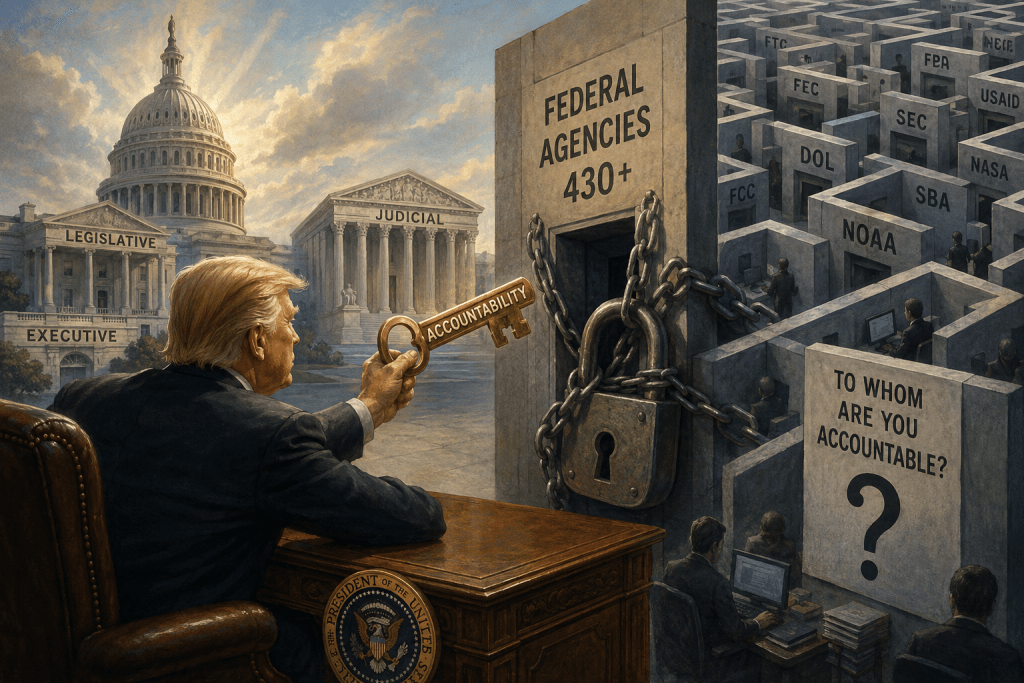
To whom are you accountable?
The Constitution vests the power of government into three branches – the Executive (under control of the President), the Legislative (through Congress), and the Judicial (the courts). Especially since the New Deal, governmental powers have been delegated to administrative agencies – an alphabet salad of government – from Administration for Native Americans to the Woodrow Wilson International Center for Scholars conducts. (Sorry, it’s from A to W, there are no federal X, Y or Z agencies). There are 430 federal agencies. There are well known Executive agencies, think of the cabinet. Congressional agencies include the Library of Congress, the Government Accounting Office, and the Congressional Budget Office. Some agencies are “independent” agencies.
In a recent Supreme Court case the question was who controlled these agencies – the President or someone else.
A 1935 case addressed a similar issue. William Humphrey was one of the five commissioners of the FTC since his appointment President Coolidge. He was reappointed by President Hoover. President F. D. Roosevelt wrote letters to Humphrey asking him to resign because his views did not align with Roosevelt’s. Roosevelt sent Humphrey another letter that simply fired him. Humphrey’s dismissal was based solely on his political and ideological differences with Roosevelt. The Supreme Court in a unanimous 9–0 decision ruled that it was not a violation of the Constitution for the FTC Act to limit the power of the President to remove FTC commissioners only to situations involving “inefficiency, neglect of duty, or malfeasance in office”. When Congress had created the FTC, it had intended the Commission to be a federal government agency that was independent and non-partisan and in passing the FTC Act, it limited the power of the President to remove FTC commissioners only to situations involving “inefficiency, neglect of duty, or malfeasance in office”. This decision was much debated with critics arguing it blotted out the Separation of Powers.
In January 2025, President Trump fired the FTC’s two Democratic appointees. He did not identify a cause listed under the FTC statute. Trump simply said their “continued service on the FTC [was] inconsistent with [his] Administration’s priorities” and that they were removed “pursuant to [his] authority under Article II of the Constitution.”
The Supreme Court held that the FTC’s for-cause removal provision is contrary to the separation of powers enshrined in the Constitution. The Constitution vests “[t]he executive Power” in a “President of the United States of America” and instructs that he “take Care that the Laws be faithfully executed.” Art. II, §§1, 3. In opting for one President, however, the Framers did not opt for the President to work alone. They knew that Congress would institute the great Departments and allow the President to appoint officers therein, to assist him in discharging the duties of his trust. Both Hamiton and Madison asserted that the President had to be able to remove those who fail to live up to their duties, lest he fail to live up to his.
The Supreme Court found the fired employee’s view is incompatible with our constitutional design. Although it is up to the Senate to decide whether to confirm those with whom the President would prefer to work, neither Congress courts may saddle him with those with whom he cannot work. Subordinates who exercise the President’s power are subject to removal by him. Then, and only then, can they remain accountable to the President, and the President to the people.
The real problem is that unelected agency employees are not accountable for their actions to anyone immediately. They may not be reappointed when their term ends. Their actions may be overturned by the courts. But, actions inconsistent with the administration’s policies or positions undermine the will of the voters that elected the President and foster political division.