

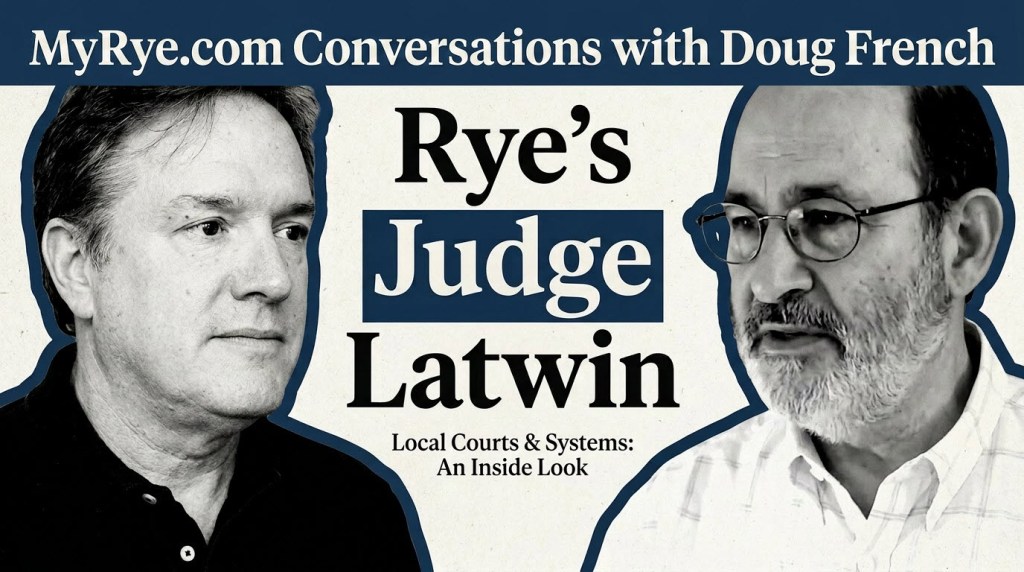
MyRye.com is entering the podcasting business with a new weekly podcast hosted by former Rye Mayor Doug French. Available on all major podcasting platforms, MyRye.com Conversations with Doug French will tackle the larger and sometimes intractable issues impacting the City of Rye through interviews with local, county and state officials and business leaders.
In Episode 8 of Season 1, French speaks with Judge Joe Latwin, who shares stories, insights, and the challenges faced by local courts. This episode sheds light on the judicial system’s impact on our community and highlights opportunities for reform and improvement. Latwin writes the Holding Court column on MyRye.com.
This episode of MyRye.com Conversations with Doug French was produced by MyRye.com. Feedback and story ideas are welcome.
Main Topics Covered:
- Structure and operation of the New York State Court system, including the role of Rye City Court
- Gaps between legislation and court realities, and areas needing reform
- The impact of technology, especially virtual arraignments during COVID-19
- The importance of judicial qualities and local court reform suggestions
- Daily life and peculiar cases at Rye City Court, including the “high weird” cases involving Playland and community disputes
- How laws are passed versus how they play out in court, highlighting legislative gaps and ambiguities
- The process of caseloads from misdemeanors to felonies and the court’s jurisdiction
- The push for virtual court proceedings, including arraignment reforms and pandemic adaptations
- Judge Latwin’s advice for the Rye community and local officials to improve enforcement and legislation
Timestamps:
00:00 – Introduction to Rye City Court and Judge Joe Latwin’s role
02:30 – Perspective on low volume, high weirdness cases at Rye City Court
04:50 – Stories from Playland arrests and community disputes
08:20 – How Rye City Court fits into the New York State court hierarchy
10:10 – Landmark case on architectural review and hanging laundry regulation
12:00 – Elected vs appointed judges in Rye and local judicial structures
13:37 – A typical week in Rye City Court: civil, criminal, traffic, and special cases
17:10 – Unique cases: fishing violations, house security, and community disputes
19:29 – Gaps between lawmaking and court reality, legislative ambiguities
21:54 – Impact of raising the age of criminal liability and virtual arraignments
23:26 – Effectiveness of courtroom technology and virtual proceedings during COVID
24:31 – Qualities of a good judge and impactful community stories
26:35 – Suggested reforms: Streamlining court levels and jurisdiction overlap
28:15 – Practical advice for the Rye City Council and local law enforcement
29:27 – Judge Latwin’s favorite legal TV shows and their influence on his career
30:00 – Final words of advice for court appearances and community engagement
Resources & Links:
MyRye.com – Holding Court Column
Watch:
Full Transcript:
Speakers
- MyRye.com (Doug French)
- Judge Joe Latwin
MyRye.com: Welcome to the MyRye.com podcast, Conversations with Doug French. I am your host, Doug French, the former mayor of the City of Rye. And this podcast is about the people and issues that impact Rye and our surrounding region. And in conversation today, we have Joe Latwin, former judge of the Rye City Court. Welcome, your honor.
Joseph Latwin: Thank you and thank you for having me on.
MyRye.com: Well, it’s a pleasure to have you. And I’d to get started with, you know, we all learn in school about the three branches of government, the legislative, the judicial, and the executive branch. But very few people realize that it really actually is at play here in the City of Rye. So from this conversation, I hope our listeners really walk away with three things. One is how the Unified New York State Court system is structured and how it operates. What is daily life like on the City Court in terms of the caseload, the flow, and some unique stories you may have? And Judge Latwin is known for his unique stories. And then any gaps or trends that you see, there’s always a gap between the laws and what actually has to be resolved in court. Are there gaps or ways that we should look for better alignment along those? So to get us started, Judge, you’ve often described Rye City Court as low volume, high weird. What did you mean by that?
Joseph Latwin: The volume in the Rye City Court is not as great as some of the other courts and thankfully so. We don’t have the major crimes that other courts have and since we’re a small community we don’t have the number of shoplifting crimes or other things that other surrounding communities may have. We used to get a big share of our cases from Playland because that was a recipe for disaster. Several years ago, there was a riot there when Playland started restricting some of the Muslim women from wearing the hijabs, the head scarves, because they thought they were dangerous on the rides. They got into a fight. Police were called in from multiple jurisdictions, and all those cases ended up in the Rye City Court. But I do want to give some kudos out to George Latimer when he was the county executive. In the old days, Playland used to a number of arrests that were really not raiseable to the status of having an arrest in a court proceeding. And George put in a policy that said, We’re going to offer you the opportunity. Either leave or we’re going to have you arrested. And the number of arrests went way down so we’re seeing a lot fewer cases coming out of Playland. And it was good because the cases that were coming from Playland were basically people doing stupid things. whether it was drinking, drugs, or other things that were not conducive in an amusement park status. And it was better to send those people home than it was to arrest them and go through the process. And I have a couple of interesting stories about that that can take a diversion. I used to get about five cases every summer that were exactly the same. A gentleman would decide it would be a good idea to take his wife and his girlfriend and the child of one of them to Playland for a day out. There was eventually alcohol involved and usually about four o’clock there would be a fight between the wife and the girlfriend. The husband would go to intervene. The county police there would see a melee going on and they’d arrest everybody. Couple of logistic problems. The police booking station for Playland was at their headquarters in Valhalla. So they’d have to drive the people up to Valhalla and book them there. And then they would take their property, including their car keys and their wallet, and then bring them back to Rye to be arraigned. And I’d get a call usually about six o’clock to go and arraign people. And I always did it this way. I called the husband in first. and I would say, what were you thinking? Did you ever get the manual? You never bring your wife and your girlfriend to the same place at the same time. And I got the usual response, was, what was I thinking? And now I knew that the wife and the girlfriend weren’t going to press charges because they would be involved too. So I would set a dollar bail for the husband slash boyfriend. And they would complain bitterly.
MyRye.com: You
Joseph Latwin: Yeah. And I would tell them, well if I don’t set bail, you’re gonna have to go to jail. And even if they release you, they’re gonna release you from Valhalla. You don’t have your keys and you don’t have your wallet. So it’ll cost you 50 bucks for an Uber Rye back to Rye I’m doing you a favor by having them drive you up there. And that worked out well. No complaints had to be. And of course, the case never came to court because no one would press charges.
MyRye.com: Well, it definitely sounds highly weird.
MyRye.com: Right, Rye. Well, that’s a very high weird in that fashion. Let’s take a step back and look at the overall picture. A lot of people don’t realize that New York, the Rye City Court is tied to the New York Unified Court System. Just walk through that structure, how it’s set up, the types of courts, the types of matters, and how it operates in general.
Joseph Latwin: Back in 1976, the state took over all of the City courts in the state. which was good because we ended up with uniform City Court law so that everything was the same and we got support from New York State. So New York State now provides for the facilities in Rye but we have to provide them if but maintain them. They also provide all the court officers so the City has doesn’t have to do that and we get support from the state in terms of operational support. The City pays for maintenance and cleaning of the facilities and that’s it. We’re coming up to the point now and this has been going on since before you were mayor, the state has been asking the courts to be upgraded to current facility standards. and they dropped that for most of the time I was on the bench and I understand it’s coming back again and the stick that the state holds is that if you don’t provide adequate court facilities they will cut off all state aid to pay for it until it’s done so that’s a pretty powerful stick I think Rye was getting about 300,000 a year in state aid and that’s a 1 % 2 % raising our taxes just to pay for that if they get it taken away. About five years ago I went to the administrative judge and said to buy property in Rye to build a new courthouse the last number I saw which was probably 10 years ago was 24 million dollars. I was able to negotiate with them because we don’t need the court facilities upgraded because we don’t have volume. They would have required a male holding cell, a female holding cell, and juvenile holding cells. We never had that many people at one time when we needed those holding cells And through the assistance and help of the Corporation Council, Kristen Wilson, we were able to negotiate with the state to cut out some of the things that weren’t really applicable. And we got the cost of doing it down to about $3 million, which I understand has gone up since then. So we would have been able to upgrade to satisfactory standards at about $3,300,000. I had no idea what it would cost now or whether they would go back and insist that we do everything that we need. There are certain things that are absolutely necessary. There is a stair lift that’s probably 40 years old in the court.
MyRye.com: Right, Rye, Rye.
Joseph Latwin: that provides access except it works sporadically and sometimes not at all which means people can’t get up to the courtroom. So then we’re to put in two elevators in the building, one for the public and one internal for any prisoners to come up and down the stairs who weren’t holding themselves down at the police station. They’re going to have to do that one way or the other to be ADA compliant. And everybody needs more room, the police station needs more storage room, the court needs more storage room. So that’s gonna have to be done. the price is much less than $24 million now.
MyRye.com: Yeah, no. And it does look like an investment that the City is going to have to make because the facility for both police and court have not been upgraded. But let’s talk about also the structure of the court system. you’ve got City court, county court, state court. It’s counterintuitive when you look at the Supreme Court because the Supreme Court is not actually the Supreme Court of New York State. It’s the Court of Appeals, which people don’t understand. So just take us through how those courts work together and what the differences are.
Joseph Latwin: Let’s start from the bottom and work our way up. You have the trial courts, which in our case is Rye City Court, which handles certain cases which we’ll get into. And you have the Supreme Court, which is the first level trial court that handles most of the cases that Rye City Court doesn’t handle because we don’t have the jurisdiction. From there, you have an appeal to an appellate court. From the Rye City Court, you appeal to the Appellate Term of the Supreme Court, which is in Brooklyn. From the Supreme Court, you appeal to the Appellate Term, which is in a different building in Brooklyn. and appeals from the appellate term go to the Court of Appeals which is the state’s highest court in Albany. They don’t have to take your case. The Court of Appeals can decide which cases it wants to hear and certain cases they must take if there is a dissent in the middle intermediary appellate court they have to take it but there usually isn’t.
MyRye.com: and who is the chief judge.
Joseph Latwin: Rowan Wilson was appointed about three years ago. And he had been a judge on the court of appeals for number of years.
MyRye.com: And so.
MyRye.com: And are there cases that go start in Rye and make their way up to the Court of Appeals, the highest court?
Joseph Latwin: not during my time. attribute that to my brilliance and my great legal acumen. But most of the cases don’t rise that far because the amounts that are involved or the questions that are involved are not something that the Court of Appeal wants us to see. The last case that actually came out of Rye City Court that I know of was in the late 1950s or early 1960s. was a decision to the Board of Architecture review about hanging laundry on the side of the on Forest Avenue and Rye Beach and that went up to the Court of Appeals eventually. It’s a leading case now on architectural review.
MyRye.com: Yeah
MyRye.com: And how was it decided?
Joseph Latwin: that the City had the ability to regulate the hanging of laundry in side yards facing streets. We don’t see too much of that and everybody has a clothes dryer now, so thankfully we don’t need the sun.
MyRye.com: So when I go to the voting booth, sometimes I have to vote for judges, other judges are appointed, like I appointed you to your first term in 2010. What’s the difference? Why are some judges elected versus appointed?
Joseph Latwin: When the state took over the City court, it took them over as they stood. So if you were appointed under the old City code, which established the court, that was continued on. If you were elected, that continued on. There are a few cities where there are elections. There are number of them that are appointed. Some have mixed. They appoint some judges. They elect other judges. I think Mount Vernon has it split. They appoint one judge and they elect two judges.
MyRye.com: It just seems weird. You don’t know anything about the judges. So the appointment process seems the most natural, Rye, where they’re vetted and appointed.
Joseph Latwin: It depends on whether the judge is around and you’re stuck with whoever’s appointed. So if you don’t know about them, you’re stuck with them for the length of their term or until the Peter Principle comes into effect and they get appointed to a higher court.
MyRye.com: Yeah, okay.
MyRye.com: Right, Rye, All Rye, let’s move to the Rye City Court now. I mean, what’s the typical day? And I know each day has a different type of case. Can you just walk us through the week and the types of cases that come before the City court?
Joseph Latwin: Sure.
Joseph Latwin: Monday we have civil cases. Now there are three types of civil cases that we have in Rye City Court. We have small claims which are claims for less than $5,000. We have commercial claims which are claims less than $5,000 with a business that’s involved. And then we have the general civil jurisdiction up to $15,000. They all have to have an access to Rye. Either one of the parties has to live in Rye or the case has to have risen in Rye. So those cases are all calling for a conference. Most of the cases, the civil cases in which I don’t go to trial for a couple of reasons. One is the amount is relatively small and they’re not attorneys involved in lot of these cases. So what’s the sense of going to trial spending $10,000 on a lawyer for a $15,000 case? But I was able to resolve most of the cases on conference because when you sit down with people and tell them, is this really what you’re suing for and how are you going to prove your damages? Or I tell them, you know there’s a law that says you’re not allowed to do this, or you are allowed to do this, or you need to meet these qualifications to sue. And once you told them that, that was their incentive to settle. So I call in one side and tell them, you got a problem with your case. Then I call in the other side and say, if I can get you an offer, will you take that? And I was usually able to resolve most of the cases that way.
MyRye.com: Yeah.
MyRye.com: Interesting so that’s that’s Monday the civil civil case. Yeah. Yeah
Joseph Latwin: That’s Mondays. Tuesdays are the criminal calendars. Criminal calendars involve cases brought on violations of the criminal law within the City of Rye. They can be violations, which is you violate the City code, leaf blower laws, one of my favorite topics. Those were always popular. Then we have, we have, misdemeanors which are criminal charges which the penalties no more than 364 days and then we have felony charges which is 364 days or more. The felony cases we don’t actually try in Rye because the Supreme Court has to decide those cases so that has to go to White Plains but we
MyRye.com: And is that the county, that the county, White Plains Court, the county court?
Joseph Latwin: Supreme Court. New York State. The county court has some jurisdiction and it overlapped. But we have preliminary jurisdiction. if there are preliminary motions, arraignments, bail, all of those things start in the Rye Court and they stay there until they go to Supreme Court. One of my problems with that is that I couldn’t resolve the case because I didn’t have the jurisdiction to do it.
MyRye.com: of New York State. Okay.
Joseph Latwin: But it would stay on my calendar and the state would come and say. you still have 40 cases on your calendar. How come you’re not getting rid of them? And I said, well, one of the reasons is they shouldn’t be here. I can’t get rid of them. And the other reason is because the state building time limits to hear the cases and you couldn’t comply with them. For instance, in a DWI case, you’d most of the time send the case to for an evaluation to see if there was a real alcohol or a drug problem or something else that would impact and require treatment. That itself will take 30 or 40 days and when you have a 60 day limitation you’re out of time already before you heard the case. So those cases get heard Usually there’s nothing exciting that happens. Most of the cases are resolved by a plea.
MyRye.com: Right, Rye, Rye.
Joseph Latwin: We did have some cases go to trial. Those were mostly DWIs, although we did have some other cases that went to trial. So those would be… The district attorney prosecutes all the misdemeanors and felonies. The City corporation counsel prosecutes the City code violations and the City code misdemeanors.
MyRye.com: And who’s the prosecuting attorney on that? that it?
Joseph Latwin: So that’s Tuesday. Wednesday we would hold hearings. For instance, if there’s a hearing on the suppression of evidence or some kind of motion, we hear those on Wednesdays. And Thursday and Fridays were our traffic and City calendars. So non-criminal City cases would come before the court. A lot of times it was building code violations, although they are criminal in nature. Most of the time they worked out because the City will say, you need a permit to get this and they’d agree to give the person more time to go and get the permit and then when they came back the case would be dismissed. Because once they got the permit they resolved the case. We also have interesting cases that came on Fridays and those are fishing cases. State Department of Environmental Conservation and the City’s constable would issue tickets for catching fish out of season or catching undersized fish. And those would come before me. Interestingly, those cases, you’re not entitled to an attorney even though they are poised like criminal. and it becomes a pain in the neck for the court because you have 20 people get arrested at one time. They’re catching an undersized flounder and you have to give them all of their, read them their rights and then eventually most of the time you make a deal with them because the people who get caught fishing and Rye are usually people who are catching their dinner. They’re not commercial fishermen.
MyRye.com: Right, Rye, Rye.
Joseph Latwin: So you really don’t want to these people too hard. And the fines were outrageously high. When I left the bench, I knew what a problem it was for the court to hear these cases. So I volunteered to handle them pro bono for the court. And I had five or six people at a time come to me. I’d tell them, look, this is what the charge is. I can fight the charge. They’re going to make you an offer. We’re just going to have a small fine. If you want to take it, I can make that deal. If you don’t want to take it, you know, we’ll go from here. And almost everybody took it. But I saved the court hours of time in dealing with each of these cases.
MyRye.com: Right.
MyRye.com: Ha!
Joseph Latwin: I’m still waiting to go to trial on one. I half jokingly told the DA who was prosecuting them, if you make me go to trial, I’m going to make you produce the fish. Because if you’re saying the fish was under sized you’ve got to produce the fish. And if the ticket for the fishing is issued in July and the trial doesn’t come up to November, I don’t want to smell that and they don’t want it and I’m sure they didn’t preserve the fish.
MyRye.com: Evidence, Rye. Right, Rye, Rye.
MyRye.com: Any other funny stories or unique cases in the City court?
Joseph Latwin: The best story we have was there was a superintendent of a multi-family development in Rye and a resident of that development came home and saw that things had been moved around his house. So he went to one of his neighbors and the neighbor said, put a nanny cam in and you’ll see what’s going on. So he put a nanny cam in and lo and behold, some time later, he notices that when he had left, the shades were up and now they’re down and things had been moved around the house. So he took the nanny cam, went to the police department, showed it to them and they went out and arrested the superintendent of the complex. Now. The charges were burglary and intimate relationships with the dog.
MyRye.com: no.
Joseph Latwin: The Judge Runes was sitting on the bench that night when they brought him in and he said bail at $100,000. And I would loved to have a fly on the wall when he went down to the police station and called home and asked his wife to bring $100,000 in cash to the police station to post the bail.
MyRye.com: Right.
Joseph Latwin: There naturally would have been some questions like, what did you get arrested for? And I can imagine her I’m not bringing money down for that. She eventually came down with 100,000 in cash, which surprised everybody because he was the superintendent of a housing facility and where would you have 100,000 lying around? Yeah.
MyRye.com: Exactly. That definitely…
MyRye.com: Right.
MyRye.com: Exactly, That fits the mold of high weird in Rye. So let’s pivot to the case law and legislation. You’ve often talked in your column holding court about just gaps between what’s happening, laws that are passed versus what…
Joseph Latwin: My weird.
MyRye.com: showing up in court. Sometimes laws are written ambiguously so that it’ll play out in court. mean, where do see some of the gaps in local legislation versus what you see playing out in court?
Joseph Latwin: The problem is that the… My wife was an accountant and she phrased it better. She said, the problem that we have is that the people who write the laws don’t have any idea of how it works practically. Congressman who passed tax laws don’t understand because they don’t do their taxes. They don’t know about the tax laws, but they passed the tax law because they want to do something. And the practitioners then have to take it in their hands to try to decide what they really wanted to do and how it’s going to work. And a lot of times it just doesn’t work. My favorite story goes back to Judge Alfano when he was on the bench in Rye Rye past the law saying that you had to have a dog on a leash. And somebody came before the court and said, yeah, that was my dog. But the law says you have to have a dog on the leash, but it doesn’t say you have to be holding the leash.
MyRye.com: Sounds right sounds about right Any other gaps that you see with between what’s happening in court versus how the laws are written?
Joseph Latwin: Yeah, a couple of years ago they did a couple of things that at the same time they did the Raise the Age, which raised the age of criminal liability from 16 to 18. So there’s a gap of 16 and 17 year olds who are charged with crimes, but they really are not criminal. They’re more like family court offenses now. And what they did was they allowed those people to be arraigned virtually by Zoom or by Teams. That was a really good thing because we would get called out at night and they were all centrally held in Valhalla at the children’s lock up up there and before they could do anything they’d have to have a parent or a guardian come you had to have the public defender, somebody who’s prosecuting and the judge all get there problem was that a lot of times the parents, if they were available at all, were in Yonkers and they had no way of getting up to Valhalla. And if it was late at night and it snowing, I’d have to drive from Rye up to Valhalla in the snow. The other thing was that they required you to finish by midnight. So if nobody was there, everybody had to turn around and go home.
MyRye.com: Right.
Joseph Latwin: About a year ago they changed it so that you could do it virtually. Which was great because people could go to a local computer or stay home and do it all on the computer. They haven’t done that for other arrangements now. So now if you get called at 2 o’clock in the morning during the week and you to go to the court for an arrangement, you’re to get up, get dressed.
MyRye.com: Right.
Joseph Latwin: comb whatever hair you have left and then go to the court. You can easily and you have to wait for the legal aid attorney if it’s a felony and you have to have the DA there if they want to show up. But if you do it virtually, there are people in the office they don’t have to travel they can cover more than one court of your time and that’s something that they’re pushing now so we can do arraignments virtually.
MyRye.com: Yeah, okay.
Joseph Latwin: and there’s no reason why they shouldn’t do it again but that’s something that the City court judges are pushing for.
MyRye.com: So yeah, I so I want to take that up in our lightning round, we’ll just about, before we get to the lightning round, just remind the audience, if you have a person or topic you’d like to hear on the MyRye.com podcast, Conversations with Doug French, just email me at French at MyRye.com or.
MyRye.com: Let me know around town. So Judge, let’s jump to the lightning round. You talked about technology and Zoom. So that looks like that was an improvement during COVID. Improvement, not a complication using technology more in the courts, correct?
Joseph Latwin: It was, it worked out well in most cases. The problem was you’d have people all over the place and you lost the decorum you had of people showing up in court. I did a court conference once where the attorney for the defendant in a criminal case was in Florida. lounging by the pool in a tropical shirt and flip-flops with a palm tree in the background. And it was not the decorum you’d want in a court. Nothing major was going to happen. It was just a status conference, as it really were. But that’s what had happened. But in other cases, I had a motion to decide, and the defendant was in the Rockland County Psychiatric Hospital. The cost to bring that to the Rye City Court to conference a case would have been outrageous. And it wasn’t necessary because there was a motion and I just needed somebody there so I can say what the result of the motion was. We were able to do that virtually and saved everybody the hassle.
MyRye.com: Yeah, no, sounds exactly right So just one word or very short answer. What is the best quality a judge should have in a local court?
Joseph Latwin: I often say that the best way to be a judge in a local court is to be a parent because you have to have the right balance of love for the people that you’re dealing with and the ability to impose a punishment where it’s going to be effective and is warranted. I can give you two stories about that. Most of the stories that you get in the court are really tragic. I had a couple of people who died of drug overdoses and it was really sad. Not much I could have done about them. But on the other hand, I had two young people who were involved in drugs and I was able to get each of them help. There was a young lady who I got into a special program they had started with probation. for young ladies with self-esteem problems. And apparently it worked. She graduated from the program. Last time I saw her, she was doing well. Her parents thanked me profusely for putting her in that program. Another case I had was a young gentleman who was injured in a college alumni. lacrosse game. the team doctor prescribed an opiate for him and became addicted to the opiates and that led to a series of unfortunate events. I was able to get him a lawyer who could get him help and when he came back to the court he had resolved the drug problems and we were able to resolve the criminal cases based on his resolution of the drug problems. So two people, life-changing stories. So every once in a while you get happy endings.
MyRye.com: Yeah.
MyRye.com: No, is great stories and it is often said that the Rye City Court judge is really the window into the community because a lot of people for the first time involved with government, if it’s through the court system, you are the window to that community. we only have about two minutes left. Let’s just kind of wrap up with a few more. One reform you’d like the New York lower court system to make.
Joseph Latwin: One of the problems is that we have too many courts, trial level courts. You have village courts for villages, you have town courts for towns, you City courts for cities, you have surrogates court for estate matters, you have family court for family matters. You have a number of these cases. if there’s a problem in Rye, we’re… kind of bound by our boundaries. In Nassau and Suffolk County, they have district courts which cover the entire county of Nassau or Suffolk, whichever one they’re in. The rules are different in each of these courts, and you can be in a situation where you have a divorce case, a child support case, and a custody case, and you can be in three different courts. It’s burden on the litigants, it’s a burden on the courts because no one has the complete picture. There was a proposal by the previous chief judge to divide the court into two levels. A Supreme Court level, which would be the big court for everything, and a local court level, so that the local courts could handle local court things and the Supreme Court could handle the Supreme Court things, and you wouldn’t have a problem going for… to three different courts for one issue. So that’s something that has not been moved on since that chief judge left. But it’s something that eventually should happen. The problem is egos. The Supreme Court judges don’t want the lower court judges going to their bailiwick. And the local court judges don’t want to be denigrated by what you can call the municipal court judge instead of a village judge or a City court judge.
MyRye.com: Right, Rye.
MyRye.com: Another question, is there any advice to the Rye City Council in one sentence you would give them?
Joseph Latwin: I can give you two sentences. One is if you’re pass a law, you need to be able to enforce it. And before you pass a law, you ought to think about what the effects are and have somebody who knows the area or the practice to go over it. I recently had a case with a landscaper and I told the Corporation Counsel
MyRye.com: Okay.
Joseph Latwin: Don’t make me go ahead with this. If you do, I’m going to tear down the whole law. And they don’t believe me, and they should, but I made a motion to dismiss and I pointed out about 10 different things that were wrong with the process of leaf blower tickets. And since then, they finally took up some of my suggestions and are taking it out of court proceedings and bringing it into an administrative proceeding, although that hasn’t happened yet.
MyRye.com: Right.
Joseph Latwin: One of the things was before you issue a summons in a violation, it has to be signed by a judge. Never happened. They don’t take these to the court. One of problems is if you have a landscaper on the property and you’re using a leaf blower, by the time you go to the court and get a judge to sign it and come back, he’s gone and done. So, it has…
MyRye.com: Yeah, yeah, Well, that’s good advice. What is your favorite legal show of all time?
Joseph Latwin: Perry Mason, think I’ve seen all of them. The old ones, I’ve seen the new ones and they’re interesting but they’re a lot more dramatic.
MyRye.com: There you go.
MyRye.com: Is that what got you hooked on the law?
Joseph Latwin: Now, there were a couple of legal shows back then. Harrigan and Son I think was one of them, My favorite book, I have two favorites though. My Cousin Vinny and A Few Good Men. They are actually accurate portrayals of what goes on in court to some extent. I’ve never heard the judge say, what are yous?
MyRye.com: So in closing, yeah, go ahead.
MyRye.com: Hahaha
MyRye.com: And so just in closing, is there one piece of practical advice you’d give to anyone who has to appear in Rye City Court?
Joseph Latwin: Yeah, the corporation counsel or the DA and the judge, you know, they’re people. Being in court, I analogize it to being in your living room. You don’t want to go in with an attitude. You don’t want to start yelling and screaming. You’re going to make more friends by being civil and polite than you are by yelling and screaming. I once told somebody who was before me, you don’t want to yell at me. I’m the guy who’s going to issue the sentence on your case if you’re convicted, and I’m going to be the guy who convicts you if it’s not a jury trial. You don’t want to get me mad.
MyRye.com: Judge Latwin, Joe Latwin, thank you for the conversation today and folks listening, if you want to find or read about more of Judge Latwin’s insights, you can read his column in MyRye.com called Holding Court. And I want to thank our listeners as always to listening to our podcast. You can find full episodes of the MyRye.com podcast, Conversations with Doug French on MyRye.com. And if you enjoyed this episode as well as some of the others, please subscribe.
MyRye.com: wherever you get podcasts. Judge, thank you very much. It was a pleasure.
Joseph Latwin: Thank you for having me and I appreciate being had.
MyRye.com: Have a good day.
Joseph Latwin: Take care.
