

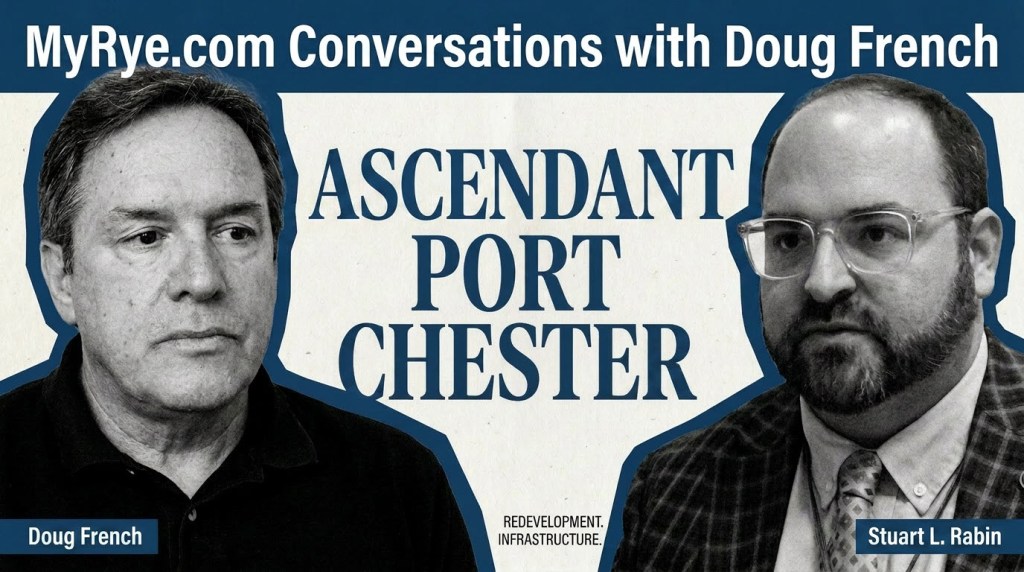
MyRye.com is entering the podcasting business with a new weekly podcast hosted by former Rye Mayor Doug French. Available on all major podcasting platforms, MyRye.com Conversations with Doug French will tackle the larger and sometimes intractable issues impacting the City of Rye through interviews with local, county and state officials and business leaders.
In Episode 14 of Season 1, French speaks to Port Chester Village Manager Stuart Rabin about Port Chester’s transformative projects and regional initiatives. Rabin shares insights on upcoming developments, infrastructure upgrades, and regional collaboration efforts that are shaping the village’s future.
This episode of MyRye.com Conversations with Doug French was produced by MyRye.com. Feedback and story ideas are welcome.
Main Topics Covered:
- Current and planned development projects including the Westchester Crossing (fka United Hospital) and waterfront rejuvenation
- Infrastructure upgrades, focusing on sewer revitalization and traffic management enhancements
- The comprehensive master plan and strategic vision for the next 5–10 years
- Regional cooperation efforts with neighboring municipalities on water management and EMS services
- Innovative user experience initiatives using AI for community engagement
- The importance of balancing rapid growth with resident engagement and consensus
- Future of housing, including increasing homeownership and fostering vibrant neighborhoods
- The role of regional waterway initiatives like LISWIC in environmental sustainability
Timestamps:
00:00 – Introduction: Port Chester’s development and regional cooperation overview
00:30 – Major current projects including housing, infrastructure, and waterfront renewal
01:37 – Sewer system overhaul and funding strategies involving federal and state grants
04:28 – The significance of United Hospital site redevelopment and future plans
05:35 – Impact of new developments on traffic and regional infrastructure coordination
10:12 – Waterfront renovation phases and the new waterfront loop project
12:40 – Downtown expansion with multiple new buildings and community buzz
14:13 – Engaging residents amidst rapid development and change
15:50 – The comprehensive master plan: goals and future vision for 5–10 years ahead
18:25 – Specific neighborhood development strategies, local business pride, and urban design
20:07 – How form-based codes streamline development and encourage mixed-use projects
22:00 – Use of AI and digital tools to enhance user experience in community navigation
26:01 – Vision for long-term community sustainability, property values, and homeownership
29:56 – Regional collaboration on water management and EMS services with Rye and Rye Brook
33:24 – The village’s biggest ongoing project: the waterfront loop and enhancement initiatives
34:06 – Challenges of building consensus and leveraging community support
34:41 – Port Chester’s growth opportunity: strategic and sustainable expansion
35:19 – Optimistic outlook: Port Chester’s future as a regionally recognized, ascending community
36:45 – Advice for municipalities navigating rapid growth and regional cooperation
37:01 – Recommended topics for future exploration: Long Island Sound and watershed management
38:43 – How to connect with Stuart Rabin and stay updated on Port Chester’s progress
Watch:
Full Transcript:
Speakers
- MyRye.com (Doug French)
- Port Chester Village Manager Stuart Rabin
MyRye.com: Welcome to the MyRye.com Podcast, Conversations with Doug French. I’m your host, Doug French, the former mayor of the City of Rye. And this podcast is about the people and the issues that impact Rye and our surrounding region. And for our listeners, our goal is to educate and inform you so you can engage on the matters that are most important to you. So, with that, today in conversation is the Village of Port Chester, Now and the Future. And with us is Stuart Rabin Village Manager of Port Chester. Mr. Manager, welcome to MyRye.com
Stuart L. Rabin: Mr. Mayor, thank you so much for having me.
MyRye.com: So our our takeaway for the listeners today is really three things. first is the current development projects in Port Chester. The second would be future plans for Port Chester and future communities, or the future of communities. And the third is regional cooperation and the role of government services. And so just to kind of get us started, get the conversation rolling, what’s going on with Port Chester?
Stuart L. Rabin: Well, it’s a it’s a great question, right? But it’s a question that the answers usually what isn’t happening in Port Chester. We have we have a tremendous amount of activity going on of various headings, you know, from development like you mentioned, of course the village is probably best known right now. As the village that is pushing ahead with the largest amount of housing development for its geographical size, which is only to almost two and a half miles in square miles. And you know, we are on the move, as we say. The village is actively participating in a large housing redevelopment or revitalization, especially if it’s downtown catchment area. And then also we are improving and revitalizing the infrastructure in the village, which is certainly at the very least.
A: century old, especially if you’re talking about the general sewer system. So one of the larger projects that we have going on right now that may have been developed may have served as a catalyst for it, but it’s certainly no less overdue, is that we are doing a tremendous sanitary sewer revitalization project. We are replacing almost a mile and a half worth of sanitary sewer and sizing it up to 48 inches, which is quite large. And that sewer project has a specific vision and it has a promise to the residents that this system is supposed to be in place in order to help the residents who are here because they deserve it and have been without it for a very long time. But it’s also going to serve the residents of the future and possibly even be what we think large enough to serve even more residents that may come long after this redevelopment is done. So w the what isn’t happening, right? A retail base is is is huge as well.
MyRye.com: Interesting. And how how is that funded? Do you get federal support on that?
Stuart L. Rabin: Yeah, so you know, we we were very strategic in what we were doing. So when we approached the Board of Trustees and kind of gave them the once over about the sewer systems and the fact that if we were doing this development, which the board had already adopted the code to say, yes, this is our our vision, there were certain infrastructure needs that had to be done and they were not needs that were gonna be easily implemented nor constructed in a pretty small window. It was going to take several years to get that done. So with board support, they issued a $35 million bond of approval. And what staff did, us, we took that $35 million bond and we approached the New York State and we applied for every single grant we could figure out under CFEA, WIA, WQIP, even the federal government. And I’m very happy to say that through our efforts and through the efforts of our partners at Delaware Engineering, we have been able to Cobble together $38 million towards the sanitary sewer revitalization. Now, with the growing rate of inflation over the last several years, we believe that the project will be a little bit greater than that $35 million, which is, you know, reasonably and expected to have happened as time goes on. Construction costs increase, but we’re in a very strong position to get this project done with very little impact to the local taxpayer.
MyRye.com: I mean it makes sense, right? If if you are increasing your capacity for residents and you’re having more dynamic restaurants and and activities, you’re gonna need the pipes to kinda take away so.
It’s: it’s it basically touches everything. If you’re gonna grow, your services need to grow with it and services include your infrastructure.
MyRye.com: So let’s get into some of the infrastructure specifically. So the first one that comes to mind when we talk about our A-block, the development current projects in Port Chester, the Westchester Crossing, as it’s called, the former United Hospital site.
Stuart L. Rabin: Yeah. Yeah, so certainly, you know, us here on staff in the village who’ve been working very close with Rose Associates and Bedrock Properties, we refer to this as our Regeneron, as many people point to from Greenberg when Regeneron came in and developed a whole campus. I mean, this is a fifteen acre parcel right at the gateway of the village, a gateway which the Village of Port Chester in the City of Rye share that’s bifurcated by two eighty seven. And a whole bunch of local roads that affect both residents of the village and the city. And this project has been way overdue. The United Hospital project, well, the United Hospital itself, it closed its doors in 2004. Here we are more than 20 years later, and now that’s a distant memory. The buildings themselves. The property has been graded, everything is ready to go. They’ve already substantially completed a lot of the stormwater and sanitary information of all the piping. And next they’re gonna be going off and start building these buildings. We are very hopeful that United Hospital will have their building permit by the fall for their first residential market rate buildings, which do include a ten percent set aside for affordable.
MyRye.com: And and this’ll be what big box downstairs residential above and parking underneath?
So no, actually it’s: primarily residential. the largest building I think right now may eke out seven stories, but all the others are lower. they are currently before the board of trustees, looking to get approval to adjust their floor area ratio that was originally adopted in the code. They are not going to perform the assisted living aspect of that development. They are gonna go to independent senior housing. So it doesn’t impact traffic or upgrade or upgrade those numbers at all. It actually brings down a lot of the the potential impacts that were already brought down by the new developer. And what they intend to do is have mostly residential. There’ll be a small space retail that’ll probably serve that area. And it’ll also include jewel box, gym for the residents there, pool, and yeah, and then there’s also going to be a hotel. Boutique Hotel. They’ve been courting for a while. They’ve done a presentation at the Port Chester IDA. Nothing’s inked yet, but it looks very promising that there’ll be another hotel in the area and this one will be located at United Hospital. About a hundred and twenty key hotel.
MyRye.com: And so one of the reasons why it was delayed initially when I was mayor was the impact on the school system. more kids into the school. So is it age restricted in certain units or how does that work?
Stuart L. Rabin: So it’s not age restricted except for those senior houses that are the fifty-five and older, but the the what would you call it? It would be like the the menu of the types of units that are being built. They’re mostly studios and one bedrooms because that seems to be where the market is strongest right now. So in studios and one bedrooms at market rate apartments, you won’t see the school impact.
MyRye.com: And I assume you’re working with the City of Rye in terms of municipal services with more people, right? Municipal services, stormwater runoff, those types of things, traffic.
Yeah. yeah. Yeah,: so you know Port Chester is since I’ve been here and especially post Hurricane Ida, we’re stormwater fanatics over here. We’ve invested nearly fifty million dollars in various stormwater projects. And we like to keep that stormwater tight and it get it underground as soon as possible and down to the Byram River, which is the difficult task. all of our effectuated documents, everything they in fact even the developer and their representations have presented at City of Rye board meetings to keep that city in the loop of what their vision is, any changes that may have come about. And our attorneys and the City of Rye attorneys, especially the environmental attorneys, have been regular in contact with the City.
MyRye.com: Okay. And what about traffic patterns right around the Post Road? There’ll be another entrance in order Yeah.
Stuart L. Rabin: Yeah, yeah. So they have as part of their SEQRA determination and with the Rye City’s understanding, there’s actually gonna be two significant impacts or traffic mitigations that are gonna be implemented in that area that’s really gonna change how that intersection operates. Besides traffic light and signaling upgrades and pedestrian upgrades, there’s gonna be a bypass road. So those who are traveling towards the City of Rye from
MyRye.com: Okay.
Stuart L. Rabin: Port Chester and Boston Post Road to get to High Street, they’re no longer going to go to the corner and be at that light and make a right. There’ll be a bypass road that will take you through the property to High Street to alleviate the congestion at that intersection. That by that happening, High Street would actually be become a one-way towards Boston Post Road, right around where the senior facility is on High Street. That would turn into a one-way. So the the streets that are farther West on High Street, closer to the Rye Brook, the cemetery area. That that part of High Street will still operate as a two-way, but the area closer to Boston Post Road will operate as a one-way towards the shopping center. Additionally, the United Hospital developers are adding a second left-only turn lane on the 287 exit ramp. So which is great for two reasons. One is
MyRye.com: Gotcha. Okay.
Stuart L. Rabin: It’ll put three lanes on that exit ramp. So if people want to go to the City of Rye, there’ll be a reserved lane for that right, just like there is now. But now you’ll have two lanes going left, which will make that that exit potentially wider, which will eliminate, like I said to the guys just the other day, that grassy area at two eighty seven where everybody seems to think they can drop their garbage.
MyRye.com: Right. Yep.
Stuart L. Rabin: It’ll basically take that that area over. They’ll have to build a new retaining wall. So hopefully the opportunity to litter on that intersection’s exit will will will lessen dramatically by that.
MyRye.com: Yeah. Right. Right. Great. Great. So let’s let’s move to the to the waterfront. Just when I thought it was completed, it looks like you’re tearing everything up again, no?
Stuart L. Rabin: So yeah, so this is a a very torid tale. So the the waterfront first collapsed in two thousand seven and I was not brought on as an employee of the Village of Port Chester until two thousand nineteen. at that time there had been up to that point there had been no construction at the waterfront. Only securing the area with temporary fencing and wood paneling and whatever was necessary. when I ascended to the village manager position in November of 2020, I said to myself, what is the project that I need to get some gas behind? And I told the Board of Trustees when they were putting me in the seat, even as an interim position, I said, listen, I’ll do anything I can do for you in this village. I’m invested here. I want to be able to make this place even better. But I don’t know and first thing about building a bulkhead. And I was honest, but I learned. And that’s the whole secret, right? village management. Is learning. Never stop learning. Never stop asking questions. Never stop researching. Doing your own. Like education is key. So in two thousand twenty one we broke ground on the waterfront phase one. Phase one was completed a month early and under budget in July of twenty two. We broke ground again for the second phase that year. That ended up going for another year and a half. And then since that time, we had to do a lot of other stabilization work that isn’t as glamorous. Retaining wall, handicap ramp, some railing, some security measures, all that’s done. And then this past May, we started on the last phase. So phase three of the waterfront initiative is actually phase one of the loop initiative. So they’re kind of on top of each other. So during our conversations with the Westchester County Dig grant process, I came up with this idea of creating an identifiable loop that would go around the village that would act not only as a pedestrian improvement and a directional improvement for the village, but also an economic driver for our businesses, right? For our residents, for our visitors. So now the it is the last stage of the waterfront, but it’s technically the first stage of the loop. So we’re very excited about this this last stage.
So let’s let’s: get into the loop when we talk about future communities because I saw your presentation. I was really impressed. so what anything else happening in the downtown area then? Because it looks like a lot of new buildings and a lot of great buzz happening. Yeah.
Yeah. Yeah. Right now we have we: have technically five buildings that are under construction right now in the downtown area. And that does not include any building, of course, that has a TCO. We have a six story example on North Main Street that faces Abendroth Avenue. That’s yeah, so that is
TCO is what’s: what is the sample, TCO?
Stuart L. Rabin: temporary certificate of occupancy. So we have one six story example on North Main Street, twenty seven forty five North Main Street. We have another one, one thirty three Irving, which is right across from the train station. We have the Magnolia that’s should be completed by this time next year, that’s right across from the Capitol. And we have an older project that’s actually old code, station lofts that’s on
MyRye.com: Gotcha.
Stuart L. Rabin: Broad Street, right across from Neri’s bakery. And that is a five story project that broke round about a month ago and they are looking to complete that in about two years. And those are going on right now. Yesterday actually just as timing we broke around on 28 Pearl, which is a building that’s being built right next to T&J across the other side of Neri’s Bakery on Pearl Street. That’s a nine story project. yeah, things are real talk about coming out of the ground. I mean it it is happening all over.
MyRye.com: So I mean that’s exciting, but so what about the residents that say, Hey, things are happening pretty quickly? How how do you how do you engage and deal with residents that say, Hey, the the pace of change is a little too quick for me?
Stuart L. Rabin: Yeah, you know you’re it’s not lost on us, right? We had thirty developments that were approved since twenty twenty two. the original anticipated vision for the form based code was that we would have six thousand units come about over the next twenty years. That was the vision for the code, a twenty year look ahead. Those projects came to us in a year and a half because of our opportunity zone status, our geographical location. And part of that geographical location being our location in Westchester as a gateway to Connecticut, right by White Plains, close to Rye Rye Brook, right across the river from Greenwich, Connecticut. I mean, there’s nothing like it to be, you know, the center of that circle. So yeah, exactly right. And with potential improvements of the MTA, we could be Amtrak’ing ourselves to Penn Station from the Port Chester train station and most likely the Rye as well.
MyRye.com: In forty minutes into Manhattan. Yeah.
Stuart L. Rabin: Whole line. So, what how do we talk to residents? Very gingerly. we’re sensitive that a lot of people are seeing their village change kind of quickly. It’s almost like a forced evolution rather than a periodic evolution. That what they expected to take 20 years. Some people may have wished may have assumed they wouldn’t even be living here in 20 years when they started to see things changing. They’re starting to see it now. create some opinions as would be expected. It creates a very some little division here and there, but we have to do our best to mitigate that and know that there’s a vision set forth for the village that’s not only supposed to support it presently, but also be able to make it sustainable for the future. And it’s a learning process. It certainly is.
MyRye.com: So I mean what’s clear and let’s move to where we talk about the future plans and and the future of communities. it’s clear you’ve got a vision and now you’ve got your strategies in place and now you’re really executing on those. So you just kicked off your comprehensive plan. so what are the main goals of that and what does Port Chester look like in the next five to ten years?
Stuart L. Rabin: Yeah, so the that’s a great question. We actually had our first public input session last night as part of the comprehensive plan process. It’s very new right now because the village had previously adopted one in twenty twelve. Then we had adopted an update when they adopted the form based code. So that whole process was called Plan the Port. Now this master plan has come into effect for a very important reason. It’s the fact that 20 years of vision arrived in a year and a half, which means the post-20-year vision needs to have some serious study happen amongst the residents and staff and other professionals. So our vision right now is of what I can tell you with the limited interaction we’ve had so far, is that we need to be able to look beyond this development. What happens after those 6,000 units? So the comp plan is going to be focused on that vision. What happens for the village of Port Chester and its neighborhoods? It’s recreational offerings. How do we expand services potentially, not only to help the people who are coming here in the future, but also to help our other infrastructure that’s going to need some attention. So we’re already starting to a lot of those projects now to kind of get ready. Like I say to people all the time, nobody wants to move somewhere and be told eventually this place is going to be great. You know, so get in on the ground floor, right? That might work for some investment kind of positioning, but if you’re going to plant roots.
MyRye.com: Right.
Stuart L. Rabin: It’s not really the f the strongest pitch. If you come here, I guarantee you in 10 to 15 years, you’re gonna love it. Like that’s not generally the best residential pitch. So what we need to do is we have to create quite honestly the Port Chester of tomorrow, quality of life wise, culturally wise, you know, aesthetically wise now, so that people when they come here, they know that yeah, there’s some other stuff coming down the line, but I could take advantage of a slew. of items off this menu of quality of life menu right now. So this comp plan is going to help do that, especially for the area what we call the CD4, the north of the trestle area. So if you’re familiar with The Kneaded Bread train trestle intersection at Mill Street, we have two gateways to Greenwich very close to one another. One is Mill Street, which is very small. It’s a very activated commercial area with a lot of businesses that focus on car detailing and repair.
MyRye.com: Yep. Mm-hmm.
Stuart L. Rabin: and and so forth. But then the area between that trestle and Greenwich, where Carvel is and Putnam Avenue, that’s our next, you know, destination. In a downtown business district, adjacent district that’s gonna be close enough for you to walk and take advantage of everything that is being built, but far enough away that maybe it’s a little subdued. It’s almost like puts the urban in suburban kind of area. And that’s what we’re looking at. Lower heights, more retail, multifaceted properties interacting with one another. I mean the Village of Port Chester on that road alone has some very have long lasting, successful commercial businesses that know how to and this is key, know how to take pride in their property, that they’re not an eyesore or a burden on the residential community in the area. Arctic Mechanical, the Nissan dealership, Rye Ridge Tile, they all take the time to manicure their properties. And that goes a long way with me and I know it goes a long way with the village. Because we have plenty of examples of the opposite.
MyRye.com: Yeah, and so this is as you pass the courthouse and the police station and just keep keep heading. Yeah. Yeah. just quickly back to the Form Base Code. Essentially what that did is simplify the approval process in terms of application.
Stuart L. Rabin: Yeah, that whole area, Lifesavers on up.
Yeah. Yeah, I mean we: were we were pro housing before the governor came up with it and turned it into a toll booth between municipalities and a lot of the state grant money. And we our form-based code process and our adjustments to the planning process, we had a strong SEQRA process. We were getting the developments passed through, you know, reasonably quickly. There was a little bit of a hiccup with Veolia, which is a a s a pinch point for a lot of development in the area.
MyRye.com: Mm-hmm.
Stuart L. Rabin: That definitely slowed us down. But otherwise, as we’ve seen in the post Veolia era, the form based code has been able to ensure that we have appropriate environmental oversight of development properties done within a short time frame, but a very meticulous time frame, so that developers are not slowed down by the village. They may be slowed down by, you know, forces outside of the village’s control between pricing, inflation, lending and Interest rates, which is not us, but we are no longer a pinch point in the development process. And the other thing that’s very important to notate about the form-based code is that it does the job to prevent every single development needing to get presided over by the zoning board for variances and other things. The code also allows for different facets of property behavior, commercial, retail, residential, whatever, you know, titles you like to use, it allows them to coexist. So for example, the 30 Broad Project, the first two floors is a brewery. The rest of the building is residential. Originally there was an office component pre COVID. That changed, but now you’ve got a two story brewery that’s gonna be doing catering and providing food and restaurant quality food, on site brewing.
MyRye.com: Yep.
Stuart L. Rabin: for beer and you’re gonna have people living upstairs. And they’re gonna be around the corner from the Capitol Theater. I mean, if you’re if you’re a music goer and that’s kind of like your lifestyle, this is awesome.
MyRye.com: Right, right. Yeah, absolutely. let’s let’s get back to this tease on the loop. So one of the things that impressed me and I’ve seen your presentation is looking at the user experience. Right? I want to move to a community and I wanna grow with that community and but you’re taking it, hey, how do I improve that user experience? So talk about the loop and some of the things you’re doing with AI to enhance that whole user experience.
Stuart L. Rabin: Yeah. Yeah. So, you know, going back back when George Latimer was still county executive, we were one of the five communities that were selected to receive the Westchester County Downtown Investment Grant, which is their version of the DRI, which to date the escapes the village, even though we we try to apply. We just we can’t get our hands on that ten million, right, for downtown revitalization. So as I’ve said in many other presentations to the public, to board members, anyone who listened, the village of Port Chester We are DRIing without the DRI, right? We’re cobbling together grants and other initiatives that the DRI would otherwise support. And we’re doing it our own way because we’re not getting that state partnership that we deserve, quite honestly. So under George Latimer, he released this, the this grant opportunity. And we were fortunate enough to be selected as one of those five communities. One of those projects that came up, as I said earlier, was this loop.
And the idea was: that the loop would help identify a circular path around the village that would tie together the area of the Capitol Theater and the train station with the waterfront and the entire business district in between. So that path will have a colored concrete. It will have identifiable signage, lighting, landscaping, seating, all that stuff. It’ll be great for the chamber to be able to leverage and say that they have membership that’s on the loop. Are you looking for a new place to open? In fact, just the other day I spoke to somebody who has an operating building that is going, it was on the loop. Well, you know, chicken or the egg. They exist, the loop will be coming through and become their front door. And I they said to me, you know, we’re thinking about putting XYZ in. And I said, I’ll be honest with you, it’s not my place to tell you who you can or you can’t lease to. That’s not my purview. But I will tell you, the idea of the loop is that it’s a pedestrian-friendly. type of walk around and engage with a business around you. If you put a bunch of businesses on this loop that are appointment only hairdressing, nails, massage, spa, whatever you want to pick, you actually lessen the opportunity for the business to take advantage of that identifying loop, you know, moniker. You know, come find us on the loop turns and just make an appointment on our website. So how do we tie this all together? So there were three projects approved.
MyRye.com: Okay. Right, right.
Stuart L. Rabin: The other project of the three besides the loop was a branding and marketing initiative that we are doing. And that branding and marketing initiative has helped us financially and design-wise supporting the creation of a new website that the village will leverage as a sister website to the general PorchesterNewYork.gov. And that website, which will be PC Downtown, that will give you all the happenings that are occurring in our downtown area. What’s happening at the cap, what’s happening with the trains, what’s happening at the waterfront, and the businesses. And we’re gonna leverage AI in that website too, so that people will be able to ask questions and interact with that website, especially if it’s the biggest question anywhere, not just in Port Chester, sorry to say, but anywhere. Where do I park? Where’s the closest parking lot to The Cap that I can use? Do I have to pay for parking here? What’s the parking hours on this street? You know, maybe somebody who’s gonna come into the village just for a show because you know The Cap is bringing people in from all fifty states, and they have an a an Airbnb somewhere, and they say, Well, I’m gonna be in town, what’s the quickest route, or what’s a great restaurant near my Airbnb? Well, eventually I think that our website and AI will be able to leverage those answers and be able to have that that interaction, almost like a virtual tour guide to the village of Port Chester, but also a virtual you know, Don King promoter of what we’re doing.
MyRye.com: Yeah. That’s brilliant. I mean the last thing you want to do is get stuck on a municipal government site, right? You need something that’s Yeah, exactly.
Stuart L. Rabin: Right. Exactly. Ex exactly. Especially ours, right? It’s like any municipal government site is kinda like, you know, great. Departments.
MyRye.com: That is exciting. what about you talked about keeping families in here for the for their for their duration. Explain that to me.
Yeah,: yeah. So, you know, that’s kind of like a vision that, you know, I’ve adopted and I think staff has adopted very well. I’ve spoken to several board members, both sitting and previously sitting. And you know, this whole development thing, it was first originally envisioned as a way to improve accessibles, right? The United Hospital parcel, let’s say they’re paying a they’re assessed for a million dollars right now. It’s really not. Let’s say they’re assessed for fifteen million dollars.
MyRye.com: Yeah.
Stuart L. Rabin: As is. When that project’s done, that property is going to be assessed for $286 million, you know, according to the Town of Rye assessor. It’s in that ballpark. That’s a tremendous increase in value. Just yesterday at 28 Pearl, it’s gonna increase 44 times in value than what it is right now when that one building is done. And you look at an entire block in the village right now, and the accessibles in comparison is stark, right? They’re they they are not. They’re not there. But what was originally conceived as an accessibles plan has swiftly translated into a plan about continuum and longevity and contingency. And that idea is I’m a young millennial. Maybe there’s another term for somebody who’s younger than these current millennials. And I say, There’s the village of Port Chester just like you said before, Mr. Mayor. We’re right, we’re on the train line. So you’re forty minutes into Manhattan, no problem. You can work anywhere downtown. And you can have that access. You come to Port Chester, we’re highly walkable if you’re gonna be living in the downtown. We got arts, we got entertainment, we got restaurants, we got good restaurants, we have great restaurants, and we have more amazing restaurants on the way, right? We’ve got I mean, what village isn’t home to two industrial bakeries, right? I mean, between Neri’s bakery is just, you know, world known, world renowned, right? The amount of the business the Neri family is doing.
MyRye.com: Yeah.
Stuart L. Rabin: What they’ve turned this into is is exceptional. So you’ve got all these characteristics of just a powerhouse community. And you fall in love with it. And you’re like, what am I gonna do? I’m gonna move on now. Where do I wanna go? How do I wanna live? I meet somebody. Now maybe you’re raising a family, maybe you’re not. But a rental downtown was your speed in your twenties. Maybe it’s not your speed in your late thirties. You want grass. You want to own multiple cars, have a garage, you have a hobby that you can’t do in a residential building. We want you to come into the housing stock. We want you to take the mission of the downtown revitalization and import it into the housing stock of our neighborhoods. Fix up the homes, buy a two family, and rent out the top to another young family. The biggest piece of the pie when it comes to Home ownership in the village of Port Chester that’s missing is that we are a village that is 60% renter. And although renters are very important, as we can see from all the development, there is something to be said when it comes to property maintenance and neighborhood vitality when you have more homeowners living in the village. You know, there’s great opportunity. You can own a six-family home, but you can also live there. And rent out the five other family units instead of renting out all six and living somewhere else. We want that home ownership to increase and not have it be detrimental against the renting population. Because there are people, they’re just not gonna be homeowners. And they’re also not gonna be renters in these new buildings. So they need middle housing. And that’s our mission is to find it.
MyRye.com: Yeah. That all sounds sounds terrific. So we’re not gonna do a deep dive in this area, but one of one of my issues when I was is in government was a lot of these problems that the municipalities face are regional in nature. I mean crime and flooding and they don’t stop at each of our borders, but we’re asked each of us are asked to tack we’re tasked to solve these problems. How is it going with with with working with your neighbors and other levels of government to actually solve some of these regional problems?
Stuart L. Rabin: Yeah, I have to tell you from the operational end, I’m I’ve been very fortunate to have, you know, mentors and partners in Rye Brook and the city of Rye, especially Greg and Chris, Bradbury in in Rye Brook. Greg Usry, previous manager in City of Rye. And I have a really good relationship with Brian Shea as well, because Brian was the assistant manager while Greg was there. So we’re no we’re definitely not strangers. we serve together, as you know, with these three communities on the EMS board, which has been a tremendous it’s probably one of the best parts of this area is the fact that this IMA has afforded these communities to work so well together. And for us to become so close because of that, because even though you have a lot of managers in Westchester that know each other or have moved around from spot to spot, I don’t think a group of managers work as closely together as the managers of Rye, Rye Brook in the City of Rye. And I think EMS is all is is because of that. Right? It’s kind of like the seed that planted that three stemmed b bush.
MyRye.com: Это.
Stuart L. Rabin: That we all share. also with the village of Rye Brook, we have an IMA for the library. And then we all have very closely working fire departments that help you know, kind of continue that connected tissue for all of us. So in this region here, it has been phenomenal. And I have to say, even going back a few years ago, when the village of Port Chester was facing these issues with Veolia at the PSC. If it wasn’t for the three communities coming together, Rye City, Rye Brook, and the village of Port Chester, to come to an agreement of whatever that settlement was at the time for the rate case, a lot of that was being driven by the future of Port Chester, because Violia was seeking a six thousand dollar a door fee for every new development that was going up in Port Chester. But it had to be agreed to.
MyRye.com: Yeah.
Stuart L. Rabin: by the city of Rye and the village of Rye Brook, along with the rates that they had negotiated to that point. Which in my opinion, any rate increase when it comes to a lot of this stuff is high, but it was significantly less than where we started. I think it was five set five percent year over year, whereas originally they were asking for fifteen. But Greg and Chris and those respective boards understood that this region needed to thrive and Port Chester is the linchpin in that in this region. So we need to even though the the traffic might get crazy sometimes, you know, with two hundred eighty seven and retail traffic, and even though there might be different levels of income and other ways that we’re divided, there’s certainly a lot more is that of things going on and who we are that connect us than divide us. And and that’s where that regional, that local connection is strongest.
MyRye.com: So hopeful. I love it. Great to you. I’m gonna let you take a break and just take a quick reminder to our audience and ask if you have a topic or person that you would like to hear on the MyRye.com Podcast, Conversations with Doug French, just email me at French at MyRye.com or just let me know around town. what we’re finding is local issues are universal as we’re hearing from Stewart. So no matter where you live, keep those suggestions coming and keep listening wherever you live. so we’re gonna pivot now to our one word short answer section that we’ll call the lightning round, just to change the cadence up a bit. I will just go through these and and get your insights. So your favorite ongoing or upcoming project in Port Chester right now?
Stuart L. Rabin: It’s gotta be the loop. You know, the the loop and the waterfront connected like that is the is the biggest thing for me. I mean I want that waterfront done. It’s very important to me that it gets done. These the people of the village of Port Chester deserve their waterfront back and it it really means a lot to be able to give that to them.
So if I’m: a Colony Pizza it comes out how far and around?
Stuart L. Rabin: So if you’re at Colony Pizza, the whole area behind the pizza parlor is actually village property. And that goes all the way to Bar Taco and extends all the way to the back of Costco. But then it’ll go up Willett Avenue and Westchester Avenue and then hook around the train station on Broad. Yeah. That’s the loop.
MyRye.com: Yeah. Yeah. Gotcha, gotcha. And that’s the loop. What’s the biggest challenge you’re facing as a manager today?
Stuart L. Rabin: I think the biggest challenge for me and any manager is always gonna be consensus, right? The idea that, you know, if we’re trying to get something done in the village, that there’s a growing consensus of support or even sometimes just a consensus for direction. You know, if there’s something we need to tweak, we need to get consensus. Consensus makes everything go. And that’s the most important that’s the biggest challenge that I always receive. It’s like, do we have consensus? Whether at the board level, the community level, the staff level, to make a decision and then stick with it. That’s the biggest challenge.
MyRye.com: Absolutely. and what’s the biggest opportunity that you see?
Stuart L. Rabin: the biggest opportunity for Port Chester, honestly, is continued growth. certainly that area above the train trestle is like the largest opportunity in front of us because you know it’s you can you can learn from all of your previous mistakes, right? And start fresh instead of always saying, Well, I wasn’t here when that was started, and I wasn’t here when that started. Well, now we have a chance to learn from the past. And then reinvest it into the future. So the biggest opportunity I think we have is strengthening Port Chester, having it grow, but growing smartly strategically with a lot of other assets included.
MyRye.com: So you’re gonna keep you to one word on this one. How would you describe Port Chester’s future?
Stuart L. Rabin: Ascendant.
MyRye.com: There you go. You wanna elaborate?
Stuart L. Rabin: Yeah, I mean, obviously we we are ascending. The future is in front of them. It’s not behind them. I think this village is finally at a point where it’s approaching its own identity and an identity that is a lot stronger than with the past. It’s no longer a village of yesteryear, but it is a it is a definitely a city operating with a village government with a bright future and it’s it’s making a name for itself. It’s becoming a
MyRye.com: Yeah.
Stuart L. Rabin: A regionally known location.
MyRye.com: That is great to hear. so if if I’m a visitor coming to Port Chester, what’s the best spot to check out? Without taking favorites? Yeah.
Without taking favorites, ’cause: there’s a lot out there that gets a lot of social media press, and I’m not gonna deny that they’re great. But I gotta tell you, my my go to place when I wanna go somewhere, I shouldn’t even say this ’cause I want to go somewhere where nobody will find me. I will go to Rinconcito Salvadoreño on Broad Street, right behind the Capitol Theater. They are located right in between thirty Broad, right across from the train station. David
MyRye.com: Okay, I’ll check that out.
Stuart L. Rabin: And Edwin, the the guys who run that place are phenomenal. They’re Knicks fans like me, Knicks in five. God bless the franchise. And they’re the only Westchester restaurant to be featured on Triple D with Guy Fieri. And they’re tremendous brothers with a tremendous business and great food.
MyRye.com: absolutely. There you go. There you go. any advice for other municipalities in navigating growth?
Stuart L. Rabin: Confidence, be confident in a vision, be confident to stay the course, and even when sometimes things change outside of your ability, learn how to be confident in your adjustment.
MyRye.com: And so last last question for me is suggest a topic or guest for this podcast.
Stuart L. Rabin: Topic or guest for this podcast. Well, I would tell you what, I think a topic that is very important for this podcast is just the general viability and health and behavior of Long Island Sound and the Byram River and the the water that we all share. the village along with quite a few other municipalities recently reassociated themselves through an IMA for LISWIC
MyRye.com: Mm-hmm. Yes. Yes.
you may have heard about it already, the Long Island watershed. And: we are working very closely together to bind together a vision for Long Island Sound and all the connected waterways and tributaries that all feed into Long Island Sound, you know, from the Sound Shore area of New Rochelle up to Port Chester, Rye Brook Rye City, Mamaroneck, Mamaroneck Village, Mayor Sharon Torres is the head of LISWIC right now. She’d probably be a very good guest to have in there if you want to talk about, you know, the the vision of LISWIC and then you know, stormwater management is probably a most important thing for this area because when we get hit, we get hit hard. And we have a lot of water and a lot of sea levels that kind of make things very challenging for us. There’s always bowls. In areas of mid county and upper county, we have a few bowls ourselves in the village. But that sea level rising is a big thing.
MyRye.com: Yeah. But that’s a great one. That’s a great topic and great great idea. well Stuart, I really want to thank you. We Karen and I moved to Rye 40 years ago, and at the time they were saying Port Chester’s going through a renaissance. Well, I’m not I’m seeing it now with your leadership and your collaboration, cooperation. I’m actually I’m really seeing it and it is exciting to see it grow and to be a regional partner with you. how should people contact you? What’s the best way?
Stuart L. Rabin: Thank you. Best way always, you know, email S Rabin at Portchester NY dot gov. I’m very active on Instagram and LinkedIn as well. So you happen to be on LinkedIn, I’m very easy to find. It’s LinkedIn dot com slash in slash Stewrabin. I do articles on there quite reason quite frequently about different topics that either affecting Port Chester or just general municipal usings, whether it be stormwater or infrastructure improvements or revitalization. I’m always happy to connect on LinkedIn. It’s a great business platform that I use to connect professionally with people. it’s certainly better than a lot of the other social media ’cause it gets bogged down by a lot of noise. So
MyRye.com: Well, Stuart, thank you again. And I just want to thank our listeners for for listening. And if you could find the full episode, transcripts of this episode and other episodes on MyRye.com You can also get local news and more on MyRye.com If you enjoyed this episode, please follow or subscribe wherever you get your podcast. And thank you all for listening to the MyRye.com podcast Conversations with Doug French. Thank you.
Stuart L. Rabin: Thank you.

I finally know that there’s some logic behind what’s happening in Port Chester. The podcast was very informative. However, I still feel that traffic and parking will be a real problem when these developments are finished. I also feel that finding housing will be more and more difficult for those on the bottom half of the economic ladder