

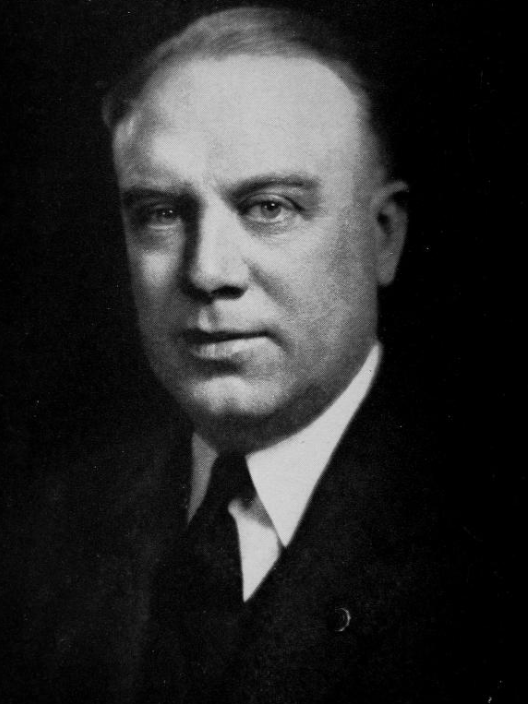
RyeGPT People of Note is a series highlighting individuals who have a connection to the City of Rye. In the series we use artificial intelligence to prepare a biography and explain the individual’s connection to Rye.
Please send feedback and suggestions for other people to profile via our Tips & Letters.
Few public servants have held prominent positions spanning executive, legislative, and judicial government. Raymond Earl Baldwin, who was born in Rye, New York, in 1893, went on to become Governor of Connecticut, a United States Senator, and Chief Justice of the Connecticut Supreme Court. His unusual career took him from the Sound Shore to the highest levels of Connecticut government, making his early connection to Rye a notable part of his biography.
Early Years and Childhood in Rye
Raymond Earl Baldwin was born in Rye, New York, on August 31, 1893, to Lucian Earl Baldwin and Sarah Emily (Tyler) Baldwin. His family remained in Rye during his early childhood before moving to Middletown, Connecticut, in 1901, when Baldwin was about eight years old.
Although Baldwin spent most of his adult life in Connecticut, his New York birthplace remained a distinctive detail of his biography. He was born just across the border from Connecticut and would eventually become one of the state’s most prominent political and judicial figures.
Education and World War I Naval Service
After moving to Middletown, Baldwin attended local schools and graduated from Middletown High School in 1912. He then attended Wesleyan University, where he earned a Bachelor of Arts degree in 1916.
Baldwin subsequently enrolled at Yale Law School, but his studies were interrupted by the United States’ entry into World War I in 1917. He enlisted in the U.S. Navy and entered officers’ training school, receiving a commission as an ensign in February 1918. He later attained the rank of lieutenant, junior grade, and served aboard a destroyer during the war.
After the armistice, Baldwin resigned his naval commission in August 1919 and returned to Yale Law School. He received his law degree in 1921 and was admitted to the Connecticut bar that same year. He then established a private legal practice in Connecticut.
Rising Through Connecticut Politics
Baldwin entered public life through local government in Stratford, Connecticut, serving as town court prosecutor from 1927 to 1930 and subsequently as a court judge. In 1930, he was elected to the Connecticut General Assembly. He became House Majority Leader in 1933 and served in the legislature through 1935.
A Republican and reform-oriented politician, Baldwin rose quickly through the state’s political ranks. In 1938, he secured the Republican nomination for governor and narrowly defeated four-term Democratic incumbent Wilbur Cross.
Baldwin served as governor from 1939 to 1941 and again from 1943 to 1946. During his administrations, he oversaw Connecticut during the years surrounding World War II and became associated with several significant state initiatives.
One of his notable achievements was the expansion of vocational and industrial training as Connecticut prepared its workforce for wartime production and the transition that followed the war. His administration also established the Inter-Racial Commission in 1943 to address complaints and discrimination affecting Connecticut’s African-American population. The Connecticut State Library notes that the commission is believed to have been the first civil-rights unit of its kind in the country.
Baldwin also emphasized fiscal management. During his tenure, his administration balanced the state budget without seeking new taxes and established compulsory annual audits of state and town books.
From Governor to U.S. Senator
In December 1946, Baldwin resigned as governor after being elected to the United States Senate. He left the governorship on December 27, 1946, to take his Senate seat and served in Washington until 1949.
His time in the Senate, however, was relatively brief. In December 1949, Baldwin resigned his Senate seat after accepting an appointment as an Associate Justice of the Connecticut Supreme Court of Errors. The move marked another unusual transition in a career that had already taken him from municipal government to the governor’s office and then to the nation’s legislature.
Connecticut’s Chief Justice
Baldwin served as an Associate Justice from 1949 until 1959, when he was elevated to Chief Justice. He remained in that position until 1963, when he reached the state’s mandatory judicial retirement age.
His career across the Connecticut government was unusual enough to earn him a distinctive place in the state’s political history. According to the Connecticut State Library, Baldwin became only the second person in Connecticut history to serve as governor, United States senator, and chief justice.
Even after leaving the bench, Baldwin continued to participate in public affairs. In 1965, he chaired Connecticut’s Constitutional Convention, helping oversee the state’s effort to revise its constitution.
Raymond E. Baldwin died on October 4, 1986, at the age of 93. Though his political and judicial career unfolded primarily in Connecticut, it began in Rye, where he was born and spent his earliest years before his family moved north to Middletown in 1901.