

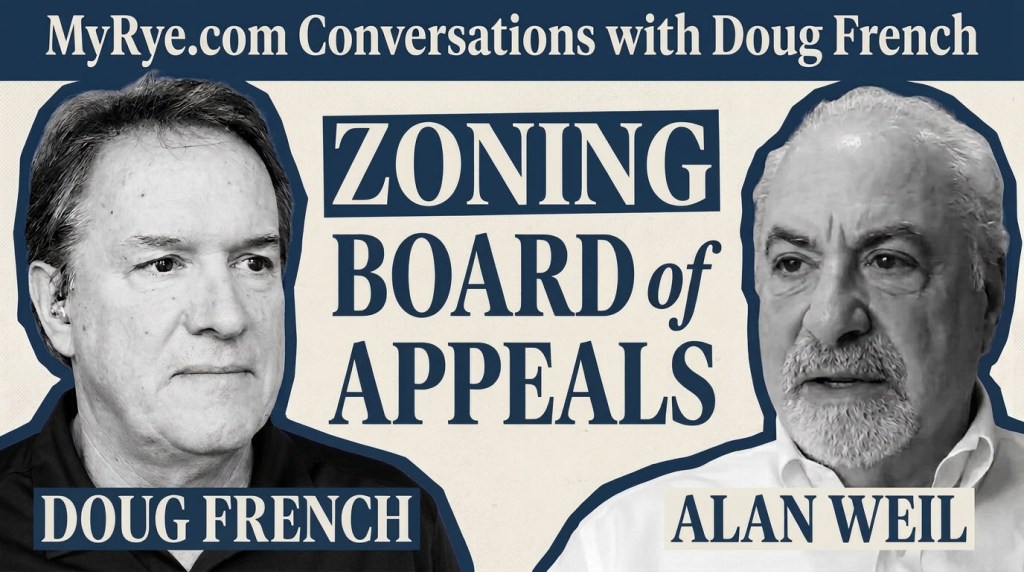
MyRye.com is now in the podcasting business with a weekly podcast hosted by former Rye Mayor Doug French. Available on all major podcasting platforms, MyRye.com Conversations with Doug French will tackle the larger and sometimes intractable issues impacting the City of Rye through interviews with local, county and state officials and business leaders.
In Episode 27 of Season 1, French speaks to Alan Weil, longtime chair of Rye’s Zoning Board of Appeals, for a practical conversation about how zoning decisions really work in the city. They break down the difference between the ZBA, the Board of Architectural Review, the Planning Commission, and the City Council, then dig into area variances, use variances, flood relief, and what neighbors can actually influence in the process.
This episode of MyRye.com Conversations with Doug French was produced by MyRye.com. Feedback and story ideas are welcome.
Main Topics Covered:
- Weil describes the ZBA as a quasi-judicial body that hears appeals when the building department denies a permit or when the Board of Architectural Review denies an application.
- French and Weil clarify that the City Council makes zoning law, while the ZBA interprets and applies it using New York’s legal standards.
- The conversation walks through the area variance balancing test, including the benefit to the applicant, detriment to the neighborhood, and the practical meaning of the five statutory factors.
- Weil distinguishes area variances from use variances, noting that use variances are extremely rare and require proof of unnecessary hardship and inability to earn a reasonable return.
- They discuss how the ZBA handles typical applications involving setbacks, lot coverage, floor area ratio, and building height.
- Weil explains how appeals of Board of Architectural Review decisions are reviewed under an unusually high standard, making it very difficult to overturn BAR denials.
- The discussion covers Article 78 proceedings, the legal challenge used when applicants or neighbors believe the ZBA acted arbitrarily or failed to apply the balancing test properly.
- Flooding becomes a major topic, with Weil describing how the city encourages house elevation and flood mitigation, especially in areas affected by Blind Brook and floodplain rules.
- French and Weil talk about how neighbor objections are handled, including adjournments, plan modifications, and informal negotiations that often resolve disputes before a final vote.
Timestamps:
01:13 – What the ZBA is and how appeals reach it
02:31 – Planning, BAR, and ZBA: how the boards differ
03:36 – The ZBA interprets law instead of making it
04:36 – The area variance balancing test in plain language
05:31 – Why the applicant’s motive matters
06:42 – Area variances vs. use variances
08:51 – Why use variances are usually a council issue
09:30 – Variances as a dialogue, not just a yes-or-no vote
11:08 – What a typical ZBA meeting looks like
14:08 – How ZBA appeals of BAR decisions work
15:34 – Why aesthetics get a very high legal standard
16:54 – Floor area ratio, lot size, and zoning math
18:14 – Article 78 challenges and judicial review
20:56 – Why zoning decisions matter for the long term
21:20 – Flood relief, FEMA rules, and house elevation
23:47 – The cost-benefit logic behind raising homes
24:18 – Wetlands buffers and flood-prone areas
25:59 – What makes a neighbor objection effective
28:54 – Common misconceptions about what comes before the ZBA
30:06 – One-word Q&A on variances, applicants, flooding, tear downs, and Rye
32:01 – Community service, board longevity, and volunteering
Watch:
Full Transcript [edited for clarity]:
Speakers
- MyRye.com, Doug French
- Alan Weil, Zoning Board of Appeals
MyRye.com, Doug French (00:05)
Welcome to the MyRye.com podcast, Conversations with Doug French. I’m your host, Doug French, former mayor of the City of Rye. And this podcast is about the issues and the people that impact Rye, the Sound Shore, and the surrounding Westchester region. Our goal is to inform you about what’s happening, why, who’s deciding, and what’s next on the local issues that matter most to you. All in 30 minutes, and we are here every week.
From the MyRye Studios. Today in conversation is zoning laws: your house, the house next door, and land use across the city, what the appeals process can change and what it cannot. Joining the conversation this week is Alan Weil, longtime chair of Rye’s Zoning Board of Appeals. Mr. Chair, welcome to MyRye.com.
Alan Weil, Zoning Board of Appeals (00:51)
Thank you, Doug.
MyRye.com, Doug French (00:52)
So if I call ya I’ll call Alan from now and not Mr Chair, but Alan,
Alan Weil, Zoning Board of Appeals (00:56)
Please.
MyRye.com, Doug French (00:57)
when you meet people and you say you’re with the Z B A, you’re chair of the zoning board of appeals, how do you describe what you do?
Alan Weil, Zoning Board of Appeals (01:03)
well the zoning board is a quasi judicial body like a court. we hear appeals from decisions made by the building department regarding someone who wants to build something on their property. And if the if what’s proposed doesn’t comply strictly with the provisions of the Rye City Code.
And within the Rye City Code are the zoning regulations that that govern land use in the city. if the proposed improvement doesn’t comply with the zoning code, then the building inspector denies the issuance of a building permit and the homeowner or the property owner can come to the zoning board and appeal that decision.
The other appellate jurisdiction we have is if a property owner goes to the Board of Architectural Review and they get denied by the Board of Architectural Review, then they can come to us and appeal that decision. So those are the two basic areas where
MyRye.com, Doug French (02:04)
Okay.
Alan Weil, Zoning Board of Appeals (02:05)
we hear appeals.
MyRye.com, Doug French (02:06)
So let’s parse out the differences between those boards. So essentially the planning department approves or the planning commission approves a site plan, the BAR or the architectural review board judges how it looks, and then you decide whether the code needs to bend. Is that
Alan Weil, Zoning Board of Appeals (02:21)
Exactly. The if the code restricts use of a property, either the location of improvements, because there are there are setback requirements creating a buffer between between improvements on property, or if it if the size of the improvement exceeds what’s allowable under the zone under the city code, then they can they can come to us
and appeal that determination and get relief and as you say bend the the rules a little bit to to either exceed the size limitations or to encroach upon the setback requirements.
MyRye.com, Doug French (02:58)
And I think I’m gonna do you and your board a big favor with this public service announcement. You do not make law. You’re actually interpreting the law. The council is the group that makes the law, correct?
Alan Weil, Zoning Board of Appeals (03:08)
Yes, that’s correct. that’s what I said off the top that we’re a judicial quasi-judicial body. we don’t make the law, the city council makes the law. the code is what it is, and the New York case law dictates how we act and the type of standards that we apply in determining whether or not to grant relief from the strict requirements of of the city code.
MyRye.com, Doug French (03:31)
So let’s get into the legal authority and where the gap is. So foundational is the law, it’s the New York area variance test, it’s the general city law eight one B. So what there are five factors. So what can you walk us through each factor in plain language and give a generic example of what those represent?
Alan Weil, Zoning Board of Appeals (03:46)
Sure, I’ll try. Fundamentally, it’s a balancing test that weighs the benefit to the applicant if the relief is granted, if they’re given the right to basically do something that’s outside the scope of what’s allowed by the city code against the detriment to the
community and the neighborhood if the relief is granted. And we look at there are five factors, but they basically boil down to that to that balancing test. Benefit to the applicant, detriment to the community. And and so we consider many things, environmental issues, we consider
what is motivating the the applicant’s request for the for the variants? So for example, in considering the benefit to the applicant, it’s one thing if we have a a young family in a small home in Rye and they want to expand and in order to expand and and build an addition to their home.
They need more space, they need another bedroom, they have a get as I said, a growing family, more children, whatever, and they want to stay where they are because they’re happy in the community. That’s a consideration, that’s one consideration. If it’s a builder who has acquired a vacant home and wants to build the biggest house he can possibly build so that he can make the most profit, that’s a different consideration. And so you know we do we do weigh these these factors and consider the specifics of the circumstance that is motivating the the the change in the home or the or or the building.
MyRye.com, Doug French (05:24)
Okay. So when I when I look at there are two types of variances. One is an area variance and then there’s a use variance. You are mostly looking at area variances, correct?
Alan Weil, Zoning Board of Appeals (05:33)
Correct. I would say in my many years on the zoning board, we’ve considered perhaps two use variances in in my entire time. And the the standard for use variances is different. It’s not the same balancing test that we utilize for area variances, which again are you sort of strictly location of the improvements. Do they encroach upon setback requirements that create buffers with?
adjoining neighboring homes or properties or size of the overall improvement. A use variance is something completely different. The applicant needs to show unnecessary hardship and they need to demonstrate that they can’t receive a reasonable return on the their ownership of the property.
if if they’re only permitted to use the property for uses permitted under the zoning code. So it’s a very difficult test. I mean they they really have to demonstrate that there’s a this economic hardship and that they can’t get a reasonable return on their investment in the property through you using the property for permitted use.
I think again, there was one instance on north on Purchase Street north of town, north of downtown, where the property owner wanted to have a Pilates studio or something like that. And the only thing that was permitted were medical office use. And
I think we granted a use variance in that case, but it’s it’s extremely rare.
MyRye.com, Doug French (07:08)
And normally if there’s a use variance, that would be kicked back to the council to change to create to pass a law, right, that would allow that that use. And a public hearing or all of that.
Alan Weil, Zoning Board of Appeals (07:16)
Yes. Yes.
MyRye.com, Doug French (07:18)
Okay. I’m just gonna run through the five factors on the area variants. One is the an undesirable change in the neighborhood or character. Two is can the benefit be achieved another way? Is the request substantial?
Physical or environmental conditions, we’ll we’ll get to flooding in a bit. And then is it self created? Is it something that you the an issue that you’ve created? So you you kinda look at these these different factors and do the balancing tests as you described.
Alan Weil, Zoning Board of Appeals (07:41)
Yes. And I think one thing that the the that the public should understand is that if you look at the history of my tenure on the zoning board, which is lengthy, we have denied applications very rarely have we denied applications. And the reason for that is that it’s a process, it’s a dialogue.
Many, many times applicants come to us with a large request. It’s a substantial request. There are alternatives that would would would require lesser variances. And we tell them that. We send them we send the applicant or their architect off and say, come back next month and modify your plans because we’re not going to approve what you’ve submitted. We’re going to deny it.
And if you want an approval, you’re gonna have to modify it and and ask for something less. And that happens again and again.
MyRye.com, Doug French (08:31)
Yeah, and that really leads right to our next topic is, a typical night. Now before before I jump to that, I just want to clarify when you say pseudo judicial, because you do sit under the executive branch, right? The three branches of government, but you do have a an appellate role and responsibility. So that’s what you mean by quasi judicial.
Alan Weil, Zoning Board of Appeals (08:47)
Correct. Exactly.
MyRye.com, Doug French (08:49)
So a typical night, so yeah, typical night is it’s a deck, a fence, a teardown, and in some cases you’re granting, in some cases you’re you’re offering suggestions to change, and sometimes you’re denying. just take us through a typical night, who’s in the room, yeah, how the whole process works.
Alan Weil, Zoning Board of Appeals (09:04)
Well, first I would say there is no typical night.
MyRye.com, Doug French (09:06)
Yeah.
Alan Weil, Zoning Board of Appeals (09:07)
we had a zoning board meeting last night and it was certainly not typical. But what happens is there are seven members of the board. and we sit in the same place in City Hall where the city council meets. And we have an agenda every month with applicants applications that are that are submitted on a time schedule in advance of the meeting and and the applications are all available and can be viewed by the public by going to the city clerk’s office and so in the audience are applicants sometimes they’re represented by counsel
Sometimes they are usually more often than not, they’re not represented by a lawyer, they’re represented by their architect. And their architect makes the presentation to us. And then it’s a public hearing. It’s an open public hearing. So neighbors are are notified as part of the application process within a radius of the subject property and the public can attend. And
many, many meetings. few neighbors are present and there’s little controversy. On occasion there are there are controversial applications that are objected to by neighbors and there’s significant
neighbor participation in the process. in with every application, we first hear the applicant and they present what they’re asking to do. And then we ask if anyone wishes to speak on the application and anyone who’s present is welcome to to speak. Sometimes neighbors go into issues that are not relevant to the application and not relevant to zoning.
typically you know there’s just a basic either support for the applicant because they think that the improvements that are proposed are beneficial to the neighborhood, or there’s a there are objections because they don’t like what’s being proposed.
MyRye.com, Doug French (11:06)
so if it’s in council chambers, are the cameras on or or it you have to well have to attend a
Alan Weil, Zoning Board of Appeals (11:10)
It yes. Yes, the cameras are on and it is recorded.
MyRye.com, Doug French (11:14)
do you often override the the other boards like the BAR that you mentioned?
Alan Weil, Zoning Board of Appeals (11:19)
Well, the code the the code is very specific about our appellate jurisdiction for the board of architectural review and the standard of review is it is written in such a way that it’s almost impossible for for the zoning board to uphold a denial by the Board of Architectural Review.
the standard is surprisingly and this is in the city code, the standard is a criminal law standard. The Board of Architectural Review has to have established beyond a reasonable doubt that the harmful effects of what’s being proposed by the applicant before the Board of Architectural Review is is going to result. And again, in my tenure, I don’t think the Board of Architectural Review has established beyond a reasonable has ever established beyond a reasonable doubt that the harmful effects are resulting from the proposed renovation or building.
MyRye.com, Doug French (12:14)
That’s interesting. that is the criminal standard. It’s not the civil standard, it’s the criminal standard. Yeah, okay. Well
Alan Weil, Zoning Board of Appeals (12:18)
Yes. And look,
I think that the reason for that is my view is the reason for that very high standard is the fact that the Board of Architectural Review is making judgments about aesthetics and that’s not what the zoning law is about. The zoning law the basis for the zoning law is the police powers clause of the constitution and the police powers clause
I’m paraphrasing, basically provides that government is permitted to regulate things in order to protect the health, safety and welfare of the public. And aesthetics has nothing to do with the health, safety and welfare of the public. It’s a personal judgment. And so the code sets this very, very high standard that really, you know, almost makes impossible a successful upholding of a denial by the BAR.
MyRye.com, Doug French (13:12)
That’s very interesting. the other thing I want to get to before we get to Article 78 are the floor area, height, you know, isn’t there a math equation on that? Can you explain that? the variances.
Alan Weil, Zoning Board of Appeals (13:23)
Yes, it’s it’s basically the relationship with the size of the lot, the size of the property and the number of square feet that can be built based upon the size of the property. it and the zoning the code, the city code sets a ratio for different zoning districts.
So, there are commercial zoning districts, there are residential zoning districts, and there are multiple zoning multiple residential districts, for example. And in some areas lot sizes can be smaller. And in other areas, like the area on Milton Point down by near the clubs, the lots required lots are larger. And so a different ratio is set depending upon the the zoning area.
MyRye.com, Doug French (14:09)
Okay, okay. one of the things that the public does not realize is the litigation you protect the city from, I think in some of your decisions, because it’s called an article seventy eight as I as I recall, where somebody can bring litigation against the board for acting arbitrarily. Can you explain kind of the article seventy eight and the risk that poses?
Alan Weil, Zoning Board of Appeals (14:26)
Yes. the applicants if we if we take action at the zoning board and applicants disagree, or if affected neighbors disagree with with the action we’ve taken, they have the right to bring an Article seventy-eight proceeding. What that is a lawsuit, a legal action that goes to the New York State Supreme Court, which it’s called the Supreme Court, but it’s the lowest court in in in the state of New York. And they have the right to appeal a determination by the zoning board. and yes, you’re you’re right. The the standard for that appeal is that they have to show that the zoning board acted arbitrarily and capriciously and outside the scope of its authority and didn’t
properly apply in the case of an area variance, didn’t properly apply the balancing test. And I again in my long tenure on the zoning board, we’ve had a handful of Article 78 proceedings. all but all but one proceeding which is still ongoing actually all but all but one proceeding has successfully upheld the actions of the zoning board. so and the one that is still pending, I think is is up on appeal at the highest court in New York.
MyRye.com, Doug French (15:37)
Right.
And that that’s the importance of of really building a record of why your decision was made the way it was with the balancing test.
Alan Weil, Zoning Board of Appeals (15:43)
Yes, correct. And there have been times when an Article seventy eight was brought and the and the court sent the case back to the zoning board and said you didn’t properly explain your reasoning in the application of the balancing test and we need you to elaborate and we’ve done we’ve done that. And it’s gone back to the court and then it’s been upheld.
MyRye.com, Doug French (16:04)
Alright, so let’s take a quick pause so I can remind our audience. If you have a topic or person you want to hear on MyRye.com podcast, Conversations with Doug French, email me at French at MyRye.com or just tell me around town. We are here every week for 30 minutes on Apple Podcasts, Spotify, iHeart, and YouTube. You can access us directly via those formats or find us at MyRye.com for all those formats, transcripts and local news.
These conversations don’t expire like the one we’re having today. This is great knowledge. It doesn’t expire. I think Alan’s been chair for more than 10 years, so it definitely does not expire. Everything he’s saying is timeless. So please share or subscribe this podcast or send a question for a previous guest, and we will provide an update here. No conversation is complete in Rye if we do not talk about flooding.
Can you talk about how the board also hears relief around the floodplain rules, or if I’ve got that correctly? people are lifting houses and they’re looking for variances. Just a little bit about flood relief.
Alan Weil, Zoning Board of Appeals (17:05)
sure. I you know, obviously it’s a it’s a serious problem in Rye that has existed for many, many years. And it might have been during your tenure as mayor. I don’t recall exactly, but there was a joint board process where the planning commission, the zoning board, and the board of architectural review
and the city council got together and and t and talked about flooding. It may have been after Sandy. But it’s it’s a continuing problem. And what was decided both by the city planner and the council and the various boards is that the board should do everything possible to encourage people to mitigate the problems of flooding. And the really the only way to do that is to elevate and raise houses and to comply with FEMA regulations, which are federal regulations about flood areas. and to comply with FEMA, for example, in certain neighborhoods, you look at Indian Village, for example, many, many
homeowners have have elevated their houses and raised them and and we grant relief from the from the city code zoning relief both in floor area ratio and and setbacks and building height requirements. we we generally grant that relief in order to encourage people to elevate their homes to prevent the damage that occurs when flooding occurs and
And it’s mostly it’s mostly along Blind Brook in the city, but it’s it’s also other areas. it’s increasingly we’re you know, we’re finding that storm surges occur and damage occurs and so people are dealing with it and and we grant relief so that they can deal with it.
MyRye.com, Doug French (18:53)
Yeah, and the theory behind or the the idea behind raising the homes is when we did the cost benefit analysis, the airport is four to five hundred feet above us. So we’re downhill, water runs downhill. And the cost benefit to to retain the water upstream or just raise the homes was was totally
different. it was so so much lower to to raise the homes that are impacted versus building the retention upstream. So that’s the theory behind the whole model and it seems to be to be working.
Alan Weil, Zoning Board of Appeals (19:21)
Yeah, I agree. It’s it seems to be working. And I also think the other area is of course there are floodplain areas because being on the Sound, where there are buffers basically that are required in order to keep improvements away from a flood prone area.
And sometimes we’ve granted relief where there’s really no alternative to the property owner other than to encroach into that wetlands buffer. we do everything we can and the planning commission does everything they can to try to protect the wetlands and not have improvements encroach into the wetlands buffer, but
again we’ve had applications where we’ve coordinated with the Planning Commission where they have encouraged the zoning board to grant relief and permit encroachments into a wetlands buffer area because the alternatives are would be worse for the wetlands.
MyRye.com, Doug French (20:17)
Okay, okay. so in our last segment, before we get to our one word Q and A, we’re gonna talk about the neighbor. And it’s interesting because the neighbor, we all have them and we all are one in some degree. So the neighbors just can’t show up and say, I don’t like this. I mean so what is an effective neighbor argument or what should they what should they understand going into if they did it want to speak on a matter?
Alan Weil, Zoning Board of Appeals (20:39)
Well, the neighbors can come in and say they just don’t like it. And they do sometimes. But look the I think the most effective argument is that permitting the relief from the zoning code is going to create a detrimental effect on the on the neighborhood and that it will set a precedent in a way that would permit others to grant to obtain similar relief and would sort of damage the character of the community. And neighbors object all the time and what we try to do as a board is is encourage the applicant to modify their plans in a way that mitigates the effect
the negative effect on the objecting neighbor and to basically make peace between neighbors. Our goal on the board, at least since I’ve been on the board, has been to try to make peace in a neighborhood and again, balance the benefit to the applicant or what’s motivating the applicant’s desire to make the modification to their home.
whether it’s because they have a growing family or whatever it is, and the neighbors objections to the to the improvements. And so very, very frequently we’ve managed to either through adjournment to encourage a dialogue between the neighbor the objecting neighbor and the applicant or through even sometimes interrupting the application and and telling them to that we’ll put them on second call at the end of the agenda and let them go out of the room and have a discussion at to
MyRye.com, Doug French (22:12)
Right.
Alan Weil, Zoning Board of Appeals (22:12)
to sort of work it out. and I would say nine times out of ten, the applicant and the neighbors have managed to work it out. And whatever the objection was, it’s mitigated and all is well. Sometimes you can’t satisfy an objecting neighbor and in those instances again we have to apply the balancing test and if it weighs in in favor of granting relief to the applicant, then we grant the variance, notwithstanding the objection.
MyRye.com, Doug French (22:38)
Right. That’s interesting.
That’s very interesting. I know there was a big complaint when I was in office about the communications process. Are you still hearing that, that people just aren’t aware of what’s happening in these applications?
Alan Weil, Zoning Board of Appeals (22:49)
I think that there’s some there’s some misunderstanding in the community about our process and there’s some misunderstanding about exactly what is permitted by code and things that never come before the the zoning board. you know hundreds of changes occur in town or developers build things as of right, meaning they are they’re complying with the code and they never come before the Board of Appeals. that’s really I think the biggest misconception is that everything goes before the the Board of Appeals whenever any anyone wants to build something on a property. It’s not the case. in fact most new development happens as of right and is permitted by code and complies with the requirements, the setback requirements and the FAR requirements.
MyRye.com, Doug French (23:37)
Good to know, good to know. all right, so in our last segment is gonna be our one word QA where it’s kind of a word association. I give you one word, you tell me in one word
Alan Weil, Zoning Board of Appeals (23:45)
Ha ha.
MyRye.com, Doug French (23:45)
what your reaction is. so the word is is variance.
Alan Weil, Zoning Board of Appeals (23:48)
Well, again, I think that variances are about granting relief from a law that restricts a person’s ability to use their property in the way they want to use their property and build what they want to build on their property. And you know, in in our country, a lot of weight gets put on an individual’s property right and
so Variances is really just an avenue for relief saying that the restrictions either are too stringent or shouldn’t apply because of special circumstances.
MyRye.com, Doug French (24:20)
So the one word answer would be relief. It’s a one word Yeah, yeah, yeah. It’s one word. All right. All right. So so so yeah, yeah. A
Alan Weil, Zoning Board of Appeals (24:24)
is that what we’re doing here? I’m sorry. I’m sorry. Okay. One word answer. One word answer. Wow.
MyRye.com, Doug French (24:31)
the next word is applicant.
Alan Weil, Zoning Board of Appeals (24:32)
Wow. one word.
homeowner.
MyRye.com, Doug French (24:35)
flooding.
Alan Weil, Zoning Board of Appeals (24:35)
Problem.
MyRye.com, Doug French (24:36)
Tear down.
Alan Weil, Zoning Board of Appeals (24:37)
Change.
MyRye.com, Doug French (24:37)
And the last one is Rye
Alan Weil, Zoning Board of Appeals (24:39)
Hometown.
MyRye.com, Doug French (24:39)
And it is a community for sure. Well, Alan, I wanna thank you. It was great to speak with you. You get your insights and all of your expertise and service to the board all these many years. I think it’s ten plus as I recall as chair and I think you’ve been on the board longer than that with I think Ted Dunn appointed you.
Alan Weil, Zoning Board of Appeals (24:55)
He did. I joked with the city planner and the corporation council last night that I was going to announce on this podcast that I was resigning from the zoning board because I’ve been on way, way too long. I think that I hope that people hearing your podcast are encouraged to get involved with community service because that’s really the problem. I’ve been on the board for so long because there just aren’t enough people willing to get involved and and do community service. and if anybody wants to volunteer to take my place, please
MyRye.com, Doug French (25:26)
Well that’s a great final thought about community service.
Alan, again, thank you. It was it was a pleasure, great insights. and to our listeners, you can find all podcast episodes, transcripts, local news, and more at MyRye.com. please subscribe wherever you get your podcasts, and please spread the word as we build our audience. Thank you again for listening to the MyRye.com podcast, conversations with Doug French. We are here weekly for 30 minutes.
And we will see you next week. Thank you.
