

Holding Court is a series by retired Rye City Court Judge Joe Latwin. Latwin retired from the court in December 2022 after thirteen years of service to the City.
What topics do you want addressed by Judge Latwin? Tell us.
By Joe Latwin

Private roads are enshrined in New York’s Constitution. Article 1, section 7 (a) says “Private property shall not be taken for public use without just compensation. Section 7(c) says “Private roads may be opened in the manner to be prescribed by law.” New York Highway Law § 300 provides that a private road may be established by making an application to the Superintendent of Highways. Within 30 days of the approval of the private road, the owner or applicant may ask the County Court to confirm the Superintendent’s decision to permit the private road.
Every private road, when laid out, must be used for the uses set forth in the application and not converted to any other use or purpose other than a road. Even the owner is not permitted to use the road as a road unless it was signified as the intention to do so in the application.
The most common method of creating private streets is by subdivision. Every property to be subdivided must have frontage on and access from a street on the Official Map, which street is suitably improved before subdivision approval may be granted by the Planning Commission. Rye’s Code sets forth the requirements for such roads. The road must be suitably located, of sufficient width and adequately improved to accommodate the prospective traffic and to afford satisfactory access to police, firefighting, snow removal or other road maintenance equipment. The Code sets forth a 50-foot minimum right of way of which 30 feet in width must be paved and have a maximum grade of 8%.
Once the subdivision plat is approved, it gets filed with the County Clerk. The filing of the plat constitutes a continuing offer of dedication of the road to the public. The City ordinarily will not accept dedication unless the road is built to acceptable standards with all the usual improvements (fire hydrants, sewers, curbing, street lighting, drainage, etc.) and maintained to current standards.
Most times, a road created in a subdivision is conveyed from the owner to the adjoining property owners usually to the center line of the road. Sometimes, a road is not conveyed from the owner and ownership of the road will remain with the developer that likely will have gone out of business after completion of the development. It becomes a rabbit hole to try to track down who owns the street. Ownership is important since liability for those injured on the road may be the responsibility of the owner and it comes with other burdens.
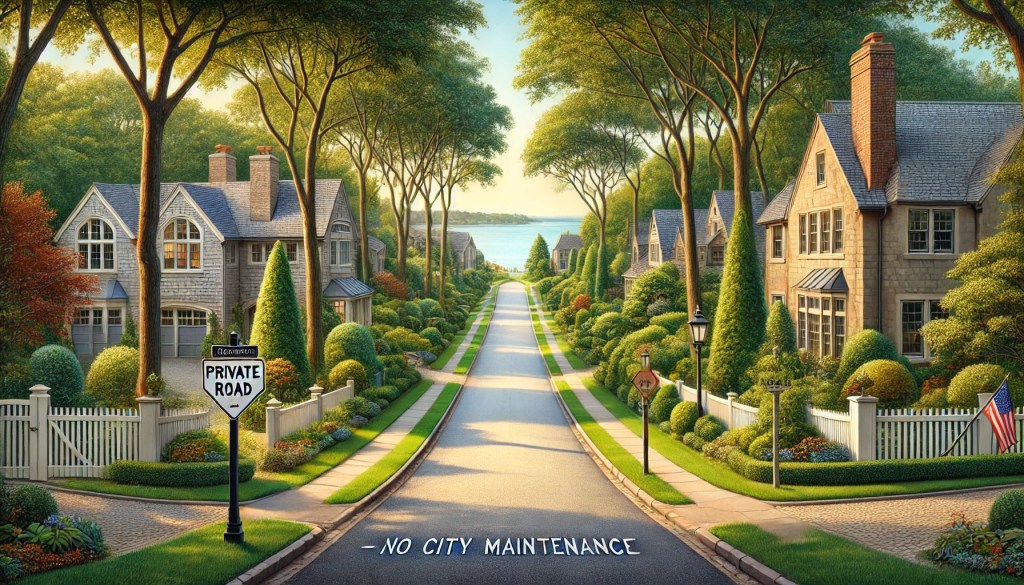
The City does not generally provide services on private roads. The owners are responsible for maintaining the road, clearing snow and ice from it, and getting any garbage/recyclables for collection out to a public road for DPW to collect. If there are multiple owners of the road, they must share the road, hopefully according to a previously written agreement. Otherwise, one or several owners might have to pay for the maintenance and chase the recalcitrant nonpaying owner for their share of the costs. Not a good way to meet your neighbors. This is why some private road owners petition the City to have the road made public.
