

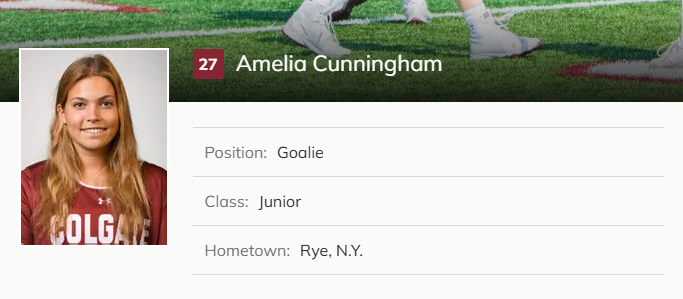
Rye High School ‘20 graduate Amelia Cunningham has filed suit against Colgate University alleging the university ignored abuse by its women’s lacrosse coach Kathy Taylor, who overtrained student-athletes to the point of injury, harassed them, and forced them to play while hurt. That abuse eventually led to over twenty players leaving the team and three players attempting suicide, the complaint alleges. Cunningham, the daughter of Rye City Councilman Keith Cunningham, was recruited to play Division 1 lacrosse at Colgate beginning in the fall of 2020 and offered a 50% scholarship.

The case, filed in New York State Supreme Court on December 22, 2025, asserts that the university failed to protect her and other athletes from abusive, discriminatory, and negligent conduct that caused lasting physical and emotional harm. Cunningham was a standout goalkeeper at Rye High School and after being recruited, committed to play at Colgate during her junior year at Rye.
“Colgate should have known that Coach Taylor’s tactics were hurting players,” said Carolin Guentert, partner at Sanford Heisler Sharp McKnight, the law firm representing Cunningham.
Yet the school kept her in her position of power. Our Complaint sets out Colgate’s failure to protect Ms. Cunningham from physical and emotional harm. College athletics are supposed to enrich a student’s life, not endanger it.”
Injuries and Health Impact
Cunningham’s lawsuit details her experience under Taylor’s leadership, beginning with a significant wrist injury during her freshman year. Rather than encouraging proper medical evaluation and rest, the complaint alleges the coach discouraged her from seeking surgery, saying she would be letting down the entire team, ultimately allowing the injury to worsen. It was only after the season that Cunningham sought surgery—by then, according to the complaint, the injury had deteriorated to a point that limited her recovery. The injury made basic tasks like driving, typing, and writing cumbersome and painful and likely ended her dream of becoming an orthopedic surgeon.
The complaint further alleges that Taylor forced Cunningham to continue playing through bronchitis and other illnesses, which led to prolonged health issues, including contracting Epstein-Barr virus and developing post-obstructive reactive airway disease that required ongoing treatment and an inhaler. Over the course of her collegiate career, Cunningham reportedly underwent five surgeries related to lacrosse-related injuries before age 23, leading to chronic pain, numbness, and ongoing physical limitations.
Mental Health and Emotional Harm
The complaint paints a troubling picture of Cunningham’s mental health during her time at Colgate. It alleges that the relentless pressure, fear of injury, and lack of institutional support contributed to a decline in her academic performance and emotional well-being.
In the fall of 2022, the complaint states, Cunningham attempted suicide, becoming the third former player from the team to do so during Taylor’s tenure. She survived and has since been diagnosed with major depressive disorder and trauma- and stressor-related disorders, which her lawyers attribute substantially to the environment fostered by the coach and the university’s inadequate response.
Coach Taylor left Colgate in May 2024 even though she had two years remaining on her contract.

Claims Against Colgate University
The lawsuit asserts multiple legal claims, including:
Negligence in hiring, supervising, and retaining Coach Taylor, creating an unreasonably dangerous environment in a sport;
Breach of contract and the implied duty of good faith and fair dealing, including allegations the university retracted Cunningham’s athletic scholarship partway through her education;
Disability discrimination under the New York State Human Rights Law, claiming the university’s response to her physical and emotional injuries failed to meet legal obligations; and
Violations of Title IX and state human rights laws related to discrimination based on Cunningham’s perceived sexual orientation and treatment by the coach.
The complaint requests a jury trial and seeks damages related to Cunningham’s physical and psychological injuries, medical costs, lost future earnings, and other compensation traditionally awarded in such civil rights and negligence actions.
Read the 49 page complaint filed with the court.
