

MyRye.com is entering the podcasting business with a new weekly podcast hosted by former Rye Mayor Doug French. Available on all major podcasting platforms, MyRye.com Conversations with Doug French will tackle the larger and sometimes intractable issues impacting the City of Rye through interviews with local, county and state officials and business leaders.
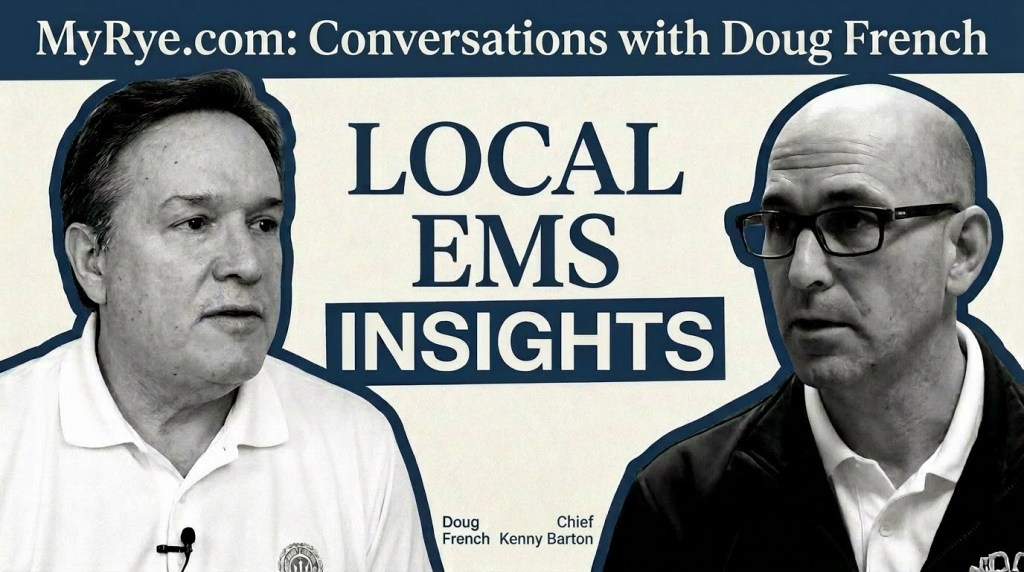
Our Episode 6 of Season 1, French speaks with Chief Kenny Barton of Port Chester-Rye-Rye Brook EMS to explore the operation, challenges, and technological advances of EMS services in Rye and neighboring communities.
Main Topics Covered:
- The scope and scale of Port Chester-Rye-Rye Brook EMS’ system, including staffing, fleet, and coverage areas.
- How technology (like AI and advanced communication tools) is transforming EMS services.
- The importance of community involvement, personal preparedness, and CPR training.
Key Insights:
- Kenny Barton has been in EMS for over 36 years and emphasizes timely activation (calling 911) to improve outcomes.
- Rye EMS handles around 6,400 calls annually, primarily in Port Chester, Rye, and Rye Brook.
- The EMS fleet includes 7 ambulances and 2 fly cars, stationed at Port Chester headquarters.
- The system is a highly collaborative, shared service model among Rye, Rye Brook, and Port Chester, with over $5.4 million annual budget largely funded through billing and municipal contributions.
- Technological advancements include real-time patient data transmission, powered movement equipment, and the emerging role of AI.
- Recent success stories include a five-resident survival rate in out-of-hospital cardiac arrests, thanks to rapid response and coordinated care.
- Community training programs for CPR and AED awareness are actively promoted to boost survival chances in emergencies.
- Challenges include aging facilities, space limitations, and upcoming population growth from new developments.
- The podcast concludes with ways residents can get involved in EMS training, donations, and preparedness.
Timestamps:
00:00 – Welcome and episode overview
01:10 – Chief Kenny Barton’s EMS background
01:32 – First steps during an emergency
02:53 – EMS response logistics: fleet and staffing
04:11 – Call volume and community demographics
05:17 – Coverage area and challenges of a dynamic region
06:01 – Technology in EMS: dispatch, data, and AI
07:01 – Hospital choices and patient transport decisions
08:44 – Understanding 911 call routing and cell phone challenges
09:32 – Role of AI in EMS
10:31 – Equipment innovations improving safety and efficiency
11:39 – Community success stories: cardiac arrest survival
12:59 – Community feedback and emergency coordination
13:15 – Community collaboration and shared service success
15:23 – Funding, municipal support, and budget breakdown
16:55 – Growth impacts and future planning
19:27 – Facility challenges and expansion plans
20:49 – Personal safety, CPR training, and community involvement
22:16 – How to get involved with EMS volunteering and training
23:02 – Donation options and supporting EMS services
Resources & Links:
- Read: MyRye.com: Giving Rye: Meet Port Chester-Rye-Rye Brook EMS
- Port Chester-Rye-Rye Brook EMS
- American Heart Association CPR Training
- Westchester Community College EMS Programs
Support and Donations:
Watch:
Full Transcript:
Speakers
- MyRye.com (Doug French)
- Chief Kenny Barton
MyRye.com: Welcome to the MyRye.com podcast, Conversations with Doug French. I am your host, Doug French, former mayor of the City of Rye. And this podcast is all about the issues and the people that impact Rye and the surrounding region. Today in conversation, have EMS Chief Kenny Barton of the Rye-Rye Brook-Port Chester area. Chief, welcome to MyRye.com.
Chief Kenny Barton: Thank you for having me, Doug. I appreciate the opportunity to speak with you.
MyRye.com: Absolutely. And the reason why we wanted to talk to you is because, you know, this time of year, there’s people getting lot more active. So emergencies can happen. We’re also seeing that seniors are living at home longer, staying at home longer. So, you know, we want the audience to walk away with really three fundamental points. One is, what is our local EMS services? What are they all about? Are they sufficiently prepared? And what can I do as an individual to prepare for an emergency should it happen and are there steps I need to be taking for myself to prepare for those situations. So those are some of the takeaways we’d like to see. Your background will be on the MyRye.com site, but just to kick off, how many years have you been in the EMS business?
Chief Kenny Barton: I started when I was 15 years old, I’ve been in EMS for, this is my 36th year in business.
MyRye.com: Okay, very good, very good, very good. So just to paint a picture for folks, hypothetically speaking, and thank you hypothetically, let’s say I wasn’t feeling well and something came over me, I knew there was an emergency situation, what’s the first thing I should do?
Chief Kenny Barton: You know, think one of the first things is, you know, just to sort of take stock of how you’re actually feeling. And if this is a significant change from anything that you’re acclimated to, you know, it really is appropriate to reach out and get us started toward that problem. I think a lot of people hesitate to call 911. I think there’s an inherent fear that a lot of people have that if the ambulance shows up that they are going to be forced to go to the hospital. And that’s not really the case. Staff will certainly advocate to take someone to the hospital if we feel it is absolutely imperative for them to go and seek more definitive treatment and evaluation from a physician. But we can always de-escalate that situation too and sort of, you know, check off people’s concerns and make sure that they are safe to remain at home if that’s what they would prefer to do. So getting rid of that hesitation is a key, it seems to me to be a key element. You know, a delay in activating us, a delay in starting care can have significant consequences. you know, it’s one of my talking points is to just, is to get that hesitation out of the way. We’re happy to come. The crew is happy to go back in service. If there isn’t work to be done, that is necessary. But we are the right resource if there really is a medical problem that’s happening.
MyRye.com: So that’s great. So let’s get behind the 911 call and get into some of the meat, potato, so to speak, logistically how this works. So let’s talk about the fleet and manpower. So how many folks do you have? How many ambulances? Where are they stationed? Those types of things.
Chief Kenny Barton: Yeah, so currently we have a staff of about 45 total between EMTs and paramedics. We have a fleet of seven ambulances currently and two paramedic fly cars. All of our vehicles are equipped at the level of advanced life support. So the paramedic level care responds out of this building with every call for service that we receive.
MyRye.com: and where they are stationed.
Chief Kenny Barton: Everything currently is stationed at our headquarters, which is in Port Chester on Ellendale Avenue. That’s our main base of operations.
MyRye.com: And one of the trends we’re seeing is this paid versus volunteer. What’s the nature? What’s the makeup of the staff?
Chief Kenny Barton: So our last volunteer left the building in about 2011.
MyRye.com: wow, okay.
Chief Kenny Barton: Our service call volume is just, it’s such that it doesn’t, we could not support the volume of calls here with volunteer staffing. We have to make sure that we can get the ambulances out the door, out the door quickly when emergencies happen. From a call volume perspective, last year, we are one of the busiest agencies in the county. did over 6,400 calls for service in 2025.
MyRye.com: Well, I was mayor from 2010 to 2014, hence 2011 was my last. So there you go. That’s the nature of this interview is to get everybody up to speed. So 6400 Calls, how does that break down by the various communities?
Chief Kenny Barton: You know, it’s reasonably split by the population, I would say. Port Chester certainly has the lion’s share of the calls with the biggest proportion of our population, followed by Rye and then by Rye Brook. There’s a large senior population in all three of our communities, so that demographic certainly helps the call volume get to where it is.
MyRye.com: And how many square miles are we talking about? Are we talking about the major highways in and around the area? How does that impact your coverage?
Chief Kenny Barton: Yeah, we have a sort of a unique coverage area. Geographically, we don’t have a really big footprint. Portchester being only two square miles. Rye and Rye Brook, you know, the actual land portion of our coverage area is not significantly greater in either of those two communities. But it’s a very dynamic area. You know, as far as the county is concerned, you know, we have an amusement park. We’re the primary coverage entity for the Westchester County Airport. We have I-95, I-287, we have a section of the Hutchinson River Parkway. So there’s a lot of variation in the types of calls that our staff experiences daily and then throughout the year.
MyRye.com: Is it a typical day?
Chief Kenny Barton: There’s never a typical day. I think that’s one of the things that appeals to people that do this work is that, you know, you sort of every day you hit the reset button when you come in and you
MyRye.com: Right. Right.
Chief Kenny Barton: You never know what you’re gonna expect. An average day with that call volume that we mentioned earlier, we’re doing roughly 16 to 20 calls a day for service within the area. A quiet day could be certainly down in the single digits, but a busy day and our busiest days, we’ll get over 35 calls. So there’s a lot of hustle that happens on those particular days.
MyRye.com: Gotcha. And how is technology changing the EMS world in terms of dispatch, mapping, finding locations, translations, Reporting metrics, AI. Can you speak to those, how technology is changing?
Chief Kenny Barton: Yeah, you know, think our ability to interact with our hospital facilities, our receiving facilities, is probably one of the biggest things that our technology has allowed us to do. we’re able to record patient data in the field with our monitoring devices and then we can transmit that data directly to a physician at a receiving hospital, follow that up with a phone call to have a conversation about what’s happening with that person or any suspicions. And it helps to, especially with certain critical problems like heart attacks and strokes, which are very time sensitive, that we are giving the hospital significant advance notice of that problem coming in and they make significant preparations in advance of the arrival of that particular patient.
MyRye.com: And how do you choose Greenwich or White Plains? You service both, correct?
Chief Kenny Barton: We do. Currently, the majority of our patients do prefer Greenwich Hospital, and it is generally patient discretion is how we’ll make the decision on where to transport a patient unless there are specialty care needs that are identified. Trauma, stroke, heart attack, are certain facilities have more capabilities than others. So we will discretionarily certainly advise patients on where to go. with certain problem sets.
MyRye.com: So what about the nature of the phone call? The 911, does it go to the Rye PD How does that route correctly?
Chief Kenny Barton: It’s a great question and it’s something that I think is really important for residents to understand how that situation works. When 911 first became a thing, everybody was using a landline telephone. Landline telephone is… That’s the best way to go. It’s the most reliable phone call. It goes directly to the closest public safety answering point, which, based on our structure of our system, is our local police department. I think the thing that people need to be aware of and have a better comprehension of is what happens now when we reflexively pick up the cell phone. The Rye community is one of the interesting locations for the cell phone call because of the proximity to the Long Island Sound and sort of open water. There are often times where that initial phone call from a Rye resident could go across and end up being received in Long Island. And the first interaction that person is gonna have is with a state police dispatcher from Long Island who then needs to understand the origin of that phone call is not in Long Island. It is coming from Westchester County, which then prompts a transfer of that phone call to state police in Westchester, who then screen it to determine police, fire, EMS needs or some combination of those resources. And when it’s determined that EMS is what is being requested for that particular service, the call then gets forwarded again to the local dispatch center in Westchester County, which is called 60 Control in Valhalla. That can lead to a multi-minute delay in getting our resources mobilized. Just because the caller is speaking to a dispatcher does not put our wheels in motion. So the best solution locally is to call the police department directly. Again, from a landline telephone, that would be by calling 911. But from a cell phone, certainly at least have the wherewithal to quickly navigate with the person that receives that call to get a quick understanding of where the problem is so that resources get mobilized quicker.
MyRye.com: So in Rye, for example, it’s 967-1234. Right, and so we’ll make sure we get the numbers of all the areas posted here. so, yeah, cell phone coverage, that’s a topic I covered last episode with the mayor. So we’ll get into that another time with another guest. But that’s a great, great insight there. What about AI and the use of AI? Is that able to help assist in providing your services?
Chief Kenny Barton: Correct. The technology is certainly up and coming. We haven’t seen a lot of it introduced into our actual patient care applications at this point. Certainly on the charting and documentation side, AI is definitely becoming a tool that we utilize. But as far as our clinical performance in the ambulance, AI still hasn’t really, hasn’t found us yet.
MyRye.com: I know the police chief was saying how they’re able to, with their body camera, get a report generated of the incident, also have it translated, help in translation, so things of that nature. Is there technology you have today that you didn’t have maybe five years ago that’s really helped the quality of service and the speed and efficiency?
Chief Kenny Barton: Yeah, the biggest change is probably with all of our patient moving equipment, our stretcher, a device called the stair chair, which is what we use to take people up and down a staircase that are unable to walk. Those devices have become powered equipment over the past decade or so. It saves the providers on the lifting side with their backs. It saves us on the liability side with certainly riskier maneuvers with manually moved equipment, causes a lot more strain on the provider and certainly has more risk associated with it. So those technologies have been very helpful there.
MyRye.com: I know when I was mayor, one of the models that we would always put forward was the local EMS. And that’s how coordination between Rye, Rye Brook, Port Chester really came together in terms of funding coordination, the level of service. It’s just, I hear nothing but great things. So let’s go, let’s put some personal stories behind this. So if you, I know the teams won a bunch of awards this past year. Can you paint a picture for the audience around? emergency situation, the nature of the situation and the personnel about the person and what they did.
Chief Kenny Barton: I think our greatest accomplishment in the past year in 2025 was with our cardiac arrests. Out of hospital survival for those events is a very small percentage most of the time. And last year we actually had five out of hospital survivals where people were able to resume function following a complete and full cardiac arrest event, you know, those are very intensive calls. There’s extremely time sensitive as far as preserving brain and heart function. And somebody, once they stop breathing and the heart stops beating and… way our system is structured with our dual response with the police departments, we get resources to those problems very quickly. And that enables us to increase survivability for our residents, that’s, I can’t think of a better objective for what we do than making sure that people are able to go back to their daily living after having an event like that.
MyRye.com: That’s terrific. That’s terrific. And so before we go on, I just want to remind the audience, if you have a topic or a guest that you would like to hear on the MyRye.com podcast, Conversations with Doug French, just email me at French at MyRye.com or just let me know on the street and we will make sure we get that worked in. So we’re going to pivot a little bit. And just maybe if you give me a one word answer or a one word rating, so I’ll throw a topic out there. And so, for example, this podcast, you could say, excellent or you could say informative, right? So I’ll throw out some topics and you can just give me your reaction. I can do a follow-up. How about, what would you say about the coordination of the three local government officials in Rye, Rye Brook and Port Chester?
Chief Kenny Barton: fantastic.
MyRye.com: All right, you want to elaborate on that a little bit? Why is it fantastic? Okay.
Chief Kenny Barton: I can elaborate on that one a lot. We have a very unique system. The shared service model that we’ve had in place for now almost 30 years is really becoming a model for EMS agencies throughout the state. Since the COVID pandemic in 2021, there was a massive attrition of providers, paramedics and EMTs in the pre-hospital world. People were scared. People took a lot of risk and exposed themselves to a pretty scary situation. without knowing a lot about what the possibilities were. And a lot of people did step up to the plate, but we certainly lost a large number of providers who just said that this field wasn’t going to be for them after having that experience. And so the state has started to try to focus on how to improve EMS delivery throughout the state. It’s very fractured and very segmented depending on exactly where you live, including within Westchester County. But our shared service model has been extremely successful. We are a 501c3 not-for-profit that is contracted by the three municipalities for service, but we have a very close working relationship. We have direct oversight via an EMS committee, which is comprised of each of the municipal managers from the three communities, as well as one citizen at large from each of the three communities. we meet quarterly, we report on our response statistics, on our financials regularly. So it’s a very open book relationship that has served everyone well in this process. And there was some legislation that came out in January of this year that the governor signed that is now mandating counties to look at their EMS systems in part and in total to identify areas that need improvement. And I can say that our service model and specifically our service is being modeled throughout the county and across the state for how we’re performing.
MyRye.com: That’s great to hear. That’s great to hear. Most municipalities want to just have everything for themselves and just do everything for themselves. So it’s great that the communities, especially in this populated area, work so well together. Okay, continuing with our little one word answer, funding levels.
Chief Kenny Barton: Funding levels are good.
MyRye.com: And what’s the nature of your, if you take your annual budget, how do you break that down? Percentages of staff versus equipment and so forth.
Chief Kenny Barton: Yeah, so our budget, 2026 calendar budget is roughly five, just under five and a half million dollars. We… We’re sort of unique in the emergency services realm that we’re able to bill for our service. So we do bill insurance companies when we take someone to the hospital. We bill Medicare, we bill Medicaid. We will send a bill to someone that does not have insurance. But there’s a decision, a long standing decision that was made by the EMS committee that we will not take anyone to collection. So we’re not looking to cause hardship, but we will certainly take insurance companies monies that help support our operation, which actually is about 65 % of our operating budget comes from our billing services. Additionally, we have about 25 % that comes from our combined municipal contribution and another 10 % that comes from donation and grant money.
MyRye.com: So the combined contribution from the municipalities, what does that run about these days? I’m not gonna guess, I could guess, but go ahead.
Chief Kenny Barton: I’m going to, it’s roughly about a million and a half of our monies that come from the three municipalities.
MyRye.com: Yeah. Which is great because when I was mayor 15 years ago, it was about 600,000 per municipality. So it’s 1.8. So you guys have really held the line on that contribution. Excellent. Now, if you look at Port Chester, development is really rapidly expanding. And has that impacted your services at all?
Chief Kenny Barton: It hasn’t really yet. There’s a lot of growth that is charted. It’s certainly well underway, but the occupancy isn’t there yet. So until we actually get the population increase that we are expecting, has not had a, really has not had an effect on our call volume yet.
MyRye.com: There’s also development in Rye though too, right?
Chief Kenny Barton: There is. There’s growth in all three of our communities. There’s senior and assisted living facilities, new ones coming to all three municipalities over the next three to five years, which is also gonna sort of directly correlate with growth as far as our call volume and our delivery of care.
MyRye.com: And so are you planning for that now in terms of looking at potential staffing levels or are waiting until things are further along?
Chief Kenny Barton: We’re certainly anticipating it. We know that it’s coming. The conversations are already on the table about what our growth is going to need to be to match what we expect the call volume to grow to over the next couple years as people move in.
MyRye.com: How about speaking of staffing levels? What’s the one word rating or word about your staffing levels, recruitment training, overall?
Chief Kenny Barton: It’s solid right now.
MyRye.com: Good. And how would you improve that? More training? Better pool to draw from?
Chief Kenny Barton: So we have two distinct pools of providers. As an advanced life support agency, we have paramedics that provide advanced care. We have EMTs that provide basic care, depending on the needs of any given call or problem, determinations made on which level of care is necessary to take that person to the hospital and treat them. Our advanced life support providers, the paramedics, their course of instruction is over a thousand hours of time. So it’s a significant investment of education time and training to get people up to that level of care. An EMT typically is roughly in the 160 to 180 hours of training time, at least initially. And then there’s continuing education that occurs regularly. once you have achieved your initial certification.
MyRye.com: Did you correlate the paramedics as a direct result of the earlier stat you mentioned about the ability to get people back in their regular workday and lifestyle?
Chief Kenny Barton: The advanced level care makes a big difference in those circumstances. Basic life support is essential when somebody has a cardiac arrest event. That has to be done perfectly. the paramedics capabilities with medications, IV access, advanced airway control, those things make a significant difference as far as our outcomes.
MyRye.com: Okay. All right, and then what about, so you mentioned the coordination with the hospitals is great. What about a one word to describe the state of the facilities, the fleet and the equipment?
Chief Kenny Barton: Facilities is probably our biggest issue. That’s problematic.
MyRye.com: More space, quality of the building.
Chief Kenny Barton: We’ve outgrown our current space. We have a three bay garage for seven ambulances. many of our service vehicles are parked outside exposed to the weather. We’re now struggling with dorm accommodation for our staff. We’re here 24 hours a day. And our other biggest challenge is our training space. We do run a training center out of the facility. Did over 2000 individual trainings in 2025, and we’re doing it out of a very limited amount of square footage.
MyRye.com: Would you ever envision having locations in each of the municipalities or would it always be centralized?
Chief Kenny Barton: We do have satellite locations currently. We don’t staff them regularly simply because of the call volume strain that we have. But we do have the ability, especially as in with this past winter when we had our major snow events, we are able to ambulances into all three communities. So the Rye Brook Firehouse and the Milton Road Firehouse in Rye both get utilized as satellite posts when we need to.
MyRye.com: So let’s move to our last block in closing. We’re going to pivot back to the individual residents. is there anything you’d like to leave the audience with in terms of their own personal safety and awareness to prepare for emergency situations, whether it’s training or screening or anything you could say, any words of advice?
Chief Kenny Barton: I’m a huge advocate for CPR. I’ve been a CPR instructor for probably 15 years at this point. And having bystanders start CPR before police or EMS arrives there absolutely increases the survivability for that person. 10 % per minute of someone’s survivability is lost when nothing is being done for them once they collapse. So we have a huge push. within our communities to increase the education of all of our residents, to try to get as many people trained, at least at the hands-only CPR level and AED awareness level as possible. So we’re doing hundreds and hundreds of those per year for the past several years.
MyRye.com: Is that in person or is that like a YouTube thing?
Chief Kenny Barton: There’s different models. We’re an American Heart Association Training Center. So there are hybrid models and I do believe they actually just released a new. a new model that could be done completely online. I’m still an advocate for the old school hands-on training. I think nothing can replace that with some quality instruction and a good opportunity to really understand the significance of the skill that you’re gonna need to perform. The hands-on version is probably the best way to go.
MyRye.com: And is that listed on your site if people want to get trained? Okay, okay. And your site again is?
Chief Kenny Barton: It is, yes. www.pcrrbems.com
MyRye.com: Easy, right? Port Chester, Rye, Rye, Brook. At ems.com, okay. What about a pitch for those that want to get involved in the field?
Chief Kenny Barton: EMS.com. There’s a couple options for getting involved. Again, unfortunately, the volunteer opportunity doesn’t really exist with us any longer. But if somebody was looking to foray into the business, Westchester Community College is a great resource for training. Even high school seniors are able to take the program at the college with the school’s permission. Adult residents have the opportunity to take the college class. are also some of the ambulance services in the county, Scarsdale and Irvington also offer EMT classes as does Phelps Hospital in Sleepy Hollow.
MyRye.com: I am what and you mentioned I think 10 % of your funding is from donations. How do people donate if they were interested in donating?
Chief Kenny Barton: Yeah, so there is a link on the website. There is a donation page there that will take you there. It does read a little bit as if you’re paying a bill, but it will go to the right place and will get certainly be acknowledged as a donation. any method credit card check where all of those things are acceptable there. We also do do an annual fund drive that usually is around the holiday time in December. A letter comes from me from this office just looking to lobby for support. Our funding is certainly our day-to-day operations are well funded by our three communities, but our ability to deal with things like our building problem are difficult. They’re a challenge for a not-for-profit.
MyRye.com: Well, I have to say, Chief Kenny, it’s been a real pleasure. Your enthusiasm is just infectious. And it’s needed, but I can see your leadership and your expertise and your passion for the service. It should be commended. So I know the community thanks you. I hear nothing but excellent things. So thank you for joining us on the MyRye.com podcast. And I want to thank all of our listeners in the audience today for listening to the podcast. Conversations with Doug French. You can find more local news and full episode transcripts on the MyRye.com website. If you found this conversation helpful, please follow or subscribe wherever you get your podcasts. And once again, Chief, thank you very much and we’ll see you, hopefully not see you, in the near future.
Chief Kenny Barton: Thank you again for having me Doug, I appreciate the opportunity.
