

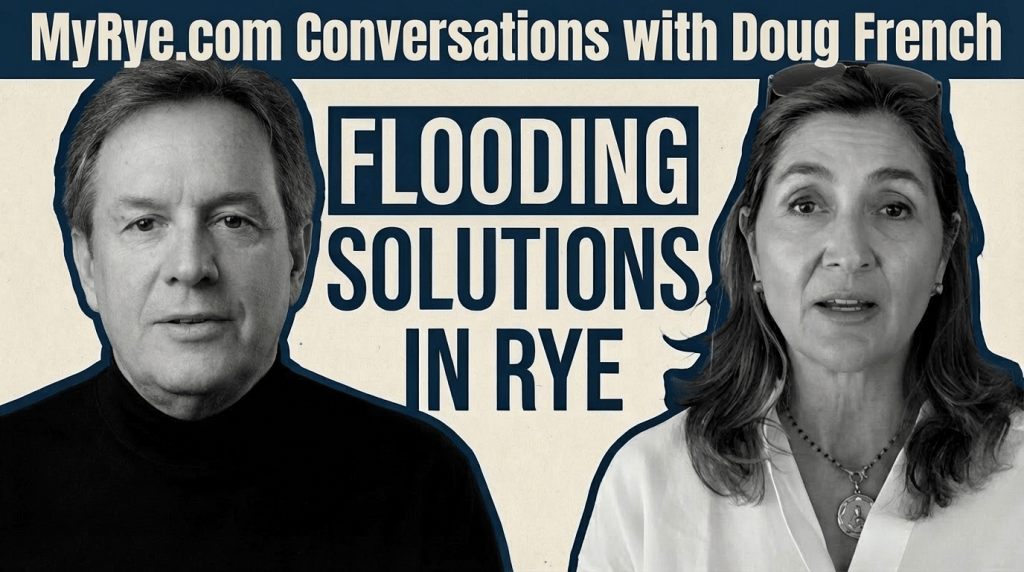
MyRye.com is entering the podcasting business with a new weekly podcast hosted by former Rye Mayor Doug French. Available on all major podcasting platforms, MyRye.com Conversations with Doug French will tackle the larger and sometimes intractable issues impacting the City of Rye through interviews with local, county and state officials and business leaders.
Our second first full espisode (Season 1, Episode 3) is now available featuring French speaking with Carolina Johnson, former Rye City Councilmember and former Flood Advisory Committee chair about flooding in the City of Rye. The conversation covers the importance of real-time flow measurement on Blind Brook and the role of the sluice gate at Bowman Dam; long-term flood mitigation strategies including berms at SUNY Purchase; infrastructure improvements like the Locust Avenue Bridge project and the role of zoning and comprehensive planning in flood prevention.
Main Topics Covered:
- The importance of real-time flow measurement on Blind Brook and the role of sluice gates
- Long-term flood mitigation strategies including berms at SUNY Purchase
- Infrastructure improvements like the Locust Avenue Bridge project
- The role of zoning and comprehensive planning in flood prevention
- Regional collaboration and projects impacting Rye’s flood resilience
- Community advocacy and individual preparedness in climate change adaptation
- Funding, permits, and the importance of oversight and accountability
Timestamps (full transcipt is below):
00:00 – Introduction to Rye flooding challenges and Carolina Johnson’s background
02:08 – The significance of measuring water flow on Blind Brook and sluice gate programming
03:19 – The potential impact of berms near SUNY Purchase for flood mitigation
04:22 – Infrastructure projects including the Locust Avenue Bridge and land access issues
05:30 – The limitations of comprehensive planning and ongoing advocacy efforts
06:37 – The funding landscape, grants, and the need for regional cooperation
07:38 – How residents can proactively prepare and safeguard their properties
09:21 – The economic costs of flooding and the efficiency of individual flood-proofing measures
10:05 – Long-term city strategies, zoning, and housing development pressures
11:48 – Managing neighborhood growth impacts and zoning priorities
13:11 – Integrating flood policies within comprehensive planning processes
14:30 – Regional development projects influencing Rye’s flood risks, including the airport and surrounding towns
16:30 – The state of detention basins at Rye’s airport and mitigation efforts
17:59 – The limitations of current flood advisory groups and the need for stronger oversight
18:46 – Tracking and implementing Rye’s flood plans through city leadership
20:08 – The urgency of action on sluice gate operations and infrastructure upgrades
21:38 – Keys for residents: Staying informed about planning, zoning, and community resilience
22:21 – A pet peeve: Waste management policies in Rye
23:24 – Recommendations for regional advocacy and future podcast guests
Issues discussed on various future episodes will include:
- Public safety
- Sustainability
- Long-term planning
- Development
- Open space and recreation
- Fiscal policy and budgeting
- Flooding
- Infrastructure
These topics concern issues that are often multijuristictional and must be addressed over many years. The show will not be focused on breaking news. We welcome your suggestions for guests, issues to be disccused. and feedback.
Doug French was the mayor of the City of Rye from 2010 to 2014, where he dealt with hurricanes, including Superstorm Sandy. He worked on finance issues impacting the city, downtown transformation, the Boston Post Road diet, pedestrian safety and sustainability initiatives, Rye Playland, and Rye Town Park. French also chaired the Rye Recreation Commission in the early 2000s and has been involved with Rye Little League, local scouting, the local Lions Club, and the local League of Women Voters. He currently serves on the Westchester County Board of Ethics. In his professional career, Doug has been a global marketing executive with leaders in the financial information sector including S&P, Thomson Reuters, + Wolters Kluwer.
Watch:
[00:05] MyRye.com: Welcome to the MyRye.com podcast, Conversations with Doug French. I’m your host, Doug French, former mayor of the City of Rye. And with this podcast, we will speak with the city leaders, state leaders, federal government, state government, local county, you name it. We’ll speak with all the officials that help shape the decisions that are impacting Rye, as well as community leaders, so that you the resident get an understanding of how you can get involved and what the issues are. And in today’s conversation, it’s with Carolina Johnson, former council member, and the topic is flooding in Rye. So Carolina, welcome to MyRye.com.
[00:38] Carolina Johnson: Thanks for having me, Doug. Glad to be here.
[00:41] MyRye.com: And so when you look at flooding, we went through a 20 year period, from the early 1980s to the early 2000s, where there was not one flood. And then the last 20 or so years, we’ve had five or six floods since then. So in your perspective, what are the top two or three projects that are in the queue short term and the top two or three longer term that will reduce flood levels to have some better impact for Rye?
[01:05] Carolina Johnson: Well, one of the very first ones that I would focus on and keep the focus on is measuring the flow of water on the Blind Brook from the Bowman Dam to about Highland Avenue. And that is important because that’ll help us program the sluice gate at the top of Bowman Dam. So what that means is we’re trying to regulate the flow of water coming down during an event. We need to have, they initially said, about 10 years of data to be able to program the sluice gate. We’re about a year, maybe four or five. And I know that there’s been some issues with some of the gauges recording the flow of water. I hope those have been resolved and we need funding every year to allocate funding to keep the monitoring going. Once we program the sluice gate, will be part of the solution. There will never be a complete 100% solution because we can’t control the amount of rain that comes down at any specific event.
[02:08] Carolina Johnson: After that, I would go for a much larger project, which would be the berms that were proposed by Ramble, the last serious detailed engineering and hydraulic study that was done. And they proposed berms around the SUNY Purchase area. One of the main findings that we discovered in the last study was the discrepancy in altitude between the White Plains Airport and Rye. We sit at sea level and the airport sits about 400 feet above sea level. So that creates an enormous current of water slipping down.
[02:49] MyRye.com: And I don’t think people realize that, that the airport is 400 feet above where we are here in Rye so we’re really in the valley.
[02:55] Carolina Johnson: Correct. So we are really at the end of the watershed and typically water wants to just splatter down. They call that the sinuosity of the brook or the river or the water course. So it’s very important that we understand that that point at SUNY Purchase, which is really right below the airport, would provide us with a mechanism to slow down the water, not to pool it, not to create another dam, not at all. It’s just to slow down how fast the water comes down because of the change in elevations and the steep slope really that there is. That would be very beneficial in terms of life saving or property saving opportunities.
[03:40] MyRye.com: And so those two, the sluice gate and the berms at SUNY Purchase, they seem like those can… Go ahead.
[03:43] Carolina Johnson: The other, those would be for flood prevention, say, or mitigation. There’s flood proofing. And the flood proofing would be in the form of taking our infrastructure and moving it out of harm’s way. And in that case, I’m referring to the Locust Avenue Bridge, for example. It’s one of the main arteries in town. It’s right near, it’s right on the firehouse and improving that passageway to get all the way down to the sound would alleviate some of that bottleneck that gets created. But it also is a main artery for Rye. So we need to make sure that it’s going to stay serviceable. The other, there are other projects. Go ahead.
[04:22] MyRye.com: But these go in.
[04:25] MyRye.com: Well, I was going to say that those projects seem to be in the near term, right? So you think that we could accomplish those in the next couple of years?
[04:31] Carolina Johnson: Well, so we got a grant for five million dollars to replace the Locust Avenue Bridge and when we did the ballpark analysis of what it would cost is ten million dollars. So where do we get the other five million from? That’s a big question. That’s where bigger partners, other partners come in.
[04:49] MyRye.com: the berms mean that seems something that could be feasible.
[04:52] Carolina Johnson: The berms is something that is doable except for we don’t have access to the land. The land is owned by the SUNY corporation. It’s not a corporation, but it’s the SUNY system. And as long as we don’t get permits from them, we can’t access the land. And that’s a project that would not be as expensive as some other projects. So that’s a more, because it’s just basically moving dirt around.
[05:16] MyRye.com: So in the idea of the comprehensive plan, flooding being one of the central issues in Rye it would seem that we should make sure that we have advocates that are supporting those three initiatives that you mentioned as priorities with our regional partners.
[05:30] Carolina Johnson: The comprehensive plan is a really nice idea, Doug, but I would caution people that the last comprehensive plan had already mandated. It’s the comprehensive plan is not an enforceable document. It’s sort of like the best ideas we have for what we want to accomplish for our town, but it’s really not enforceable. So the last comprehensive plan had a series of floodgates to be put at Oakland Beach Avenue and other choke points and like flow points that never happened. so this is, it’s a good exercise and we should do it and go through it. But your expectations need to be managed because there’s really nothing Enforceable that comes out of it so we can say we should keep an eye on the ball and But really it’s in the nitty-gritty. It’s in every budget that goes through the council every year It is maintaining our lobbyists at the state level and at the federal level So we get the monies because we do not have the budget We do not we cannot come up with a budget to do a simple job like it is elevating the Locust Avenue bridge takes $10 million, takes a lot of time from city staff to go through all the paperwork. These are mountains and mountains of applications and paperwork that you have to go through and somebody has to manage that project. We don’t have the capacity at City Hall to do that and do that in multiple areas at the same time. So we would have to balloon the city hall staff and budget just to cover the big infrastructure needs that we have.
[07:14] MyRye.com: Right. So if you were to put your hat on, you started out as a Rye resident impacted by flooding. You then built the whole advocacy network with a few folks to really push for flood solutions. And then you sat on the city council. If you go back in your advocacy role, what are the things that residents can do to expedite some of these, maybe outside of the comprehensive plan, but really the flood plan to get that ramped up?
[07:38] Carolina Johnson: I think that people should stay educated on what they can do for themselves because we all have a responsibility. Climate change is a serious thing. Climate change is very difficult to predict when and where it’s going to hit. We know we’re prone to flooding. But say, for example, the New York Times climate reporter wrote many years ago that Asheville, North Carolina was the safest place in the United States to live because it was the safest in terms of flood disasters or climate disasters. And look what happened to it a couple of years ago. It is really difficult to know that you’re going to be in a safe area, whether it is fires or earthquakes or flooding. We all need to be prepared. So I think you prepare yourself by knowing where you are, knowing what the flood maps say, knowing where your house is and knowing what you can do. So let’s say this is extremely expensive, but Some people have no other option but to elevate their homes. That is something that the City of Rye, very long ago, determined was something that was doable. Each individual can safeguard their property by elevating their homes and flood proofing their homes. So I think that’s an incredible way of looking at things and that new structures all have to be compliant, FEMA compliant. And even though I would say sometimes the bar for FEMA is not the right bar, sometimes it’s a little low. But you need to stay educated. And that’s, I think, your best tool.
[09:21] MyRye.com: Yeah, because I think when the Army Corps was looking at the cost-benefit analysis, the cost for people to raise is a lot lower than some of the upstream development or retention strategies they looked at.
[09:33] Carolina Johnson: Correct. The cost benefit analysis we always lose on. It doesn’t matter. And collectively, in 2007, we lost about $85 million worth of property damage that we racked up in Rye. But the cost of an infrastructure project as big as an Army Corps of Engineers would plan is in the hundreds of millions of dollars, where the city alone just cannot shoulder it.
[09:59] MyRye.com: So we’ve got these three short-term projects. What’s longer term that the city should be focused on?
[10:05] Carolina Johnson: I mean, there are zoning, I think, is the really important tool you have that’s enforceable, where you can really impact the most. So. Although, mean, we have a code that was mostly said in the 60s. We have a town that we have multiple neighborhoods and houses that were built way before we had a zoning code. So it’s a hodgepodge of things that is kind of difficult to manage. we are, people may not know, but New York State has an 800,000 unit deficit. for housing units. And that is, that’s incredible. You know, people need to live mostly downstate, close to the city where the jobs are. Maybe that’ll change with AI and people can move around the state a little bit more. But this is the, the concentration, the critical mass is downstate. So where we are, if you looked at the census numbers from the 1990s to now, in 1990, we had just under 15,000 people living in Rye. Right now we have over 16,000 16,000 and a half more or less It’s not a huge increase. It really isn’t. So Rye has been able to manage that. And then we have the push and pull between people who want to come into the city to have the young family join the school system and people who want to downsize and they need a smaller place. so there’s an interesting mishmash that we haven’t mastered. We haven’t really… found the right median of stock that we need to have for our housing. So there’s a lot of pressure on both sides, right? Some people want to maintain things as they are, not build anything else because everything else will create flooding. But then we also need to open our doors. We need to have more people because we need to house more people. There is an incredible demand for people to have housing. So we have to juggle all things and I think zoning is the best way where you can really have enforcing, you can enforce the laws on the books. mean that’s zoning would be my number one priority.
[12:32] MyRye.com: And that sits with the City Council to change the law then.
[12:35] Carolina Johnson: Correct. It is the City Council responsible. The Zoning Board of Appeals can only provide relief for those people who have a project and they need to balance the impact of what the goals are for these application and what the neighborhood feels. But the City, the Board of cannot just tell somebody, don’t think that’s right. No, you have to go by what’s acceptable in terms of the law, what’s applicable, and what can you deny and what can you not deny.
[13:06] MyRye.com: So when you look at the comprehensive plan, there are lot of components to that comprehensive plan residential development, central business district, business development, environmental protection, flood control, coastal resources, community facilities. All of those have some element or impact flooding in some form or fashion. So as part of the comprehensive plan process, there should be a very distinct flood policy or flood mitigation policy in each one of these categories as we start to lay out the future.
[13:35] Carolina Johnson: It would be an interesting… perspective to hold a comprehensive plan, but the comprehensive plan, you will see that there’s a lot of pressure from other from other areas. And, and so if they always keep flooding in mind, that would be great. They probably wouldn’t be able to arrive where they need to arrive. Because it’s just one lens, you can only have one lens, right? You have to integrate all the lenses. So something is always that’s why I go back to educate yourself and see what you can do to safeguard your property because that will be your best option.
[14:12] MyRye.com: And what about regionally? So flooding is a regional problem. What are the development projects that are impacting us that you see where we probably need to have a louder voice or influence in some of what’s happening around us, like the airport, like the Brunswick development? What are some of those projects?
[14:30] Carolina Johnson: So there are projects all around us that impact us. They all around us. And the city of has been active in the only, this is we have New York is a, you can’t, it’s a home state rule, right? It’s a, that’s the term of it. And so you cannot impose, on any other on your neighboring towns. So in terms of traffic, in terms of flooding, we cannot impose Port Chester and tell them stop developing. You’ve grown from a few thousand people to now tens of thousands of people living in your city. We can’t tell them what to do or not to do. So that is very, very important. And I just think that unless the county really takes over, and it’s going to be impossible because we do have great partnerships with Rye Brook and Mamaroneck. Harrison and Port Chester are not as partnerable with, they have their own agendas and they have their own growth that they’re they need to commit to and are working towards and it’s very difficult unless the county really comes in and zones everyone in terms of watershed communities.
[15:47] MyRye.com: Well, that’s interesting. saw LISWIC was part of a regional planning, but I think that that’s mostly on Long Island Sound versus some of the Brook. There should be a comparable group that’s looking at brook and stream flooding across the county with all the different regional partners.
[16:03] Carolina Johnson: Yes, there’s some, I mean, there should be one. Yes, Liswick is more, you know, determining the health of the sound, right? And here we’re trying to not so much clean the water that’s coming down, but slow it from coming down or detain it or, you know, yeah, slow it down. So…
[16:12] MyRye.com: Right, right.
[16:26] MyRye.com: What about the airport? Have they done everything that they should be doing to retain water?
[16:30] Carolina Johnson: No, the airport should have, they have three scheduled detention basins. And after Ida, we went on a tour and we saw a lot of phragmites in detention basin A. Detention B was pretty good, solid, working. Detention C was never built. So it would be great for the airport to go ahead and clean out that detention base in A, maintain B, and build up C. Years ago when the folks from downstream is old New York City gets water from Rye Lake, they diverted all the runoff from the airport from Rye Lake to go into the Blind Brook. And so that we need a little bit more mitigation there for sure. Brunswick School also built in enormous beautiful facilities that now impact SUNY Purchase and downstream from there. And from there Harrison has allowed a lot of building but like I said it you know they’re not going to deny building when it doesn’t break their laws so
[17:39] MyRye.com: Right, right. So it sounds like Rye has done all that it can do in terms of ideas and solutions and we really need action from our regional partners or some teeth behind that. Who are some of the key people? Is it that we still have the Flood Advisory Committee that’s looking at these issues, building out our flood plan?
[17:59] Carolina Johnson: Well, the Flood Advisory Committee is what it is, right? It’s advisory. So you’re only called upon whenever the council wants an opinion from you. It’s not that the Flood Advisory, and I just stepped down from it, it’s not like the Flood Advisory Committee can take action in any way, shape, or form. They can make a recommendation, but only once the council has said, please look into these. It’s not like, yeah.
[18:27] MyRye.com: So who has the flood plan? If I were to say, where’s the Rye flood plan and how are we tracking against that plan? Is that the city planner? Is that the mayor? Is it the city manager? Who’s keeping track of the projects that you just mentioned and making sure we’re getting funding and progress and making it a priority?
[18:46] Carolina Johnson: I think the city manager’s best position to keep track on it, obviously, he needs funding authorized by the city council to go after, you know, these lobbyists or that lobbyist. And that’s the way the world works. And that’s what we need to be doing. We need money from the state to accomplish these or that project. And we need to go after that. the grant, the three million grant we got a few years back.
[19:13] MyRye.com: my concern is there are a lot of new families that have moved into Rye. The flooding impact at a personal and emotional level is, and financially, it’s tough. And when that happens, the next flood happens, the city has to be prepared with answers on what’s gonna happen when, where do we need funding? And so we show some progress because some of the projects you mentioned, are 15 years old right when you started getting involved 15 20 years old so we have to balance government time versus resident need for action and It sounds like we’re making the right Progress, but not fast enough
[19:49] Carolina Johnson: Right and it just means that you know the people on the council need to have the eye on the ball and just keep pushing for the the flow studies that are going on right now so that we can then program the sluice gate. The sluice gate was put in 15 years ago and it’s not operational so when we have that that’ll be amazing but we
[20:08] MyRye.com: Yeah, I cut the ribbon.
[20:14] Carolina Johnson: on the flooding commission, we didn’t know that this loose gate was not operational. We assumed it was. Then later we learned it wasn’t. But we have no authority over anyone to ask for accountability. It’s the council.
[20:18] MyRye.com: Right. Right.
[20:29] MyRye.com: Yeah. And that’s why this podcast is about speaking with local, city, state, federal, county leaders, community leaders, because a lot of the people in the council come and go, but there should be a plan that’s tracked and made progress against. before we jump to our last segment, I just want to…
[20:46] MyRye.com: Let our listeners know if you have a guest or a topic that you would like on the MyRye.com podcast, Conversations with Doug French, shoot me an email at french at myrye.com and we will have our crack staff consider it. So Carolina, this has been very educational and I want to move to our final segment, which is about one question and just one sentence, okay?
[21:09] MyRye.com: So if you could keep it brief to one sentence. so the first thing I would say is why Rye
[21:15] Carolina Johnson: Why Rye because it’s a beautiful community, coastal community, great schools, great people, proximity to the city. So not just one reason, but many, and just the best neighbors in the whole wide world.
[21:30] MyRye.com: And what was the one insight on the council that you would share with yourself as a resident on flooding? Because you’ve worn three hats.
[21:37] Carolina Johnson: I say stay educated on how things work. People have no idea the difference between the Planning Commission from the Board of Architectural Review, from the Zoning Board of Appeals. They don’t understand how these works. So if you have a minute to peruse the website and see what each one of them does and it’s not saying, planning, they should be looking at these or that. No, the Planning Commission has a very defined role on the projects they can look at or that need an application to go through their process. So stay educated. The website, the city website, is full of information.
[22:19] MyRye.com: What’s your one Rye pet peeve?
[22:21] Carolina Johnson: that we have garbage pick up twice a week. We don’t need it. I compost my garbage, my edible, my garbage. And so I only need one, once a week. my gosh. It’s like some people think this is a resort. It’s not.
[22:32] MyRye.com: we moved here it was three days a week. Three days. In the late 80s.
[22:39] MyRye.com: If you were to bump into our Congressman George Latimer or Ken Jenkins or Josh Nathan, what is the one thing that you would say?
[22:46] Carolina Johnson: please help us get those berms at the SUNY Purchase level. We need the money and we need the permits to move forward with the berms so we can alleviate the serious flooding we have. Upstream mitigation, I think, still remain our focus. Some of the downstream…
[23:06] Carolina Johnson: choke holds are important, but that one is the most important. I mean, obviously getting the culvert under I-95 or the Rye Metro North would be great, but we know that’s going to take, I don’t know, centuries to happen.
[23:20] MyRye.com: Do you have a topic or a guest that you would suggest for this podcast?
[23:24] Carolina Johnson: I would chat with Steve Otis. He knows a lot about flooding and he knows where to get the money. And we need him to stay focused on Rye.
[23:33] MyRye.com: And what is the Carolina Johnson brand today if people want to connect with you?
[23:38] Carolina Johnson: Send me a postcard.
[23:39] MyRye.com: Because you’re in Miami.
[23:40] Carolina Johnson: Yes, I’m in Miami part of the time.
[23:42] MyRye.com: Okay, well, Carolina it was a real pleasure and I want to thank you and I want to make sure I thank all of our listeners for listening to the MyRye.com podcast, Conversations with Doug French. You can find more local news and full episode transcripts at MyRye.com. If you found this conversation helpful, please follow or subscribe wherever you get your podcasts. And with that, Carolina thank you again and we’ll see you all next time.
[24:09] Carolina Johnson: Thanks for having me.
