

Overview:
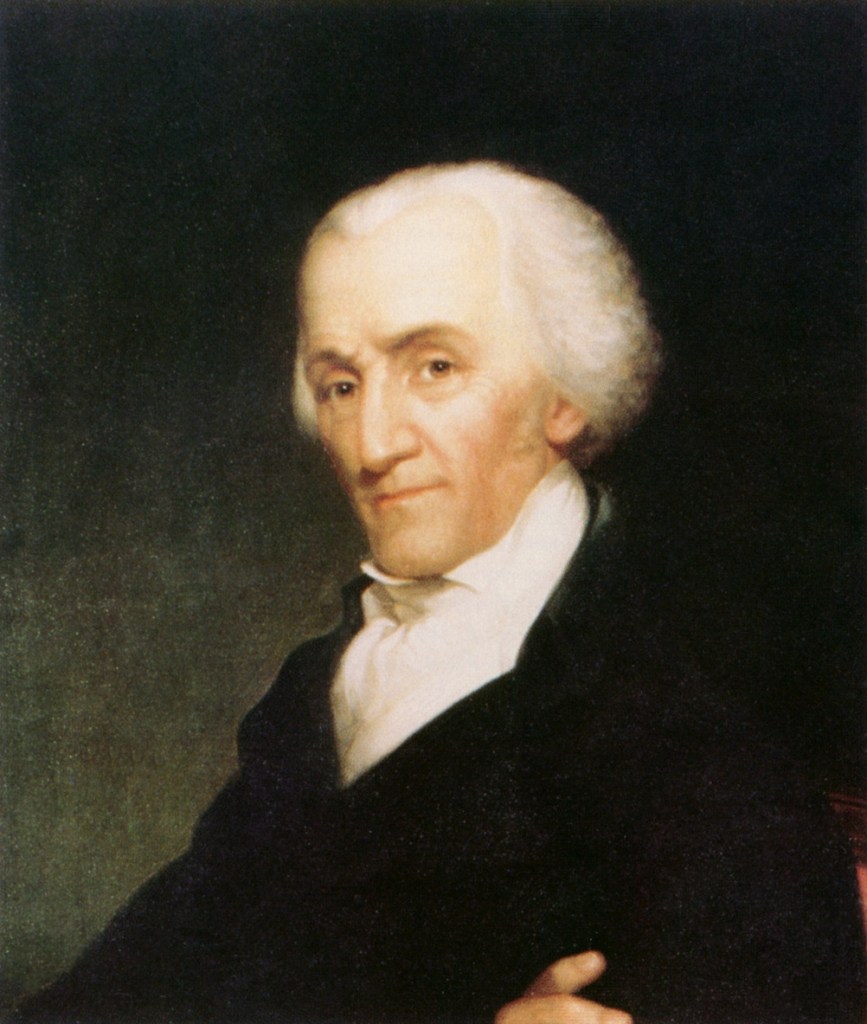
Elbridge Gerry, a Founding Father, signed a bill in 1812 that redrew electoral boundaries in Massachusetts to secure a victory for the Democratic-Republican Party, resulting in the Federalist vote being concentrated in a small number of districts and the Democratic-Republicans being well distributed across many districts, a practice known as Gerrymandering.
Holding Court is a series by retired Rye City Court Judge Joe Latwin. Latwin retired from the court in December 2022 after thirteen years of service to the City.
What topics do you want addressed by Judge Latwin? Tell us.
By Joe Latwin

Redistricting reminds me of the fellow that went to get a pizza. The pizza guys ask if he would like the pie cut into 6 or 8 pieces. They guy says “make it 6, I don’t think I can eat 8 pieces”.
The Constitution does not mention districts. Initially it just specified how many representatives the original 13 States would have– “New Hampshire shall be entitled to chuse (James Madison, a graduate of the College of William and Mary, reported got an F is spelling) three, Massachusetts 8, Rhode-Island and Providence Plantations 1, Connecticut 5, New-York 6, New Jersey 4, Pennsylvania 8, Delaware 1, Maryland 6, Virginia 10, North Carolina 5, South Carolina 5, and Georgia 5.” Article 1, Section 2 of the Constitution says “Representatives . . . shall be apportioned among the several States which may be included within this Union, according to their respective Numbers . . . The Number of Representatives shall not exceed one for every thirty Thousand, but each State shall have at Least one Representative. . .” Initially, under the Jefferson method where seats were allocated to political parties, large States, like Virginia, were favored. The Hamilton method, where the basic number of seats for each party was done by dividing their vote totals by the fixed number of votes needed to win a seat, was used on and off for the next 50 years. After the Civil War, the 14th Amendment stated, “Representatives shall be apportioned among the several States according to their respective numbers, counting the whole number of persons in each State.” The total number of voting members in the House was fixed at 435 by the Reapportionment Act of 1929. The Constitution does not say how Congressmen are to selected except the 17th Amendment allows the Governor to fill vacancies. Other than filling vacancies, the selection of Congressmen is left to the respective States.
Further constraints were imposed by the “One person, One vote” ruling by the Supreme Court in Wesberry v. Sanders in 1964. As a practical matter, this required districts to be of roughly equal size.
So, if the population of the U.S. is x, it gets divided by 435 to compute how many residents should be in every district. Question 1 – how do you count residents? Until the 14th Amendment, under Article 1 Indians not taxed (they might be counted in their Tribal censuses) and 3/5ths of the people not free were excluded from the count. After then, Indians not taxed were still excluded from the count until The Indian Citizenship Act of 1924, (the Snyder Act), was passed by Congress in 1924 and admitted Native Americans born in the U.S. to full U.S. citizenship. Question 1 – if a State gets more than 1 representative, how do you divide the State into that number of districts? That is left up to the Legislature of that State and its politics.
Some mischief began early. Some States divided up their districts based on how to get the most seats for the party in power and limit the opposition. You could put all the Democrats in one district, guarantying one Democrat seat but also guarantying the rest Republican. You could also draw the districts so that Republicans remained a minority in every district. This mischief became known as Gerrymandering- named after Elbridge Gerry, a signer of the Declaration of Independence and the Articles of Confederation, a co-writer of the Bill of Rights, Governor of Massachusetts, member of Congress, and Vice President. In 1812, during his second term as governor, Gerry signed a bill that redrew electoral boundaries in Massachusetts to secure a victory for the Democratic-Republican Party. The redrawing resulted in the Federalist vote being concentrated in a small number of districts and the Democratic-Republicans being well distributed across many districts. The strange shape of the resulting electoral map led the Boston Gazette to publish an illustration that portrayed a map of the new Essex district as a menacing salamander with teeth and claws, with the title “Gerry-mander”
The Gerrymander had a future in politics, while his cousin the Gecko went into insurance.