
RyeGPT People of Note is a series highlighting individuals who have a connection to the City of Rye. In the series we ask OpenAI’s ChatGPT to prepare a biography and explain the individual’s connection to Rye.
We welcome your feedback on this series – the use of artificial intelligence, the accuracy and usefulness of each article and your assistance in understanding other pertinent insights related to the person’s connection to Rye.
You can add comments at the bottom of each article or you can send feedback via Tips & Letters.
For over half a century, M. Paul Redd Sr. was a cornerstone of Westchester County’s civic, political, and journalistic landscape. Commonly referred to as Westchester County’s “Mr. NAACP,” Redd was a passionate advocate for social justice, fair housing, and economic opportunity. Yet, one of his most profound and enduring legacies unfolded right here in the City of Rye, where a personal battle against systemic housing discrimination transformed into a landmark victory for civil rights across New York State.
Deep Roots and the Fight for Rye Colony
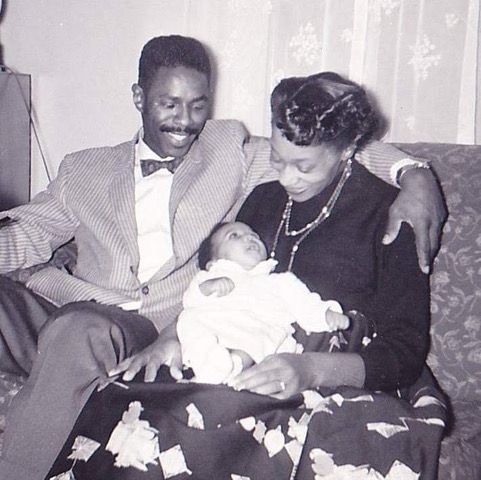
M. Paul Redd Sr. was born in 1928 and dedicated his life to breaking down racial barriers. Alongside his wife, Orial Anne Banks Redd—whose own family ties to Rye dated back to the late 1800s—the couple sought a place to raise their growing family in the early 1960s. After seeing an advertisement for an available garden apartment at the Rye Colony complex, located near the Rye train station, Orial called to inquire.
However, when the African American couple attempted to secure the rental, they faced immediate, blatant racial discrimination and were denied housing. Rather than backing down, the Redds chose to confront the injustice head-on.
The struggle quickly galvanized a network of local activists and allies. Prominent Rye residents, including noted author Dorothy Sterling and Lotte Kunstler, took action to expose the apartment complex’s discriminatory practices. Sterling and Kunstler visited the Rye Colony rental office themselves to verify that units were indeed available and being actively withheld from Black applicants.
Backed by this crucial evidence, the Redds pursued legal action. They were represented by Lotte’s husband, a local attorney from nearby Port Chester making his very first foray into civil rights law: William Kunstler.
Local Backlash and a Statewide Victory
The legal battle was fraught with tension. The Redds received aggressive, threatening phone calls laced with racial slurs from hostile residents demanding they leave Rye. The backlash escalated into overt intimidation when a seven-foot wooden cross was set ablaze on the front yard of their allies, the Sterlings, on Kirby Lane North.
Despite the threats to their safety, the Redds stood firm. In December 1962, they won their landmark housing discrimination case, officially permitting the family to move into the Rye Colony apartments. Showing his natural leadership and resilience, Paul Redd Sr. would later go on to serve as the very first cooperative board president of Rye Colony.
The impact of their court victory extended far beyond the borders of Rye. The legal precedent set by their case directly catalyzed the passage of New York State anti-discrimination legislation in 1962, widely known as the “Redd Bill,” which outlawed discriminatory practices in private housing across the state.
A Voice for the Community: The Westchester County Press
Beyond his monumental fair housing fight, Redd was a powerful force in local journalism. In 1961, he began writing a column titled “M. Paul Tells All” for the Westchester County Press, the county’s only newspaper dedicated entirely to African American voices.
In 1986, Paul and Orial purchased the historic publication. Under his stewardship as publisher and president for more than 20 years, the Westchester County Press served as a vital, unvarnished chronicler of education, housing, politics, and civil rights for the local Black community. Redd rejected sensationalism, focused heavily on community elevation, and personally laid out the paper every Monday evening to ensure it reached its thousands of subscribers.

Fifty Years of Local Leadership
Redd’s commitment to the local community was woven into his day-to-day life in Rye. A natural organizer, he co-founded the Black Democrats of Westchester in the 1950s and served actively on the Rye Democratic Committee for an astonishing 46 years, alongside roles as vice chair of the Westchester County Democratic Committee.
His advocacy extended deeply into workforce development. As president and chief operating officer of the Westchester/Putnam Affirmative Action Program, Redd spearheaded initiative efforts that successfully provided job training and employment placement for approximately 4,000 individuals—predominantly African American women—over a seven-year span. He additionally served as a Gold Life Member and President of the Port Chester/Rye branch of the NAACP, and sat on the boards of the local American Red Cross, the United Way, the Urban League, and the Girl Scouts.
An Enduring Legacy
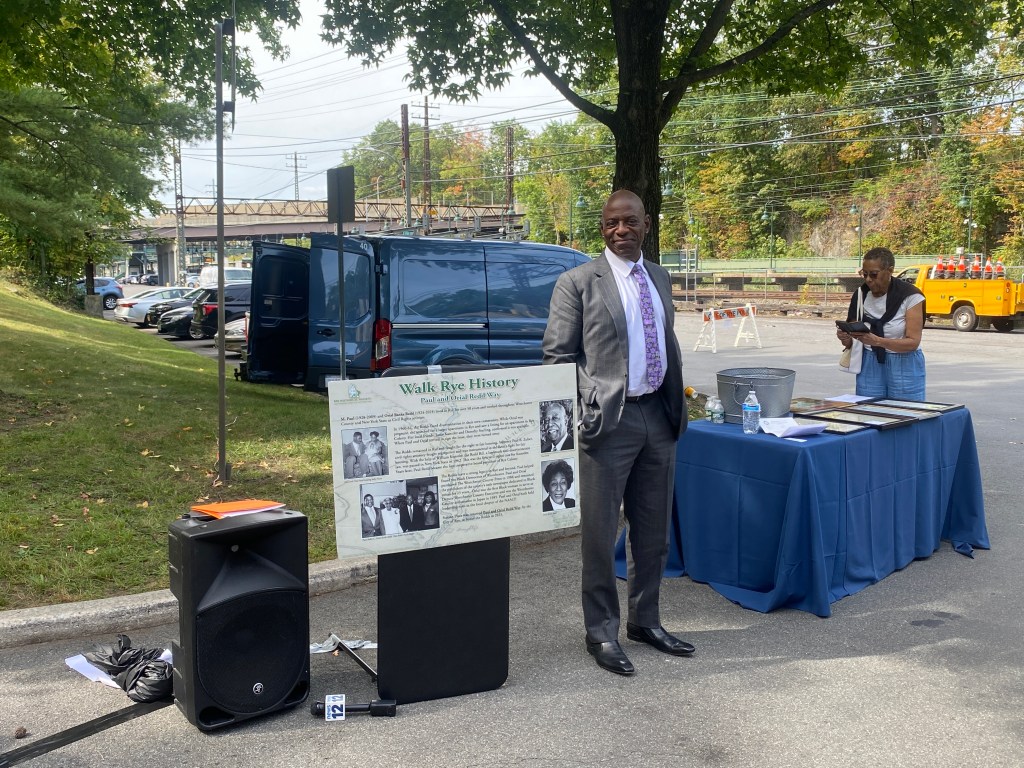
M. Paul Redd Sr. passed away on January 9, 2009, at the age of 80, leaving behind a profound legacy that local officials and residents continue to honor. To ensure his contributions are never forgotten, the Port Chester/Rye NAACP establishes annual high school scholarships in his name. Furthermore, local recognition culminated in a permanent testament to his courage: a formal street naming ceremony at Station Plaza by the Rye train station, standing just steps away from the very apartments he fought so bravely to integrate.