

RyeGPT People of Note is a series highlighting individuals who have a connection to the City of Rye. In the series we ask OpenAI’s ChatGPT to prepare a biography and explain the individual’s connection to Rye.
We welcome your feedback on this series – the use of artificial intelligence, the accuracy and usefulness of each article and your assistance in understanding other pertinent insights related to the person’s connection to Rye.
You can add comments at the bottom of each article or you can send feedback via Tips & Letters.
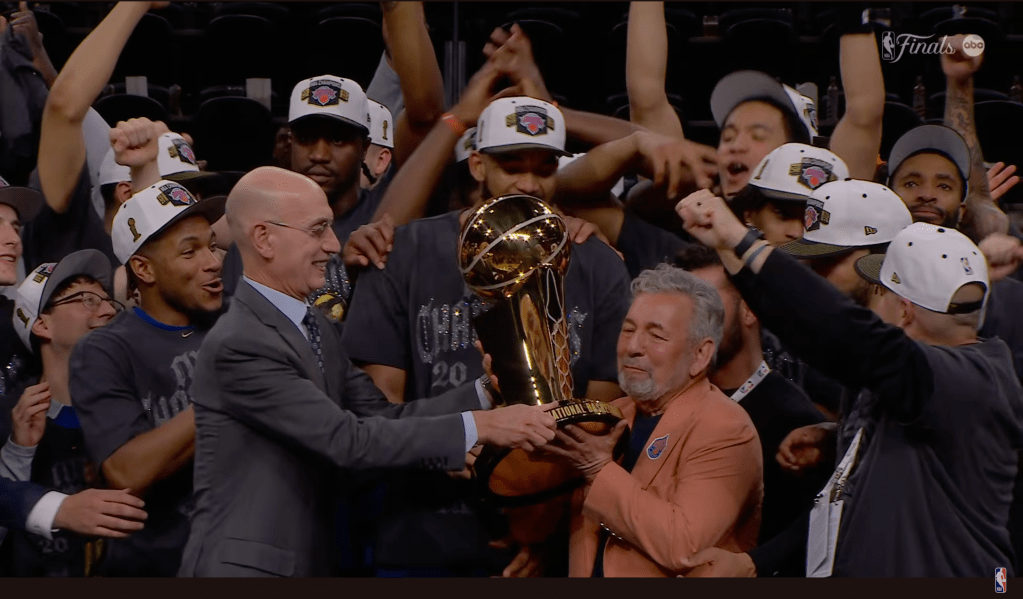
A Rye native stood at center court Sunday night as the New York Knicks celebrated their first NBA championship in 53 years.
NBA Commissioner Adam Silver, a 1980 graduate of Rye High School, presented the Larry O’Brien Trophy after the Knicks defeated the San Antonio Spurs 94–90 in Game 5 of the 2026 NBA Finals. “The wait is over,” Silver declared as he handed the championship trophy to Madison Square Garden Executive Chairman and CEO James Dolan.
For Silver, who was born in New York City and raised in Rye, the moment represented a fitting connection between his hometown roots and his role leading one of the world’s most influential sports leagues.
Early Life and Education
Adam Silver was born on April 25, 1962, in New York City and grew up in Rye, New York. He earned a bachelor’s degree in political science from Duke University in 1984 and went on to receive his Juris Doctor from the University of Chicago Law School in 1988. His formal training in law and public policy would later shape his methodical and governance-focused approach to sports leadership.
Joining the NBA
Silver joined the National Basketball Association in 1992 as a special assistant to then-Commissioner David Stern. Over the following two decades, he advanced steadily within the league, taking on responsibilities that spanned legal affairs, team operations, league governance, media, and international growth. In 2006, he was appointed deputy commissioner and chief operating officer, becoming Stern’s top lieutenant and a central figure in labor negotiations, franchise oversight, and the NBA’s expanding global strategy.
Appointment as Commissioner
In February 2014, Silver was unanimously selected by NBA team owners to succeed David Stern as the league’s fifth commissioner. His appointment marked a generational transition for the NBA, placing a longtime league insider with a legal background at the helm during a period of rapid cultural, technological, and business change.
Early in his tenure, Silver drew widespread attention for his handling of the Donald Sterling controversy. After recordings of racist remarks made by the Los Angeles Clippers owner became public in 2014, Silver imposed a lifetime ban on Sterling, levied the maximum allowable fine, and initiated proceedings that ultimately led to the sale of the franchise. The episode became an early defining moment of his commissionership and established his reputation for decisive leadership.

Leading the Modern NBA
As commissioner, Silver has presided over a period of sustained growth and transformation for the league. Under his leadership, the NBA expanded its global reach, strengthened its digital and media platforms, and adopted a more open posture toward player expression and social issues. His tenure also included navigating the COVID-19 pandemic, during which the league completed its 2019–2020 season under unprecedented conditions.
Silver has become known for a collaborative and transparent leadership style, frequently engaging publicly on issues that extend beyond basketball and positioning the NBA as one of the most culturally responsive major professional sports leagues in the United States.
Connection to Rye, New York
Adam Silver grew up in Rye near the Long Island Sound and graduated from Rye High School in 1980, where he was known as a strong student and athlete. According to a 2014 Sports Illustrated profile referenced in local reporting, Silver lived in a large house near the water, was an A student, served as class president, ran on the cross-country team, and was editor-in-chief of the high school newspaper.
As a youth he spent time with friends at the Rye Nature Center, visited local markets, and watched Muhammad Ali fights at a theater in New Rochelle. Silver’s family was active in local civic life — his mother was an educator and community activist in Rye. She emerged as one of the most outspoken opponents of developer Robert Moses’ proposed Oyster Bay–Rye Bridge, which would have linked Long Island and Westchester, even enlisting her youngest son to help spread the message by wearing “Ban the Bridge” buttons.