

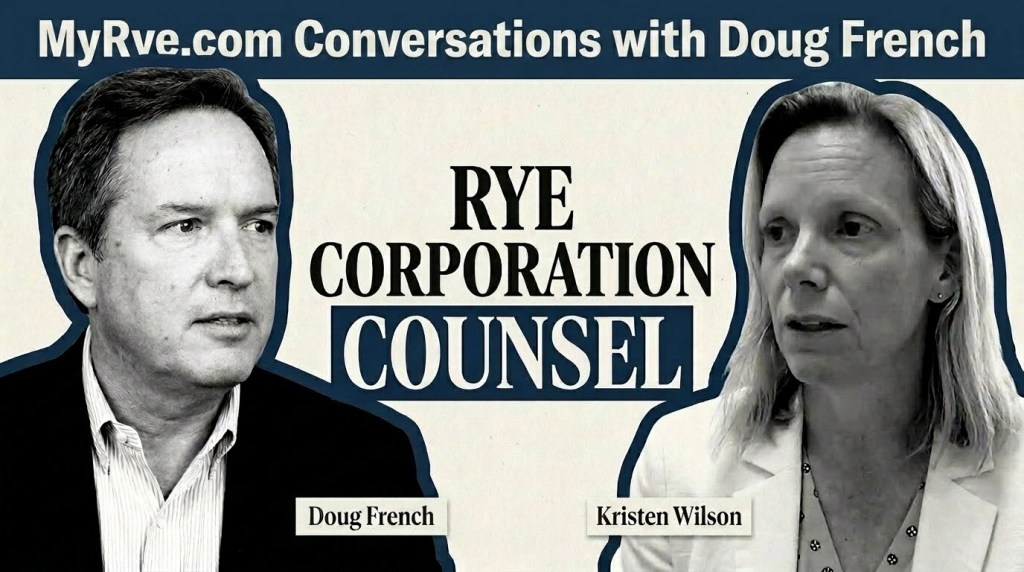
MyRye.com is entering the podcasting business with a new weekly podcast hosted by former Rye Mayor Doug French. Available on all major podcasting platforms, MyRye.com Conversations with Doug French will tackle the larger and sometimes intractable issues impacting the City of Rye through interviews with local, county and state officials and business leaders.
In Episode 13 of Season 1, French speaks to Rye City Counsel Kristen Wilson to unpack what her role actually involves and how city legal work connects to everyday life in Rye. Wilson explains the balance between advising the City Council, representing city departments and boards, and handling conflicts when different parts of the city need separate legal representation.
They also discuss the wide range of matters that come through Rye City Court, from traffic and parking violations to leaf blower complaints and marine patrol issues. Wilson walks through the responsibilities of the city prosecutor, explains how county and state cases are handled, and shares what residents should know if they’ve never been to court before.
A major part of the conversation focuses on administrative and land-use law, especially Article 78 proceedings and SEQRA, the State Environmental Quality Review Act. Wilson explains how these processes shape city decision-making, why a careful record matters, and how legal process helps protect city actions from challenge. The episode also covers home rule, tree law, housing policy, telecommunication regulation, and the legal issues shaping Rye’s future.
This episode of MyRye.com Conversations with Doug French was produced by MyRye.com. Feedback and story ideas are welcome.
Main Topics Covered:
- Kristen Wilson’s role as Corporation Counsel for the City of Rye
- How Rye City Court handles traffic, parking, and local code violations
- What Article 78 proceedings are and why they matter
- How SEQRA affects development and planning decisions
- Wilson describes how the Save the Sound case led to major sewer infrastructure and environmental improvements
- Home rule, tree law, housing policy, and local control
- Wilson explains who the city lawyer represents and when conflicts require outside counsel
- French and Wilson break down the difference between local, county, state, and federal legal matters
- Advice for young lawyers and insights from Kristen’s triathlon career
- The conversation closes with career advice, personal reflections, and a lightning round
Timestamps:
00:01 – Doug French welcomes listeners and introduces the episode topic
01:09 – Who the corporation counsel represents in the City of Rye
03:13 – Rye City Court, common cases, and what residents should expect
04:47 – When county and other agencies are prosecuted by the city
05:26 – Criminal cases and the role of the county District Attorney
06:06 – Advice for residents dealing with parking, leaf blower, and first-time court issues
07:48 – Managing the city’s legal docket across different courts and issue types
08:41 – What an Article 78 proceeding is
11:42 – Federal cases and the Save the Sound lawsuit
13:09 – How the Save the Sound resolution led to sewer planning and local improvements
15:58 – Working with specialized outside counsel
16:37 – Labor matters and union negotiations
17:08 – Insurance, trip-and-fall cases, and outside counsel support
18:54 – How Wilson balances legal risk with city initiatives
20:59 – SEQRA explained
23:31 – Home rule and local authority
24:52 – Tree law and balancing property rights with environmental concerns
26:02 – Emerging legal issues, including SEQRA changes, housing, and telecom regulation
27:25 – Using AI to search the city code
28:46 – Wilson’s long tenure on the city council dais
29:10 – Advice for young lawyers
30:10 – Ironman and triathlon reflections
31:34 – Lightning round begins
32:42 – Guest recommendation: Judge Livingston
33:23 – Closing and contact information
Watch:
Full Transcript:
Speakers
- MyRye.com (Doug French)
- Rye City Counsel Kristen Wilson
Doug French: Welcome to the MyRye.com podcast, Conversations with Doug French. I am your host, Doug French, the former mayor of the city of Rye, and this podcast is all about the people and the issues that impact Rye and our surrounding region. For our listeners, our goal is to educate and inform you on the issues that matter most to you so you can engage and make a difference in our community.
Today’s conversation is about the Law and Corporation Counsel, and with us is Kristen Wilson, the City of Rye Corporation Counsel. Counselor, welcome to MyRye.com.
Kristen Wilson: Thank you for having me as your guest, Mayor French. I’m excited to be here.
Doug French: Operative word is former Mayor French.
Kristen Wilson: Former. Always a mayor in my mind.
Doug French: For our listeners, in this episode, I’d like you to walk away with three things: one is Kristen’s role as the people’s prosecutor in the Rye City Court; the second is an overview of the city’s legal docket and managing such a large caseload; and the third is Kristen’s role as corporation counsel in advising city council and staff on legal and litigation matters.
With that, I think we’ll open up with our icebreaker question. What’s in the news nationally all of the time is the Attorney General role — whose lawyer is the Attorney General? That’s the same question to you as the city’s lawyer. Whose lawyer are you?
Kristen Wilson: It’s always the question of the day. I run into conflicts more often than I would wish, but I will start off by answering what I am not. I am not the general public’s lawyer. I am hired and fired by the Rye City Council — the seven members, the seven elected officials. I represent them as a body. I represent, at times depending on the day, department heads, boards and commissions, and I render legal advice to different bodies or arms of the city. At times there are conflicts, and in those moments I bring in outside counsel to represent the other entity that might be at odds with the entity I’m representing.
For instance, many years ago Rye Golf Club had an issue with its sewer tax and the assessed value we had it on the books as. They filed a grievance with our Board of Assessment Review, so I had the Rye Golf Club on one hand and the Board of Assessment Review on the other, and had to bring in outside counsel so that both bodies could be represented accurately.
Doug French: Interesting. So you do have to walk that fine line from time to time.
Kristen Wilson: Yes, actually more often than not.
Doug French: So let’s look at our first section — your role as the prosecutor. Most people get their legal knowledge from the show Law and Order. In this case, in the Rye City Court, you play the role of the people’s prosecutor. What types of cases do you handle, and what’s the process around those cases?
Kristen Wilson: Rye City Court — first I would say that’s the friendliest court anyone will likely ever walk into. If you haven’t been in court before and you are summoned to Rye City Court, do not be afraid. It is a very friendly court, from the court officers to the city court judges. I’ll include myself and my associate as well — we will certainly take the time to explain the process to everyone.
The docket that I handle is every Thursday and Friday morning, lasting about two to three hours. The matters we handle include state vehicle and traffic law violations, county and city code violations, and occasionally navigation law violations for issues our Marine Patrol comes across — primarily during the summer months. Those deal with fishermen not being licensed, catching fish they shouldn’t, and boats not equipped appropriately with proper safety equipment like lifeboats, safety vests, and fire extinguishers.
Doug French: And when does the county get involved? What types of cases does the county act as prosecutor?
Kristen Wilson: I actually step into the shoes of the county prosecutor. Similarly, if the New York State Police or the MTA have cases in Rye City Court, we have an agreement with all of the other agencies in which we prosecute those cases on their behalf. MTA officers, state troopers, and county officers often come to court when their cases are on the docket, but I represent their interests. That happens regularly and we handle those cases in the normal course.
Doug French: Any criminal case in Rye City Court — the DA of the county would handle, correct?
Kristen Wilson: Correct. The DA handles anything that’s criminal in nature. There are a handful of occasions every year where there are both criminal and civil components involving the same defendant on a particular docket. In those cases, we work hand in hand with the DA’s office to ensure we’re all on the same page, and if there’s a plea deal to be struck, that both the city and the county are aligned.
Doug French: So most residents probably come in for traffic violations, correct?
Kristen Wilson: Traffic or parking.
Doug French: Traffic or parking — so any advice for the resident coming to court?
Kristen Wilson: First, if it’s parking, you can appeal online. I would recommend doing that so you don’t have to wait in line — we handle the appeals administratively and quite quickly online. We also just transferred leaf blower violations over to an online system as well. So you are welcome to come to court, but my advice to the homeowner or business owner who receives a violation for improperly using a gas leaf blower is to go online and dispute your ticket or pay online.
Secondarily, if it’s your first time in court — again, don’t be afraid. We’re very nice, and we’re here to try and get you back on the right path.
Doug French: Right, because for many people it’s their first entrée into the community. If you’re outside of the community, Rye City Court is really your first experience with local government — and I’ve heard great things about it. Not being a defendant myself.
Let’s move to our next block. The city has a lot of people that have disputes against it, as well as the city needing to protect its own interests. Talk about managing the city’s docket across all kinds of matters, and how those processes are handled — administrative law versus other types of courts.
Kristen Wilson: Sure. My job is different every day. We handle things as small as a local speeding ticket or leaf blower violation, and they run the gamut. There are state law issues, federal issues, and certainly matters handled administratively. Most cases are venued in state court and state supreme court in White Plains, and those range from breach of contract to Article 78 proceedings — which are probably the most frequent type of lawsuit I defend. We also have matters that are currently pending, and have been pending in the past, in federal court.
Doug French: I was going to get to this later, but do you want to explain Article 78?
Kristen Wilson: Sure. An Article 78 proceeding is a special proceeding in New York State that a petitioner — someone who’s been aggrieved — can commence against a governmental body. Those are the most frequent types of proceedings I handle, because many aggrieved parties will file an Article 78 petition against the Planning Commission, a Zoning Board of Appeals, the City Council, or any board in the city that has discretion. If you’re a discretionary body, you are ripe to be sued.
For instance, the Planning Commission several years ago was involved in a lawsuit because they rendered a decision that went in the applicant’s favor, but the neighbor was upset. The neighbor commenced an Article 78 proceeding. These types of proceedings differ from a typical complaint in that a judge will base his or her decision on the record before the discretionary body — there are usually no depositions, no discovery demands, and not a lot of documents going back and forth. The judge’s job in an Article 78 is to ask: was the Planning Commission arbitrary and capricious? Was there any rational basis upon which they made their decision?
My job would be to point out to the judge — they made this decision based on X, Y, and Z in the record. If it wasn’t before the Planning Commission when they rendered the decision, the judge doesn’t consider that evidence. That’s why there’s not a lot of discovery, as one would typically see in, say, a contractual dispute.
Doug French: Got it. So essentially, if you’re denied your application and you believe they acted arbitrarily, you can file an Article 78 under the Civil Practice Law and Rules, saying you’d like the decision reviewed. That puts everything on record and the judge sees the application that was before them.
Kristen Wilson: Correct. Every year we get maybe a half a dozen — six to eight — Article 78 proceedings. They vary: sometimes against the city council, some against the Zoning Board, sometimes the Planning Commission, occasionally the Board of Assessment Review. It depends on the year.
Doug French: Before I switch topics — you were talking about federal cases?
Kristen Wilson: Yes. Depending on the type of lawsuit or the statute under which we’re sued, that will dictate whether state court or federal court has jurisdiction. The longest-running case the city has probably ever been party to — and likely the most prominent matter I was involved with — is the Save the Sound lawsuit. That was commenced by Save the Sound against the city and nine other municipalities under a federal statute, so it was in federal court in the Southern District of New York. The rules are slightly different than state court, and the causes of action are based on federal statutes as opposed to state law.
Doug French: Is that still in court, or has it been resolved?
Kristen Wilson: We have resolved it. It was commenced in 2015, and we just signed our final revised settlement. In terms of impact to the city of Rye, this is probably the most impactful case and resolution — in a good way. There’s certainly a large financial component, but the results of this lawsuit led the city to develop a comprehensive plan for its sewer system. It’s not a glamorous case — we’re talking about underground sewers that no one sees and hopefully no one smells. But it was aging infrastructure, and because of this lawsuit, the city was required to create a comprehensive plan and identify the most significant repairs that needed to be immediately addressed.
It also led to significant local legislation — now when you sell your house, you have to get a discharge compliance certificate from the building department to ensure that your lateral is working properly. And it led to three environmental benefit projects, or EBPs. The car park behind Purchase Street was restructured, repaved, and has bioswales — an environmental benefit in terms of stormwater retention, trees, and rain gardens. The Sterling Field parking area now has semi-pervious pavers. And there’s a large rain garden at Rye Rec Park near the amphitheater. All of those were done as a result of the Save the Sound lawsuit.
This matter also involved a lot of work from Ryan Coyne, Christian Miller and the building department with the discharge compliance certificate, and the city council in agreeing to fund millions of dollars of sewer repairs. It crossed a lot of different departments and lasted about ten years — and I think it’s probably the most impactful lawsuit the city has ever seen.
Doug French: And those types of cases — you bring in specialized outside counsel as well?
Kristen Wilson: We did in the beginning. We brought in a boutique environmental firm, since this case was birthed through the Clean Water Act — a pretty specialized area. We also worked closely with our neighboring communities, since we were all in the same lawsuit, all had the same issues, and all discharged to Long Island Sound. So it was a group effort.
Doug French: And labor matters — that’s handled by a specialized lawyer for all the labor negotiations, correct?
Kristen Wilson: Yes. Vince Toomy has been around longer than I have, and if it’s a personnel issue or dealing with union contracts, we usually call him. He has expertise in that area and knows the civil service laws very well.
Doug French: Any grievances with the unions — that’s also handled with outside counsel?
Kristen Wilson: Yes.
Doug French: And other types of cases — insurance, for example? That usually has outside representation as well, correct?
Kristen Wilson: It does. One of my goals as corporation counsel has been to make sure we have coverage on everything possible — whether it’s our firehouses in flood zones or a standard trip-and-fall case. When we are sued and we have insurance coverage, I often tap outside counsel who specialize in a particular area. Every year we have around fifteen to twenty typical trip-and-fall or slip-and-fall cases handled through our insurance carrier. The most recent notable one that’s still pending — and has been in the news quite a bit — is Jeanine Pirro, who tripped and fell outside of City Hall. We have an active lawsuit with her, so hopefully that gets settled.
Doug French: Yes, we all know Judge Jeanine.
Kristen Wilson: Yes.
Doug French: So let’s pivot now to how you advise the council. The key question is: how do you manage all the initiatives the city wants to pursue — infrastructure, development, sustainability, quality of life — versus risk management with the law? You’ve had extensive experience in environmental and municipal law. Walk me through how you manage that process of advising staff and council.
Kristen Wilson: It is a careful balance, and the best word for it is process. That is the best way I can protect the city council or the various boards and commissions. Whether it’s a new law the council wants to adopt, the first part of my job is to ensure that we have the authority to adopt that type of law, and to look at other municipal entities to see if they’ve done something similar. After that research is done, it’s really a matter of following the right process — making sure that if there’s a public hearing to be held, everyone has the right to be heard. If it’s a matter that triggers a state environmental review process, making sure all the notices go out and that we consider all the required environmental factors. At the end of the day, whatever decision the discretionary body makes, as long as it’s based on the record before them, I feel confident it would be upheld in court.
So if it’s a development application or a zoning petition — for instance, The Osborne came in several years ago for a zoning petition — the decision has a good chance of being upheld if the process is followed. It’s really about helping guide the deciding board through that process, checking the boxes, and doing the necessary due diligence.
Doug French: SEQRA is also a pretty extensive process. Can you walk through that?
Kristen Wilson: Sure. Governor Hochul’s proposed amendments were adopted and became effective June 12th. SEQRA stands for the State Environmental Quality Review Act. All “actions” are subject to SEQRA, and there are different criteria determining what type of action it is, which dictates how thorough a review process you have to go through. It is quite a statute in terms of its requirements — it has a very broad definition of what “the environment” is, and it keeps getting broader. Some of the amendments that just became effective expand the areas of environment that an applicant has to examine if they want to develop property.
It is not a substantive law that dictates an outcome — it’s more of a process. If you’re going to consider developing or changing property, you have to consider all these environmental factors and mitigate any impacts to the maximum extent practicable, weighing the applicant’s needs and desires against community character and the community’s concerns. It often trips up discretionary agencies. SEQRA violations are included in Article 78 proceedings against the city about 90% of the time — alleging not only that the Planning Commission acted arbitrarily, but also that they violated SEQRA by failing to take a hard look at, say, an endangered species or the potential impact to a wetland.
Doug French: Sounds like City Hall is going through some improvements right now, based on the background noise.
Kristen Wilson: Yes, we’re getting a new HVAC system.
Doug French: Hopefully you went through the right process to get approval on that.
Kristen Wilson: (laughs)
Doug French: So let’s pivot — home rule is also in the news a lot. Can you explain that to the audience?
Kristen Wilson: Sure. Not every state is a home rule state, but New York is, and I believe a majority of US states are as well. It essentially allows local governments to handle their local affairs. In the New York State Constitution — I believe it’s Article 9 — it sets forth what I’d call a local government bill of rights, broadly stating what authority the state is delegating to local communities to run on their own. Because we are a home rule state, the city of Rye can adopt its own local environmental regulations. We’ve exercised that authority most recently with the leaf blower amendments, our wetlands law, and our tree law. All of that was done pursuant to municipal home rule. It’s really the state’s way of saying: local problems should be handled by local officials — we’ll stay out of it.
Doug French: The tree law is exactly what I was getting at — you’ve got private property rights versus the environmental impacts of cutting down trees. You grappled with that issue and put forward amendments to the law, correct?
Kristen Wilson: We did. We had to go through the SEQRA process and weigh and balance the impact to property owners who want to develop their property as they see fit, versus the environmental benefit of having more trees. It’s not a yes or no — it’s a balance between how much the community wants to regulate versus allowing people to exercise their own discretion.
Doug French: And just before we leave this block — any emerging topics or legal issues that residents should be aware of? Climate resilience, federal or state changes, anything coming down the pike?
Kristen Wilson: The most critical changes just occurred with SEQRA, because that impacts almost every application that comes through City Hall. Other areas we’re keeping a close eye on include Governor Hochul’s housing initiatives — I hope those will be addressed by our comprehensive plan steering committee or included in the comprehensive plan update. And one area where our local authority is being slowly eroded is cell towers and telecommunications facilities. The federal government has preempted that area of law in about 90% of the ways it can, and it’s slowly chipping away at what little authority local governments still have.
Doug French: Does that mean we’re not going to get cell service at Milton Point?
Kristen Wilson: I don’t think that’s going to dictate whether or not we have cell service at Milton Point.
Doug French: And just one last thing — if someone wants to look up the local law or city code online, that hasn’t always been a great experience. Is AI making it better? Should I start with AI, or go right to the city code online?
Kristen Wilson: I would actually start with AI, because if you’re looking for a particular issue, it might be addressed in three or four different chapters of the code. AI will help you identify all the relevant chapters. Our code is certainly accessible, but it’s old in many respects and not always laid out in a commonsense way.
Doug French: I still think we have the “tying horses up at the saloon” law in there somewhere, right?
Kristen Wilson: Absolutely, yes.
Doug French: You have to tie your horse up — okay.
So this is a quick commercial break. If you have a topic or person you’d like to hear on the MyRye.com podcast, just email me at french@myrye.com, or let me know around town. I ran into listeners from the Rye, New Hampshire area — local issues are universal, so please keep those suggestions coming and keep listening wherever you may live.
I did want to cover this before we wrap up — if you watch the council meeting, you’ve been sitting on the left side of the dais for almost 20 years now, correct?
Kristen Wilson: Yes. My first city council meeting was in December of 2006. I’ve spent many Wednesday nights in City Hall chambers.
Doug French: I was astounded to see that — a great accomplishment. Any advice for young lawyers coming up?
Kristen Wilson: I would highly recommend finding something you’re passionate about — that will make your career so much more worthwhile. Law school teaches you how to think differently, and that skill is usable across many careers. But if you’re passionate about a particular area, whether it’s immigration law or criminal law, take as many courses as you can in that area, and then get as much hands-on experience as possible. I wanted to do environmental and land use law, and I’m very lucky that that’s what I do most days.
Doug French: That’s great. And people may not know that you’re also an accomplished triathlete. Any standout moments from your training or events?
Kristen Wilson: Many! The most memorable finish line is certainly the first Ironman I ever finished — up in Lake Placid. That will always be a life-affirming moment. You’re in a pretty dark place, and then you cross that finish line and realize, “Wow, I just did it.” The camaraderie with three thousand other strangers is second to none. And I’ve had the blessing of being able to race in Kona — which is brutal and beautiful at the same time. It makes you realize what you can accomplish when you put your mind and heart to it.
Doug French: And that’s Hawaii, correct?
Kristen Wilson: It is, yes.
Doug French: The wind — you were telling me it’s constant resistance there, right?
Kristen Wilson: It’s like riding a bike through a powerful hairdryer the entire time. It’s windy and hot and unrelenting.
Doug French: So we’re now going to pivot to our lightning round — just one word or short answers. What’s the toughest part of being corporation counsel?
Kristen Wilson: Two words: conflicts and prioritizing.
Doug French: One word to describe advising the city council.
Kristen Wilson: Dynamic.
Doug French: Proudest legal accomplishment as corporation counsel?
Kristen Wilson: Resolving the Save the Sound lawsuit.
Doug French: Any favorite Ironman memory or race?
Kristen Wilson: Crossing that first finish line. Though I’ll say — a couple of years ago I raced Lake Placid and my bib number was 1051, which is City Hall’s address. I got a lot of comments from City Hall staff about that.
Doug French: That’s awesome. Favorite playlist artist when you’re training?
Kristen Wilson: U2.
Doug French: Favorite Rye coffee spot?
Kristen Wilson: Patisserie — because they have the best pastries too.
Doug French: And do you have a suggestion for a topic or guest on this podcast?
Kristen Wilson: I do. I know you interviewed Judge Latwin, but I would suggest our first female city court judge — Judge Valerie Livingston. I recommend her because she has the perspective of having been an assistant DA, and now she’s on the other side of the bench. She might have some interesting perspectives to share.
Doug French: That’s great. Well, thank you, Kristen — it was wonderful to speak with you and get your insights. And thank you for your service to the community — it’s almost twenty years. If people want to contact you — not that they should, since you’re not the public’s lawyer — what’s the best way to reach you?
Kristen Wilson: Shoot me an email: kwilson@ryny.gov. That’s the best way.
Doug French: And to our listeners, you can find the full episode, transcripts, local news, and more at MyRye.com. If you enjoyed this episode, please follow or subscribe wherever you get podcasts. Thank you all for listening to the MyRye.com podcast, Conversations with Doug French.
Kristen Wilson: Thank you.
