

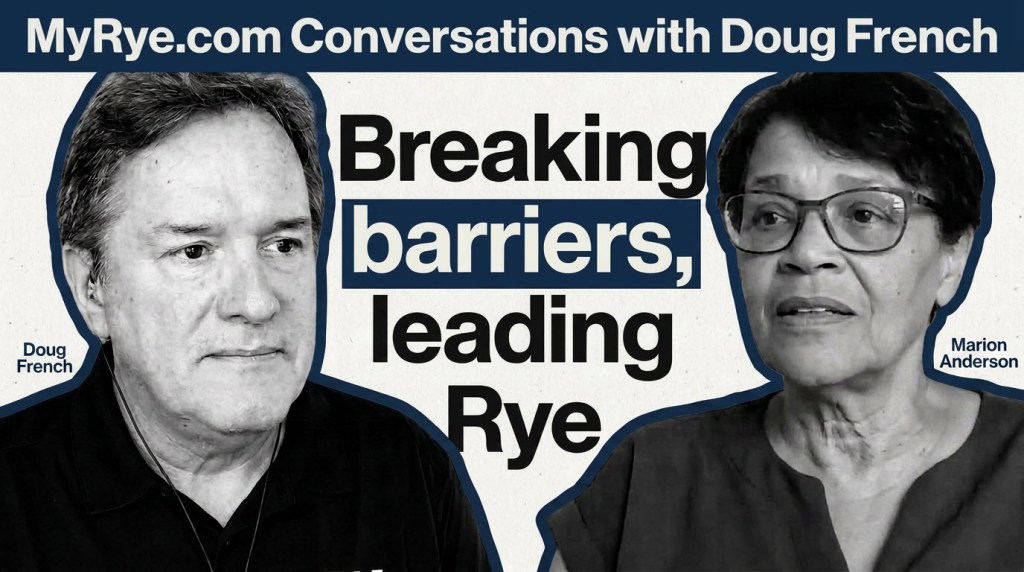
MyRye.com is entering the podcasting business with a new weekly podcast hosted by former Rye Mayor Doug French. Available on all major podcasting platforms, MyRye.com Conversations with Doug French will tackle the larger and sometimes intractable issues impacting the City of Rye through interviews with local, county and state officials and business leaders.
In Episode 15 of Season 1, French speaks to Marion Anderson, Rye’s first African American City Council member, as she shares her lifelong connection to Rye, groundbreaking achievements, and visions for a more inclusive, sustainable community. Explore key insights on community history, development challenges, and future initiatives shaping Rye’s character.
This episode of MyRye.com Conversations with Doug French was produced by MyRye.com. Feedback and story ideas are welcome.
Main Topics Covered:
- Marion Anderson recounts her historic election and family legacy of civic engagement
- Insights into Rye’s evolving demographics and community diversity
- Updates on the comprehensive plan: priorities around traffic, housing, and sustainability
- The Redd family’s civil rights legacy and the significance of the Rye Plaza memorial
- Strategies for balancing growth while preserving Rye’s small-town charm
- Future regional concerns: water, cell service, and environmental sustainability
- Encouragement for volunteerism and fostering an inclusive community environment
Timestamps:
00:00 – Introduction to Marion Anderson’s community journey and historic election
01:13 – Reflection on what her election meant for Rye community and diversity
02:07 – Childhood memories growing up in Rye’s Glen Oaks neighborhood
02:58 – Change and continuity on Purchase Street and community landmarks
04:07 – Family history, civic inspiration from parents, and voting rights significance
05:41 – The influence of her mother’s civic activism and legacy
06:47 – The Redd family’s civil rights activities and local impact
08:06 – The importance of community memorials and the Rye Plaza dedication process
14:54 – Update on the comprehensive plan, outreach efforts, and community engagement
17:06 – Challenges of traffic, housing affordability, and environmental resilience
18:03 – The median income and housing market in Rye
19:01 – Supporting young families and seniors through community planning
20:43 – Future community priorities: diversity, regional collaboration, and sustainability
22:08 – Preserving Rye’s charm amid growth and development challenges
23:00 – Fostering inclusivity, transparency, and regional cooperation
24:53 – Emerging issues: cell service, deer management, and climate initiatives
26:29 – Short answers: Rye’s future, community proud moments, favorite childhood memories
27:02 – The hours and dedication required for effective civic service
27:21 – Advice for young leaders: education and engagement
28:19 – Opportunities for promoting walkability, biking, and green initiatives
28:42 – Final thoughts: Rye’s community spirit and contact information for Marion Anderson
Watch:
Full Transcript:
Speakers
- MyRye.com (Doug French)
- Rye City Councilmember Marion Anderson
MyRye.com: Welcome to the MyRye.com podcast, Conversations with Doug French. I’m your host, Doug French, former mayor of the City of Rye, and this podcast is about the people and the issues that impact Rye and our surrounding region. Our focus is really to educate and inform you, our listeners, so you can engage on the issues that matter most to you.
Today in conversation is the topic of Rye City Council: Leadership, History, and Moving Forward. And with us is Marion Anderson, Rye City Council member and the first African American elected to the Rye City Council. Marion, welcome to MyRye.com.
Marion Anderson: Thank you. Happy to be here.
MyRye.com: So in this episode, I’d like our listeners to walk away with three things. First is Marion’s lifelong journey as a Rye resident and historic first on the City Council. Second is the progress on the city’s comprehensive plan. We spoke with the mayor earlier in an episode. Marion’s taking a leadership role in the comprehensive plan, so we’ll get an update as far as that stands. And then third is some of the issues that matter most to her when it comes to community, inclusion, and quality of life.
So to kick off the conversation, Marion, I’d like you to take us back to election night when you realized the historic moment of being the first African American elected to the City Council.
Marion Anderson: You know, you’ve already said I’ve grown up in Rye. It’s not a particularly diverse community, less diverse now than it was back then. It was a big moment. I thought back to my mom and dad, who moved here in the 1940s. I grew up in a totally white community, and it was a big moment, I think, for Rye, in a time that our country is in such upheaval and there are so many things going on.
It just made me proud for the community. It really did. It was a good thing.
MyRye.com: That’s great. So let’s dive into it a little bit. You are a true Rye lifer, born at United Hospital, no longer there, raised in Glen Oaks, graduated from Rye High School. What are some of the memories you remember growing up in Rye?
Marion Anderson: Well, as you said, I grew up in the Glen Oaks neighborhood. It was a primarily Italian neighborhood. A few Black families in the neighborhood, but it was the time when you were outside, you were playing, you were in and out of people’s homes. It was a very different way that people lived.
We were out on the streets playing stickball, having crabapple fights, just being left to our own devices, climbing trees, riding bikes. So it was a very innocent time back then. It was free.
MyRye.com: What was Purchase Street like?
Marion Anderson: Purchase Street, it’s very similar. What I love about Purchase Street is that many of the buildings that are there were there, and they’ve been repurposed into something else, which is kind of a cool thing.
So you look at OKO Restaurant. Way back in the day when I was a kid, that was a clothing store. But it’s been through so many iterations.
Rafele was Woolworths, and where their bar is, it was the counter for Woolworths. And then we had, at some point, the Gap. But the buildings are repurposed. It has that look, and there’s something familiar. There’s something nice about having that familiarity over the years with the structures. It’s cool.
MyRye.com: When I was doing some research for Rye Recreation, it was actually Jackie Onassis who had talked about preserving New York City and the landmarks so that when people mark their place and time, they want to come to some place familiar that other people before them have been. So, yeah, Purchase Street is like that.
You also talked about your family history, what it’s meant to you and how it’s really shaped your public service. Can you tell us some stories about that?
Marion Anderson: My parents moved to Rye in the late ’40s after the war. My dad was a Seabee in the Navy, and he was stationed in the Philippines. My mom came here first. She originated from Virginia, a very poor family, 14 children, on a farm.
Back then, she was able to go to sixth grade, and that’s when schooling stopped for an African American person in Virginia.
She came here to Rye, and I think one moment that I remember so clearly is in 1964 when the Voting Rights Act was passed. My mom went to vote at Osborn School, which my dad was a carpenter on, and she took us into the voting booth with her.
People don’t understand how important voting was. She was not a highly educated woman, cleaned houses, did laundry or whatever, but that right to vote was so important, and she instilled that in her kids. It’s just amazing.
MyRye.com: What a great story. What would she say now when she sees that you’re the first African American on the City Council?
Marion Anderson: She would be thrilled. I’m thinking, you know, my sister was actually the first person in her family to ever go to college. So we have some firsts.
My sister went off to Wellesley, transferred to Yale, and graduated from that first class of women graduating from Yale. So I think it’s just something in our family that we’re into the firsts and knowing how important it is to break those barriers, because then you’re opening up the barriers for others.
Right now, going to Yale as a woman, nobody would even think about it, right? But back in 1970, it was a big deal when my sister graduated.
MyRye.com: And how has your mother’s influence really impacted you in terms of civic engagement and guided you into the initiatives you get involved with?
Marion Anderson: I remember this political involvement was a big deal for her. And I remember going into the city and campaigning for Robert Kennedy and handing out literature on the street.
I remember on Purchase Street, kind of near what’s now the little mini mall, there was a John F. Kennedy office there in Rye when he was campaigning.
She made us aware of those things and just made sure that we were out there and standing up for ourselves because she had to fight her whole life. So she opened doors for us.
And the main goal for her was education. It is just like whatever you learn from a book, somebody can’t take it away from you. Your education, you got it, and how important that is because it was something that she was lacking.
MyRye.com: Great stories. I also see that you have championed initiatives for Paul and Orial Redd and the Plaza. Tell us about them.
Marion Anderson: Mr. and Mrs. Redd were here in Rye. They had children, Paul Junior and Paula. We all went to high school together.
However, the Redds, as their family was expanding, needed a larger home. And they became involved in trying to find an apartment.
It was just that perfect intersection of people in the community. We had a Jewish community that was living up on Kirby Lane North, and they were activists. One of those families, the Sterling family, the mother was a writer and she wrote African American history books.
She became a champion of the African American population in Rye, which was, I think, probably larger than it is now.
The Redds were looking for an apartment, and she helped them by going to Rye Colony. There was an open apartment, and she went to find out. She did the reconnaissance. The apartment was available, and she quickly got Orial, who was waiting across the street, to come over.
Well, suddenly that apartment was no longer available once she showed up at the door.
This then turned into other people getting involved. And one of those people was William Kunstler, the great civil rights attorney. It was one of his very first civil rights cases. He lived in Port Chester, and he took the case.
There was a cross burning, an eight-foot cross that was burned on the Sterlings’ property.
MyRye.com: So what year was this about?
Marion Anderson: This was about 1963, ’64, in the early ’60s.
Kunstler’s involvement led to a housing discrimination bill, a New York State bill, the Redd Bill. It’s named after Paul and Orial Redd, and that opened the door for them to be able to move into Rye Colony.
Eventually, Paul became the chair or the president of their board. But they were so involved in politics and human rights activities throughout Rye. That was just one step.
They owned a newspaper, the Westchester County Press, which is still in operation today. It is a newspaper that focuses on the African American community. Paul had a tagline, “M. Paul Tells All,” and that was his article. They still put that in that newspaper.
It lent a voice to the African American community in Westchester. So they branched out from Rye, involved in the Port Chester-Rye NAACP, National Association for the Advancement of Colored People. Both of them were past presidents.
The organization, of course, is still very active and I think becoming more active now in these times in Port Chester, Rye and throughout the nation.
He started the Westchester Black Democrats, which is an offshoot of the Westchester Democratic Committee. He was involved in the Urban League. He did a lot of work on housing and affordability and workforce work.
Mrs. Redd was no slouch. She was actually the very first African American, but also the very first woman, to be a deputy county executive for Westchester County.
MyRye.com: Wow, I didn’t know that. Interesting.
Marion Anderson: Yeah. So we now have the second woman, 50 years later. It’s the second woman. So she really broke barriers.
They both broke barriers. They were very involved with so many things in the community. They were incredible.
MyRye.com: And in the Plaza area that’s named after them, where do you define that area of the Plaza?
Marion Anderson: I did this with Ingraham Taylor. We went to high school together, Rye High School.
We went to the city and we did a presentation because we really wanted to get this done. And we were told kind of quietly, “You know what? You need to build a coalition. Get some people that are supporting this.”
Well, that was not very hard. This all really kind of started when Ingraham and I were talking at the Fourth of July event on the Village Green. Mrs. Redd had just passed away in June, and we said, “We need to really remember these people for what they have done for the community.”
It was not hard to build a coalition. So many people signed on. So many people were involved. We did go to the city. The city basically said, “You know what? You work with our city manager, and we will help you get this done.”
And it happened. We had politicians, we had nonpoliticians. It was just an incredible intersection. We would do Zoom meetings and there would be 20 people on the Zoom meeting to get it done.
MyRye.com: That’s great. So as we talk about how Rye changed over the years, one of the things that you and I talked about offline is there’s really a change in terms of age range.
People used to come at all ages, move here, live here, retire here. That’s really changed with a focus on schools, where people come primarily during the school-age years to raise their kids and then they move out.
So as we move to the comprehensive plan, you’re taking one of the leads. Give us an update on where that stands in terms of the outreach to the community and some of the main goals, because I know you’ve kicked off several meetings already.
Marion Anderson: Actually, this week there was a big kickoff meeting. A couple of big milestones: We have our steering committee that is working directly with our consultants, AKRF. They had their very first meeting, and they started laying out the priorities, their themes, their goals.
It was really interesting being a fly on the wall, listening to how this is going to happen.
Their role at this point is they’re going to start rolling out all different ways of engaging with the community. Can they come out at the sidewalk sales? Can they do small focus groups? Where can they meet?
The ultimate goal is to get a really rich cross-section of the people who live in Rye. Not the usual — we’ve got our people that are flamboyant and are out there — but we also have people that are living in apartments and that are a little bit more quiet and doing their work and coming home and going to sleep or whatever.
So we want to make sure that we are getting a rich cross-section of everyone in the community.
They’re going to start working on setting up focus groups, but they’re also going to be working on setting up subcommittees that might work on specific tasks, such as traffic or zoning.
MyRye.com: What can you share in terms of the priorities and the themes that you mentioned?
Marion Anderson: Land use. Rye is landlocked. There’s really not much property out there for us anymore. So what is the community goal, and what is it that we’re going to be looking at as we are building in Rye or not building in Rye? How can we do that? Big question.
Transportation and traffic. That’s something that has changed dramatically over the years. There is a lot of traffic in Rye.
Looking at green infrastructure. I know the school district is going back to talking about busing or not busing, but you go to the schools and the traffic is just abysmal. It’s very hard to get around the community.
Flooding, resiliency, moderate-income housing, because the economics of the community have changed dramatically. How can we live and stay in Rye? How can we make it affordable for people to be able to have their children stay and live here?
MyRye.com: You had mentioned the median household income as well as the purchase price. Can you share those stats with me?
Marion Anderson: I just read an article this morning, and it was in the White Plains Patch. Rye has a median income reported at $483,000-plus per year, and the housing median cost is $2.2 million.
So that’s the upper echelon. However, we do have people that are much, much, much more modest in their income, people living on Social Security, people living on much less.
So how do we balance that? It’s all about finding balance.
MyRye.com: And so how do we balance that? With your background in early childhood education and working with nonprofits, how do we better support those young families and seniors? Any ideas that the city’s discussing?
Marion Anderson: Well, I’m discussing things that I really would love to see us talking a lot more about as we are building.
We’re going to be building. Our old comprehensive plan was about single-family homes. We’re not going to be building too many single-family homes except knocking something down and building something up in its place.
But new real stock that people can afford — we need to be looking at moderate-income housing, how that would look in our community, that would give people the opportunity to start here.
When I was campaigning, these people just stuck with me. It was a young couple with two kids, stroller, and they lived on Theodore Fremd in apartments. They were both attorneys, and they were lamenting the fact that they don’t think they would be able to afford to stay in Rye.
This was a dual-income family, professionals who were worried about their struggle to do it because it’s a really appealing community.
How do we address this? I think this is one of these things comprehensive planning can help us really dialogue about and figure out how we can diversify economics in the community a little bit, re-diversify the ethnicity within the community.
It’s about making us a little bit more diverse community, but on multiple fronts. It’s not all about ethnicity.
MyRye.com: Exactly. And so seniors can stay here as well and retire, because more and more seniors want to stay at home. They don’t want to have to move or move to assisted living. They’d rather just stay at home. SPRYE, for example.
Marion Anderson: Right, exactly. For my mom, it was something we were able to do. She stayed in her house until her death.
It wasn’t an easy thing to do, but it was very important for her to be able to live in her home.
MyRye.com: So let’s pivot now to looking ahead in the community. In many of your remarks on Inauguration Day and at the annual meeting at the Square House, you spoke about community progress, the importance of volunteerism, preserving Rye’s character while moving forward.
Can you share some of your thoughts around those comments?
Marion Anderson: I think Rye is such a unique community. And there are so many wonderful things that I think it’s important for us to be able to look at and figure out how to preserve or refurbish and reuse in a different way rather than tearing things down.
I think many people are concerned about Harrison over here, Port Chester over here, what their building is looking like, and kind of seeing things going straight up. Is that something that we want to see in our community?
So it’s looking at all of these things and trying to figure out: How do we maintain the best, which is that, I think, small, quaint hometown feel? That little curve to Purchase Street, the architecture, the dentils, the arched windows, those kinds of things.
How do we preserve those things and maintain that, but also make it new at the same time?
MyRye.com: And you’ve also talked about collaboration, transparency, bringing diverse voices to the table. How do we foster a greater inclusive environment and unity?
Marion Anderson: I think so far, six months in, our council and our mayor have done an awesome job of just that, of really starting to reach out.
This is also with the county. It’s trying to forge a positive relationship with the county.
There’s now an intermunicipal agreement between Rye Town, Rye and Harrison. First time Harrison has actually come to the table with us to talk about flooding and Beaver Brook and that kind of thing. So those conversations are going on. It is a first.
It’s LISWIC, which is 14 communities. Rye is part of those 14 communities. It’s been reinvigorated, and we’re looking at flooding.
Water does not care about artificial boundaries of communities. So we have to be working together. The only way to work together is to talk together. So it’s really about getting the dialogues done.
We’re working with Rye Country Day School on what they needed to get done. Osborn Home, it’s been a very long process, but they finally got their approvals.
Senior care is changing, and it’s allowing them to be able to update their model and have programs and services that are going to meet the challenges moving 10, 20, 30 years into the future, which is what we all need to be doing.
MyRye.com: Exactly. So just to sum up on the look ahead, issues are regional. Are there any other emerging priorities that you’re seeing with Rye or with the county that residents should be aware of on a regional focus?
Marion Anderson: I think we’re really starting to look — we have been looking — but do a deep dive into cell service. It’s a problem in certain parts of the city.
There’s a commission working on the deer population, and there’s a committee that’s working on that. So there are so many little things that are going on in the community.
Definitely sustainability efforts. Part of the July Fourth events is 250 years’ worth of trees in Rye. We want to preserve those also. It’s about our environment.
And I think we did a great job — not everybody’s going to think so — but on the leaf blower, I think we came to a pretty quick consensus. And I was thrilled this morning to see the city actually had a battery-powered mower doing the Village Green, and it was so quiet. My dog just kind of laid down and watched.
So it’s good. It’s good stuff.
MyRye.com: That is good stuff. It used to be, “Hey, how come I have to do it on my property, but the city doesn’t have to do it?” So it’s good to see.
I just want to let our listeners know, if you have a topic or person of interest that you’d like to hear on the MyRye.com Podcast, Conversations with Doug French, just email me at French@MyRye.com or let me know around town.
So we will move to our last section, which is the lightning round. It’s one more short answer, just to kind of change the cadence a little bit.
If you could describe Rye’s vision for the future in one word, what would that be?
Marion Anderson: Quaint.
MyRye.com: Quaint. Your proudest moment in community service so far?
Marion Anderson: There have been a lot of them, but I think the Redd project, getting that done, was just a real big deal.
MyRye.com: A favorite Rye memory growing up?
Marion Anderson: Hanging out in the streets with the kids.
MyRye.com: What is the toughest part of being on the City Council?
Marion Anderson: The hours. I work full time, and then to go into a City Council meeting, I’m losing sleep.
MyRye.com: Yeah, definitely a lot more hours than people expect going in.
Marion Anderson: Exactly. It’s intensive.
MyRye.com: Best advice for young leaders in Rye?
Marion Anderson: Educate yourself.
MyRye.com: Favorite spot to take a walk in Rye?
Marion Anderson: A couple: Rye Town Park, Village Green.
MyRye.com: How about your favorite spot for coffee?
Marion Anderson: Actually, my kitchen.
MyRye.com: Great answer. Now, we do have deer coming up as a topic in a future episode, so that was a nice shout-out earlier. But any other suggestion for a future podcast topic or guest that you would recommend?
Marion Anderson: I would love to start talking about traffic and some green initiatives around figuring out how we can mitigate and get people to learn how to walk.
I would love to see a walking and a bike-riding — not electric bike, but a bike-riding — community that we can get out.
I walk a lot, and I know one of our other City Council people, Jamie Jensen, is always walking all over the community. She outdoes me, but it’s great meeting people.
MyRye.com: That’s great, too. Any final thoughts before we close out the session?
Marion Anderson: Rye is a great community. Rye is a welcoming community, and I think we’re all just very lucky to be in Rye.
MyRye.com: That’s great. Marion, really a pleasure to get to know you better, hear your insights, and also thank you for your service to the community. It’s great to have you on the council.
Should people want to contact you, what is the best way?
Marion Anderson: My city email: MAnderson@ryeny.gov.
MyRye.com: And thank you again, Marion.
To our listeners, you can find the full episode, transcripts, local news and more at MyRye.com. If you enjoyed this episode, please follow or subscribe wherever you listen to your podcasts, or give us a comment and/or a thumbs-up.
Thank you all for listening to the MyRye.com Podcast, Conversations with Doug French. And we’ll see you next time.
Marion, thanks again.
Marion Anderson: Thank you.

I am glad that Marion Anderson is on the Rye City Council and that she is such an important part of Rye’s future plans. Her input is invaluable.