
RyeGPT People of Note is a series highlighting individuals who have a connection to the City of Rye. In the series we ask OpenAI’s ChatGPT to prepare a biography and explain the individual’s connection to Rye.
We welcome your feedback on this series – the use of artificial intelligence, the accuracy and usefulness of each article and your assistance in understanding other pertinent insights related to the person’s connection to Rye.
You can add comments at the bottom of each article or you can send feedback via Tips & Letters.
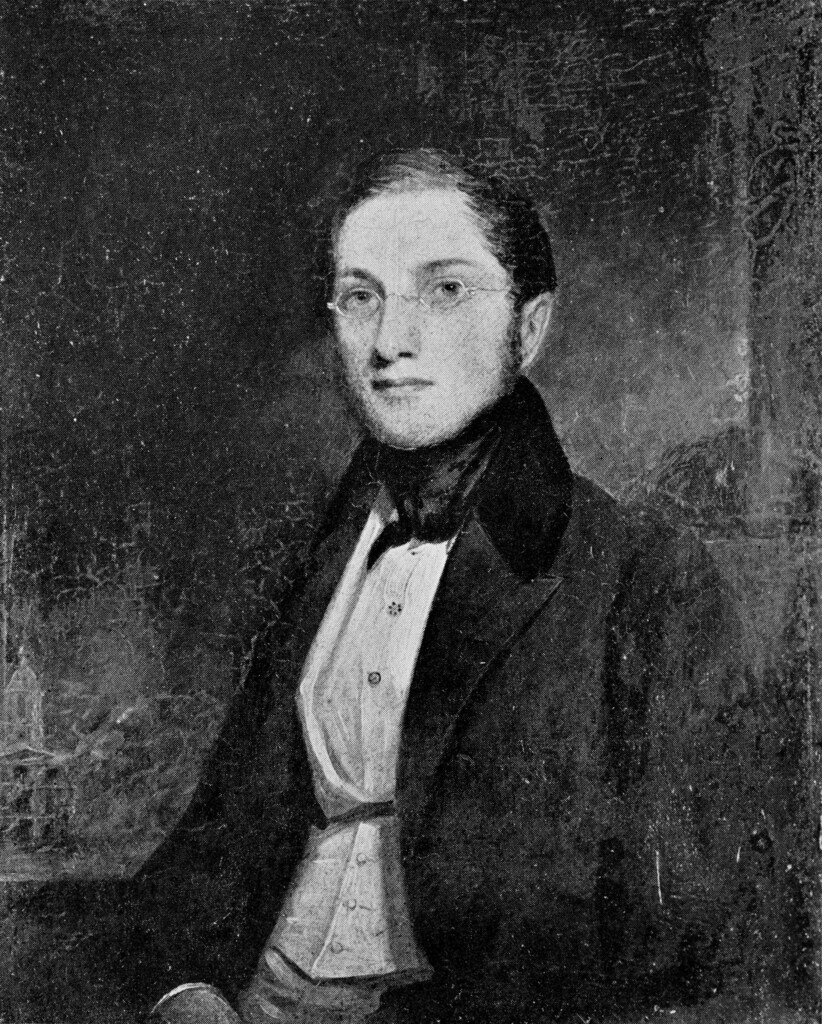
Early Life and Family Heritage
Born in New York City on September 11, 1808, John Clarkson Jay was the eldest of eight children born to Peter Augustus Jay—a prominent attorney and Recorder of New York City—and Mary Rutherfurd Clarkson Jay. His lineage carried deep roots in American public life: his paternal grandfather was John Jay, the diplomat, co-author of The Federalist Papers, and first Chief Justice of the United States.
Jay received a classical education fitting for his family’s standing. He attended Columbia College, graduating in 1827, and subsequently earned his medical degree from the College of Physicians and Surgeons in 1831. On November 8, 1831, he married Laura Prime, daughter of the prominent New York banker Nathaniel Prime. The couple had eleven children, five of whom survived to adulthood.
Though trained as a physician, Jay soon shifted his focus toward business—becoming a partner in the mercantile firm Gracie, Prime & Co.—and dedicated much of his intellectual life to the natural sciences.
A Passion Rooted in Rye’s Waters
Jay’s fascination with nature began during his childhood visits to his family’s ancestral property in Rye. Walking along the shoreline of Milton Harbor and Long Island Sound on the Rye farm, he began collecting shells—a pastime that grew into an internationally recognized scientific career in conchology (the study of mollusk shells).
Over several decades, Jay assembled what became the most extensive private collection of shells in the United States, comprising more than 50,000 specimens and thousands of distinct species from across the globe. He published foundational catalogs in the field, including Catalogue of Recent Shells (1835) and Description of New and Rare Shells (1836). In 1854, when Commodore Matthew C. Perry returned from his landmark naval expedition to Japan, the shell specimens gathered during the voyage were submitted to Dr. Jay for scientific examination and cataloging.
Jay’s collection and extensive 1,000-volume scientific library were later acquired by philanthropist Catharine Lorillard Wolfe and presented to the American Museum of Natural History, forming the cornerstone of the museum’s malacological department.
Civic Leadership and the New York Yacht Club
In addition to his conchological work, Jay was heavily involved in New York’s scientific and civic institutions. In 1832, he joined the Lyceum of Natural History (later renamed the New York Academy of Sciences), serving as its librarian in 1833 and treasurer from 1836 to 1843. From 1859 to 1880, he served as a trustee of Columbia College.
Jay was also a pioneer in maritime sports. In July 1844, he joined eight other prominent yacht owners aboard John Cox Stevens’s yacht Gimcrack in New York Harbor to found the New York Yacht Club (NYYC). Jay served as the club’s early secretary and skippered his own 44-foot yacht, Coquille.
Life at the Jay Estate in Rye
Following the death of his father, Peter Augustus Jay, in 1843, John Clarkson Jay inherited the family’s Rye property. That same year, Jay retired from his active Manhattan business pursuits and moved permanently to the Rye estate to care for the property as a full-time resident.
For nearly five decades, Jay made his home at the 1838 Greek Revival mansion built by his father on the site where Founding Father John Jay spent his youth. During his 48 years as a resident of Rye, Jay maintained the estate, oversaw its expansive farmland and gardens overlooking Milton Harbor, and continued his research until his later years.
Dr. John Clarkson Jay passed away at his home in Rye on November 15, 1891, at the age of 83, outliving his wife Laura, who died in 1888. He was buried in the Jay Family Cemetery in Rye.
Today, Dr. Jay’s former residence serves as the focal point of the 23-acre Jay Estate—the centerpiece of the Boston Post Road Historic District, a National Historic Landmark managed by the Jay Heritage Center.