

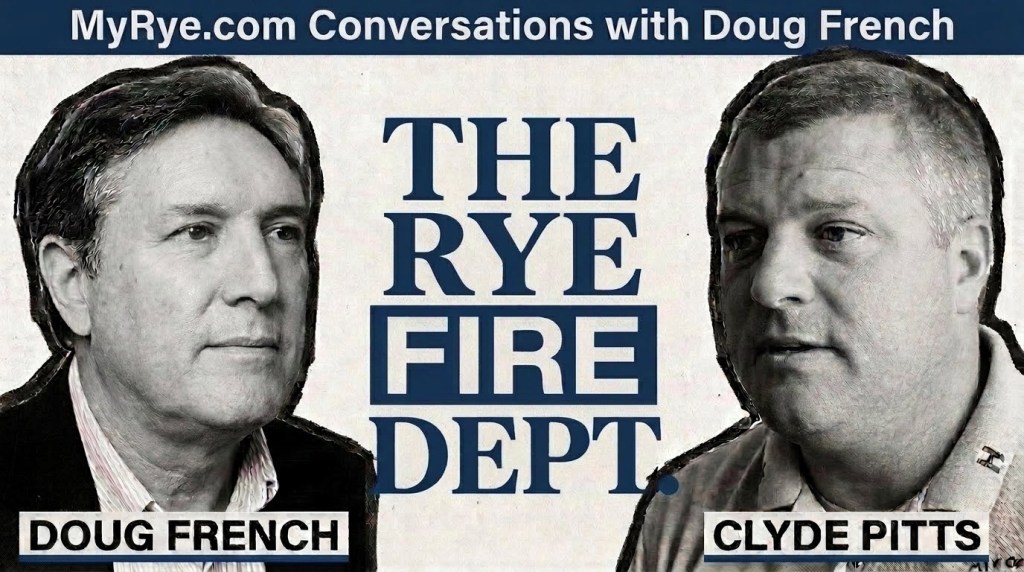
MyRye.com is entering the podcasting business with a new weekly podcast hosted by former Rye Mayor Doug French. Available on all major podcasting platforms, MyRye.com Conversations with Doug French will tackle the larger and sometimes intractable issues impacting the City of Rye through interviews with local, county and state officials and business leaders.
In Episode 20 of Season 1, French speaks to Clyde Pitts, longtime captain of the City of Rye Fire Department, about practical fire prevention, household preparedness, and how Rye’s combination department (paid and volunteer) operates. The conversation focuses on what residents can do at home to reduce risk, plus how the department uses training, technology, and mutual aid to respond quickly and effectively.
In this episode, French and Pitts cover everything from lithium ion battery safety and smoke detector maintenance to evacuation planning, senior check-ins, and the department’s growing use of drones.
This episode of MyRye.com Conversations with Doug French was produced by MyRye.com. Feedback and story ideas are welcome.
Main Topics Covered:
- Pitts describes the first few minutes of a fire response as the most chaotic part, with crews gathering information, coordinating resources, and adapting to changing smoke, heat, and access conditions.
- How fire can double every 30 seconds and why synthetic materials in modern homes make fires burn hotter and faster than many people expect.
- Pitts outlines the most common residential fire causes in Rye: electrical issues, cooking, unattended candles, and the growing risk from lithium ion batteries.
- Practical guidance on lithium ion safety, especially using manufacturer-recommended chargers, avoiding soft surfaces like beds during charging, and storing devices on hard surfaces.
- Prevention basics every household should have in place: working smoke detectors, carbon monoxide detectors, a fire extinguisher or fire blanket, and a family evacuation plan.
- Pitts explains that hardwired or interconnected detectors offer better protection, and that sensors have replacement timelines even if batteries are still being changed regularly.
- The conversation covers family escape planning, including identifying multiple exits, choosing a meeting point, and knowing how to alert 911 or a neighbor if someone needs help quickly.
- For seniors aging in place, Pitts stresses the importance of having someone that checks in regularly, sleeping with the bedroom door closed, and using technology or trusted contacts to speed emergency response.
- The department’s Community Connect system is highlighted as a major planning tool, allowing residents to share address-specific details such as bedroom count, shutoffs, and other critical notes before an emergency.
- Pitts explains that Rye Fire is a combination department made up of career and volunteer firefighters, with two engines and one ladder truck in the career side and additional volunteer companies supporting response.
- He notes that the department handled 1,400 calls last year and is on pace to exceed that number, with responsibilities that now include fires, technical rescue, flooding, and other all-hazards incidents.
- We discuss the role of drones in response, including locating highway incidents, scouting smoke or fire before arrival, and helping crews approach from the safest and fastest direction.
- Pitts also walks through mutual aid and automatic aid, including regular coordination with nearby departments and the way staffing, apparatus, and contingency planning support readiness.
- The episode closes with community outreach efforts, annual fundraising, school education programs, and the October open house designed to make fire prevention more interactive and approachable.
Timestamps:
00:00 – What the MyRye podcast covers and why local issues matter
00:29 – Introducing Clyde Pitts and the fire safety focus
01:13 – What the first minutes of a fire scene are really like
02:46 – Why fire spreads faster in modern homes
03:29 – Leading causes of residential fires in Rye and beyond
04:04 – Chimney maintenance, fireplace screens, and ember safety
05:09 – Safe lithium ion battery charging and kitchen fire basics
06:23 – Smoke detectors, carbon monoxide alarms, extinguishers, and evacuation plans
07:48 – Why testing is not enough if sensors are past replacement age
08:47 – Building a family escape plan with routes and a meeting point
09:44 – Using an egress ladder from a second story
10:31 – Fire safety planning for seniors living alone
11:01 – Why sleeping with the bedroom door closed buys time
11:31 – How Community Connect helps firefighters pre-plan by address
14:25 – Apartment and condo fire safety and knowing the exits
17:07 – How Rye Fire is structured as a combination department
19:04 – Why volunteer numbers have declined and training demands have changed
21:06 – How inspections, training, and prevention all connect
22:39 – What firefighters carry and why the gear is so physically demanding
23:30 – Why Rye Fire call volume keeps rising and what “all hazards” means
24:57 – How drones help locate incidents and improve response
26:35 – Why 911 is the safest first call in an emergency
27:52 – What residents should tell firefighters when they arrive
29:20 – How Rye coordinates mutual aid and automatic aid with neighboring departments
31:39 – The biggest operational pressures: staffing, equipment, and readiness
33:13 – Fundraising, prevention education, and the annual open house
36:00 – Lightning round: arrival, progressive culture, and readiness
36:55 – Lessons learned from past incidents and improving every response
38:21 – Where to find department information and inspection scheduling
38:42 – Final thanks to the community and city leadership
Watch:
Full Transcript [edited for clarity]:
Speakers
- MyRye.com (Doug French)
- Captain Clyde Pitts, Rye Fire Department
00:12 — MyRye.com, Doug French
Welcome to the MyRye.com podcast, Conversations with Doug French. I’m your host, Doug French, former mayor of the City of Rye. This podcast is about the issues and the people that impact Rye and our surrounding region. Our aim is to inform so you can engage on the local and regional issues that matter most to you. And we’re here every week. Each week, we cover a topic about the city and the local community. This week’s conversation is about fire safety. What to know, how to prevent and prepare, and how the Rye Fire Department keeps us safe. Joining me is Clyde Pitts, longtime captain of the City of Rye Fire Department. Captain, welcome to MyRye.com
00:50 — Captain Clyde Pitts, Rye Fire Department
Good afternoon, Doug. Thank you for having us and taking interest in what we’re doing here at the fire department.
00:55 — MyRye.com, Doug French
Absolutely, absolutely. So to open things up, and I’ll call you Captain. Most people only know fire emergencies for what they see on TV. So can you paint a picture for the audience about what’s it like to be in a fire, the heat, the visibility, the noise, those types of things?
01:09 — Captain Clyde Pitts, Rye Fire Department
Yeah, so probably the most chaotic part is the first few minutes, the arrival, and hopefully it looks more organized than maybe what it appears. But that’s really the most chaotic because that’s where you’re trying to gather all the unknown information and homeowners coming at you with more information. You’re dealing with where’s the smoke coming from, where is it going, flames. You’re you’re trying to coordinate your resources. Same time the radio is going off with additional resources. Trying to get in touch with you. So that’s really the most chaotic part. When you mentioned the heat, the smoke, you know, obviously those are things that we train for.
We try to train in the most realistic conditions. You can circumvent the heat a little bit, obviously by supplying water to the fire or creating a thermal layer to kind of change the environment. And then obviously sometimes if the heat is too intense, you know you’re too deep and you have to reposition yourself to where even our gear can only take so much. So you reposition yourself to a position that you’re comfortable enough to be in, but you can still address the emergency
02:15 — MyRye.com, Doug French
So what are some of the misconceptions that people have about fire? Because I mean you’ve been in and you’ve got the equipment, but if you’re a resident and you’re in a fire, what are some of the misconceptions people have?
02:24 — Captain Clyde Pitts, Rye Fire Department
About the fire department or fire itself.
02:26 — MyRye.com, Doug French
Fire itself.
02:27 — Captain Clyde Pitts, Rye Fire Department
So the fire itself, I think what most people don’t understand is fire doubles every thirty seconds. And in today’s world, we live with a lot of synthetic materials in our homes, our couches, our decorations. They’re not what used to be considered legacy furniture. And they burn hotter, they burn faster. And planning for that potential incident is really key to a successful outcome.
02:52 — MyRye.com, Doug French
And what are some of the leading causes of residential fires these days?
02:57 — Captain Clyde Pitts, Rye Fire Department
Electrical issues, cooking issues. They’re usually very ordinary things that happen. And, you know, you’re still seeing candles that get left unattended. We are starting to see an uptick in lithium ion batteries, and how they are charged and stored and those are creating hazards these days as well.
03:15 — MyRye.com, Doug French
There are also a lot of applications for outdoor burning fireplaces, wood burning fireplaces. Have you seen any issues with that?
03:22 — Captain Clyde Pitts, Rye Fire Department
Yeah, I mean, you know, an unmaintained chimney obviously could create creosote buildup, it will create chimney fires. And then just having a proper cover, screen cover, glass cover in the front to keep popping embers and things from popping out. You know, if I was to look at call logs of just fire incidents alone, it’s probably been a while since we’ve had fireplace-related incidents that weren’t quickly resolved just by taking the logs out of the fireplace. You know, nothing that created fire extension. So you know not as much as you see in the past. A lot of people have switched to gas. So you have a little cleaner burning fuel there, which reduces those types of incidents.
04:01 — MyRye.com, Doug French
So with the rise in the lithium ion batteries and people doing a lot more cooking these days, it looks like everybody’s got something going on in the kitchen and candles and space heaters. I mean, any practical advice for residents when it comes to dealing with those types of appliances?
04:16 — Captain Clyde Pitts, Rye Fire Department
Yeah, so when it comes to the lithium ion batteries, you know, charging and storage are the two main topics, charging with the proper cables that are recommended by the manufacturer. How you store them, don’t charge things on combustible, soft surfaces, try to keep them on a hard surface. A lot of people like to charge their phones, their iPads, and lay them on beds, and that’s where when things are charging, they’re heating up and then that’s where sometimes those reactions happen. And then when the batteries get too hot and they fail and potentially catch fire, they’re going to burn very hot. So things around it are going to burn significantly quicker.
And then when it comes to cooking, you know, the biggest thing is always having a fire extinguisher that you know where it is. And also just don’t leave it unattended. You know, if you’re cooking, adult, child, and so forth, you’re not going to be cooking and leaving things unattended unless it’s safely contained in a pot or something like that.
05:10 — MyRye.com, Doug French
So let’s pivot to prevention and preparation. You mentioned fire extinguishers. You know, what other types of household items should people have in place?
05:17 — Captain Clyde Pitts, Rye Fire Department
So everybody should always have working smoke detectors, carbon monoxide detectors, and ‘working’ includes testing them regularly. Like I said, a fire extinguisher or even a fire blanket, having them, knowing where they are, knowing how to use them, and then an evacuation plan is key to have as well.
05:33 — MyRye.com, Doug French
Does it matter if they’re wired or battery? Is there a difference?
05:37 — Captain Clyde Pitts, Rye Fire Department
Any detection is better than no detection. So anytime you can have them hardwired or what’s considered interconnected to where if one goes off, they all go off, you have a better chance of hearing that, especially in the middle of the night. And then anytime it can be tied back into a monitoring service also allows for if you’re not home, we’re going to get the call faster and then we can get there and you know, mitigate that situation much quicker.
06:02 — MyRye.com, Doug French
So I mean you’re essentially talking about smartphone and smart-home technology, right? Are you seeing more and more residents applying those?
06:08 — Captain Clyde Pitts, Rye Fire Department
We do, yeah. I mean a lot of things are a lot more user-friendly, less manual interaction with switches and programming timers and things like that. So you are seeing a lot more of that kind of stuff.
06:19 — MyRye.com, Doug French
So what are some of the common mistakes that people make, just probably not replacing the batteries or testing?
06:24 — Captain Clyde Pitts, Rye Fire Department
When it comes to detectors?
06:25 — MyRye.com, Doug French
Yeah.
06:26 — Captain Clyde Pitts, Rye Fire Department
Yeah. So yeah, I mean a lot of things, you know, it chirps in the middle of the night, you take the battery out or you take it down and you just be kind of out of sight now, out of mind, you forget about it. And then just also, following the manufacturer’s replacement guidelines. Typically smoke detectors that are solely smoke detectors, the sensors are only good for ten years. And if it’s detecting carbon monoxide, that sensor is usually only good for five years. So a lot of times you’ll see, even though they’re changing batteries or hitting the test button, it doesn’t mean that the sensor is as you know sensitive as it should be. And this therefore, regular replacement according to the manufacturer’s specifications is important.
07:02 — MyRye.com, Doug French
Okay. You mentioned it briefly, but I’d like to go through some of the practical steps that families should be doing to kind of reduce some of the risk, just simple habits. You mentioned, you know, creating a family escape. Can you kind of walk through what a plan would look like?
07:14 — Captain Clyde Pitts, Rye Fire Department
Yeah, so a family should plan their escape routes and where they’re going to meet. So, a bedroom has a window and a door typically to meet code. So if you can’t get out the door to the hallway, you know what you’re doing at the window. You have back doors, front doors. If you can’t get out one, you know how to go to the other. And then that way you know where a central meeting point is, and also how to alert the fire department. If you know if you’re getting out hastily and you can’t grab your phone, you go to a neighbor’s house, you alert the fire department, police department, EMS, depending on what your emergency is, and get that ball rolling as well.
07:52 — MyRye.com, Doug French
What about fire ladders out the window? I mean, is that recommended as well if you’re on a second story?
07:56 — Captain Clyde Pitts, Rye Fire Department
Yeah, definitely. I mean, I remember growing up we had one you know, in my parents’ room because their particular room location, that would be the best secondary egress for them. So if somebody has the ability to have an egress ladder that they could keep stored under their bed, and easily accessible, obviously knowing how to use it is key. And potentially even practicing with it, maybe on a lower window just for setup and ease of getting out and getting out safely.
08:21 — MyRye.com, Doug French
You know, there’s the rise of seniors aging in place, huge trend in Rye and the surrounding areas. What if you live alone? Same type of process, but should you have a kind of a contact, a neighbor or somebody to align with?
08:34 — Captain Clyde Pitts, Rye Fire Department
Yeah, especially when you’re speaking about, like you said, seniors, always having that person that checks in on you, and so forth. I remember again, growing up, my grandmother used to let her neighbors know if everything was okay by which window shade was supposed to be open by a certain time.
08:50 — MyRye.com, Doug French
Nice.
08:50 — Captain Clyde Pitts, Rye Fire Department
You know, today’s technology that’s definitely old school, but having that kind of setup to where, you know, people are checking in on you. You know, you live alone, having a way to signal the need for help quickly is important. And then, you know, we do emphasize in the fire service that if you can sleep with your bedroom door closed, it just buys you so much extra time for either escape or shelter in place until you know the fire department comes and can assist you out of a window or something. So again for seniors, if they’re sleeping with their bedroom doors closed and something happens, essentially they can shelter in place there. And then we’re going to be coming to assist.
We talk about technology we have with our software that we’ve invested into the last couple years. You do have the ability to get into our software, it’s called Community Connect. And unfortunately I don’t have the exact website to share, but it’s easiest to go to the RyeNY.gov and under the Fire Department page under Government, you’ll be able to access it quickly. And you can put in information in there that’s going to be tied to your address, which gives us very crucial pre-plan information so we have an idea en route what we’re dealing with. So not just only could it be a senior that lives alone, but they’re also telling us, you know, how many bedrooms the home has, where specific shutoffs are, things like that, all these things that we don’t really get to go into residential properties and pre-plan, they can give us on their own.
10:15 — MyRye.com, Doug French
I love that. When I was in office, we had a huge storm—I think it was Sandy that knocked out so much of our infrastructure. Had we had that information in advance, it would have helped outreach and emergency response. I think we need to promote this more. I’m going to have a council person coming up in the next couple of weeks. We really need to promote that because that is a great asset and it takes out the noise and confusion you talked about once you get on-site. If you have that information in advance, isn’t that going to help knowing a lot of information going in?
10:52 — Captain Clyde Pitts, Rye Fire Department
Yeah, I mean it’s really crucial when we get it. We always utilize it for commercial buildings because they’re obviously bigger and present greater hazards. But in today’s world of technology, which we’ve been speaking about so much already, it’s such a tool to have that doesn’t cost an extra body, you know, personnel wise, it’s not an extra piece of apparatus, it’s all built into a database. It pops up every rig has an iPad in it, they can see this information. And it’s like anything, the more you put into it, the more you’re going to get out of it.
11:21 — MyRye.com, Doug French
And especially with flooding in Rye, right? So if you know seniors are living alone, or have medication or other needs responders should know about, you have that information as it’s called Community Connect. So it has that type of information as well?
11:33 — Captain Clyde Pitts, Rye Fire Department
Correct, yeah. You could put a lot of things in there. There’s even just room for just general notes. So all good stuff that can be put in there.
11:40 — MyRye.com, Doug French
Excellent, that’s a great idea. What about multistory apartments, that kind of thing? Is there any advice for folks that live in apartments or condos?
11:48 — Captain Clyde Pitts, Rye Fire Department
Yeah, I mean we do regular inspections in anything that’s a multiple dwelling, which is three dwelling units or more. So we’re going to be inspecting the common spaces for all the things that fall under the general fire code. But yeah, and the same thing, like just knowing your exits and knowing that path out. A lot of times a dwelling like that, the alarm system is tied to a monitoring service. It’s going to be in the common spaces and then individual apartments are going to be local. So they’re only going to be sounding in that apartment itself. That way if you’re cooking and you set it off, it won’t sound throughout the building. But if you hear the common alarm, you should basically be looking to get out and then let us figure out what the cause was.
And the more people that are obviously out of the building, the easier it is for us to affect and mitigate whatever the root cause was.
12:34 — MyRye.com, Doug French
Okay. Great.
12:35 — Captain Clyde Pitts, Rye Fire Department
Instead of having to worry about additionally finding staffing to get the general population out of the building.
12:41 — MyRye.com, Doug French
Okay. Let’s take just a quick pause here, and I just want to remind our audience if you have a topic or person you’d like to hear on the MyRye.com podcast Conversations with Doug French, simply email me at French at MyRye.com or just let me know around town. We’re here once a week, and you can find us on Apple Podcasts, Spotify, iHeart, and YouTube weekly. You can also find us at MyRye.com with links to all of those formats. So please share, like, subscribe, and leave a comment about the podcast. We are growing, so spread the word. Our conversations are timeless. So listening to past podcasts on topics of interest can really get you up to date with experts on those local and regional issues.
And we’re getting great feedback. Some of the feedback is the weekly images that come out of the podcast. Those will improve if I talk to our crack staff. If you watch this on YouTube, you’ll see it’s a great podcast, though some of the imagery gets some comments from time to time. Also I want to mention the MyRye.com studio. So firefighter Peter Kennedy, about 15, 20 years ago, painted this room before it became a studio. So kudos to Peter for that. Little did he know it would be on YouTube one of these days. So let’s pivot to the organization and operation. Let’s talk about how the fire department keeps us safe. Can you just walk us through the structure and operation in terms of the staffing and the number of companies, that kind of thing?
14:00 — Captain Clyde Pitts, Rye Fire Department
Yeah, so the department is what’s considered a combination department, which is made up of career firefighters and volunteer firefighters. On the volunteer side, you have four companies, so two engine companies, a ladder company, and a patrol company. Additionally we have the ladies auxiliary. So I guess you could consider five companies. On the career side, it’s not really made up of companies, but we run two engines and one ladder truck. As first due to most calls, most incidents. So staffing for a general day usually consists of not counting me, is five, which will be an officer and four firefighters. If you’re on if you have a vacation, you’ll be down to one officer and three firefighters.
I’m here Monday through Friday and am on call as needed when the incidents are larger. And that’s basically how we run. The four to five career firefighters are staffed 24/7. We go to each and every incident and then we’re supplemented by the volunteers when they’re available. And then typically, if it’s a structure fire or kind of an extended operation type of event, you will typically get two or three volunteers. Volunteer Chief Dan Bochicchio makes a ton of calls every year. And that’s what makes up the initial response from us. We do have mutual aid, automatic-aid agreements with other departments as well.
15:24 — MyRye.com, Doug French
So how’s that model working? I mean, years and years and years ago it was more of a volunteer and a smaller paid staff. We’ve shifted now to more paid staff and fewer volunteers, is that right?
15:35 — Captain Clyde Pitts, Rye Fire Department
Yeah. You know, going back, it used to be more volunteer-driven and the career side was definitely smaller, and the career side was usually driving the rigs and volunteers were jumping on. But in today’s world, I was a volunteer for five years before I got hired. The demand for the certifications and training to get to that level is just tough. So it’s not Rye-driven, it’s nationwide. But I remember, from September to December, I took my initial classes and I completed Firefighter one, firefighter two, and what was called survival. So basically three classes in the time from September to December, which made me ready to go. And then in today’s criteria and structure that has to happen with New York State, you’re going to get one of those classes in that time frame.
So, the demand on somebody to have a job. Have a family, put in that kind of time, it’s tough. So the numbers dwindle down. But it still works. We get guys and girls all the time that join. Not in alarming numbers, but you know, here and there. And then they’re as active as they can be. And like I said, when it’s something major, you’ll see them pop up and you know they’re listening. So if it’s an automatic alarm and they can clearly hear quickly that it was just food on the stove, then you know, you might not see them. But as soon as they know it’s something, you will see, you know, a lot of the same active members, very often.
16:56 — MyRye.com, Doug French
Yeah, we saw the same transition with EMS where it used to be heavily volunteer-based. But as you say, with the certifications and the specialized knowledge, you need more paid personnel to handle these incidents. How do you do so how do you balance all the work? Yeah, fire suppression, inspections, preventative work. I mean, how do you balance it as a captain?
17:15 — Captain Clyde Pitts, Rye Fire Department
Yeah, so we kind of treat that as it’s one mission, right? So they all work together. If we’re doing inspections, we’re being preventative. We’re also planning because we’re getting in the buildings. All five lieutenants and myself are code-enforcement officials, different levels of that. So we all have the ability to do inspections. They bring out their crews, the crews have the ability to see the building, plan the building, put it into the program we were speaking of earlier. Which globally is called First Due Community Connect is just a piece that interacts with the community for their feedback and their input. You know and then it’s in a way that’s training, but then there’s the other physical training of all the different disciplines.
Our training officer does a great job laying out weekly topics as well as full department classes throughout the year. So the schedule’s kind of built and you know exactly what you can work on each and every week. And then, you get into station duties. We have other special assignments that we give each lieutenant as we’re trying to continue to grow and build the department. All the different disciplines we pick up, the technology that’s advancing, all those different areas we continue to grow.
18:20 — MyRye.com, Doug French
That’s great. So let’s get into the data a little bit. And if I didn’t have this on my initial notes, how heavy is all the equipment? If I have all the equipment on as a firefighter, how much is it?
18:30 — Captain Clyde Pitts, Rye Fire Department
Yeah, so just our bunker pants and coats, the air bottle that people would see, helmets, you’re looking at about 75 additional pounds. And then if you start bringing tools and hose and things like that, the weight adds up.
18:43 — MyRye.com, Doug French
Yeah, so the training is pretty rigorous, I would imagine.
18:46 — Captain Clyde Pitts, Rye Fire Department
Yeah, I mean it’s you have to create that muscle memory so that when it does happen it’s just second nature. And then you can just worry about the different variables that happen at the different incidents because obviously no two are the exact same. So certain things like where things are, what this person’s going to do when they step off the truck, all those things are predetermined, practiced beforehand and it’s just second nature when you get there.
19:09 — MyRye.com, Doug French
Right. So what about the numbers? How many calls does the department handle and what’s the volume over time? Has that changed?
19:15 — Captain Clyde Pitts, Rye Fire Department
Yeah, so we are historically increasing year over year. We did 1,400 calls last year. So you’re looking at 115 to 120 calls a month on average, some months just heavier than others. But if you look at it on an average basis, that’s what we’re doing and we’re already on pace to do more than that this year. You know, the fire service people tend to think you know keyword fire, but we’re you know, nowadays it’s an all hazards. Service. So we’re doing anything from you know fires, accidents, technical rescue type things, flooding, so many different like I said, disciplines that we have to know and do. And you know, basically we always joke that it’s like, you know you need a plumber, you need a plumber or an electrician when somebody doesn’t know who to call, who they call, they’re calling the fire department.
So we do our
20:01 — MyRye.com, Doug French
Right.
20:01 — Captain Clyde Pitts, Rye Fire Department
Best to mitigate it if we can or at least point them in the right direction if it’s not something that should be handled in the fire department’s purview. So it’s a lot of different things. But yeah, 1,400-plus calls and growing every year. And the trucks are out on the roads even more doing training than they used to be in the past. So definitely a lot going on.
20:19 — MyRye.com, Doug French
So are you using drone technology at all to maybe go out in advance and see what an incident is, if it’s just a smoke alarm gone awry or what?
20:28 — Captain Clyde Pitts, Rye Fire Department
Yeah, so the public safety commissioner invested in the Drones as First Responders or first responders program. We just put our second building-mounted drone onto the Milton firehouse. So you have one at the police department and one at the Milton Firehouse, giving you pretty much full coverage of the city. And we can utilize that—just take the highway, for example. When we get dispatched to the highway, people are usually identifying it by the last mile marker or exit they’ve passed. So it’s not usually an exact location all the time. That drone can pop up, figure out exactly where it is, and then they can radio to us where they found it and then our response can be more direct instead of sending people in different directions and kind of converging onto one point from different directions.
It can locate an incident, and you can also use it for search and rescue. But even like a house fire, the drone could launch, and at least start to give us a visual while we’re driving out. You know, do we see smoke? Do we see fire? Do we not? And start to give you know, if we give you a street view to say, Hey, there’s vehicles parked in the way, we’re not going to get around those, we’ve got to come in a different direction which speeds up the response.
21:34 — MyRye.com, Doug French
And what about 911? So th I mean show you mentioned the front desk also is kind of a central part for the police station. Should we call 967-1234? Or sometimes your cell phone will pick up a different agency, correct? When you call 911?
21:49 — Captain Clyde Pitts, Rye Fire Department
Yeah, I mean yeah, it does depend on if it’s a landline or cell phone and where
21:52 — MyRye.com, Doug French
Right.
21:53 — Captain Clyde Pitts, Rye Fire Department
You happen to be. I mean 911 is just the easiest because it’s going to go by whichever route is fastest. If you’re calling 967-1234 straight to the police desk, also is totally okay. As they start they have to then call 60 Control, which is the dispatch for our fire service. So there could sometimes be a little bit of a lag there where 911 might go directly to 60 Control. But at the
22:15 — MyRye.com, Doug French
Got it. Yep.
22:17 — Captain Clyde Pitts, Rye Fire Department
At the same time the police will be dispatching, you know, a PD unit and we can hear that. So we can also just start responding. They’ll be like, you know, Car 12 can get over here, you know, reports of a structure fire. And we’ll hear that we could start going while they’re already, calling 60 Control. But I just feel like 911 is always the safest bet. It’s going to get you to the operator of that cell phone tower or that landline’s going to route the fastest.
22:41 — MyRye.com, Doug French
Okay. And as a resident, if you have an incident, what is the best way to work with the fire department? When you say you show up and residents are there, I mean what’s the best, what’s a good practical guide for residents dealing with an emergency and when the fire department shows up?
22:57 — Captain Clyde Pitts, Rye Fire Department
Yeah, if we get there and there are residents, if there’s one that can just give us the pertinent information, is the building evacuated? They kind of know where the incident started. If it’s a fire, they know where it started, giving us a good accurate location of where that is. Saying they are in a bedroom in a four-, five-, or six-bedroom house doesn’t narrow down exactly where that could be because nowadays you can have first-floor primary bedrooms. And you could have all your secondary bedrooms on the second floor. And even in Rye, you get third-floor bedrooms. Having someone there to give us accurate information. And it’s going to be specific, but that’s our job to make sure we narrow down the question exactly.
If somebody’s still in there trying to get an exact location from them is what we’re going to try to do. Like instead of just telling us they’re in a bedroom, we’ll try to start narrowing down where that bedroom is. Point to it, show me. And then getting everybody else as far away from the scene because there’s going to be a lot of big pieces of equipment rolling in. There will be hoses going everywhere if need be. So if we get that one person that can give us good information quickly, then we’ll take it from there.
24:00 — MyRye.com, Doug French
Okay. So we don’t operate in isolation, obviously, there’s mutual aid. Can you talk a little bit about who we coordinate with? Is it Harrison, Port Chester and how that all works?
24:10 — Captain Clyde Pitts, Rye Fire Department
Yeah, so we have working relationships with pretty much anybody whose jurisdiction touches the City of Rye. So again we do work with just about every department that touches us, but every good plan A needs a plan B, right? So we have leveled calls, so we can build off of that. We can get resources off of you know, a first alarm. Then if the incident grows, we go to second alarm, third alarm. Those are all pre-built and everybody knows exactly what resources we’re getting and from where we’re getting it. They’re planned based on location, so the proximity, and then also what that department can provide us. That may be a ladder, an engine, or both.
So we’ve recently started working with Greenwich, which is a department we hadn’t been working with in the past. So we have pretty much like I said, everybody that touches us down to New Rochelle, Pelham, White Plains, Greenwich, we’re responding to neighboring departments more than we used to in the past because we can not only give them an apparatus and a driver, but we can give them a full complement of firefighters on that rig as well. So all those things work out. But any type of call that’s what we call a structure call. That includes smoke in a structure, things like that. We get automatic aid from Larchmont and Rye Brook. Those are two career departments.
So they’re fully staffed all the time. And we reciprocate the same kind of automatic aid with them. That increases, or I shouldn’t say increases, but benefits our ISO rating because they’re staffed and in-house and not looking to respond to the firehouse for the call and then get in the rig. It counts towards our response numbers. So all those things, not only to make sure we have the right personnel, but to strategically make sure we’re benefiting in all the areas that we can by setting it up properly, we make sure we’re doing so.
25:51 — MyRye.com, Doug French
All right, and what do you think are your biggest pressures when it comes to your operation?
25:55 — Captain Clyde Pitts, Rye Fire Department
So I mean the biggest pressure is really just like I said, just the initial arrival. That’s when you have all your unknowns.
26:02 — MyRye.com, Doug French
No, I just mean the organization, the resources that you have, the operation. Staffing, equipment,
26:08 — Captain Clyde Pitts, Rye Fire Department
I mean staffing and equipment as always. Again, we’re handling more complex disciplines now. So you have to have the right staffing and training. We have to be staffed to a level that not so much that we can handle all large incidents, but we can handle most and at least from the start until additional resources arrive. The apparatus, again, you have to have the right apparatus, the right equipment. So those are probably two of the biggest things we do day in and day out, making sure we have things are going to break, things that need to get fixed. What’s the backup plan for that? What’s the backup plan for that? It’s essentially what we are, right?
We’re an insurance plan, and it’s being prepared when we’re needed. So it’s the same thing. So we’ve run into some different obstacles in the last couple of years and we put some more contingency plans in place so that if one fails, the next one’s right there. And they’re working out for us.
27:03 — MyRye.com, Doug French
All right, so I know you guys have done a great job in community outreach with fundraising and training and all kinds of outreach to the community. Can you just summarize that for us, what you guys are doing?
27:14 — Captain Clyde Pitts, Rye Fire Department
Yeah, so I mean obviously community outreach is something we truly love to do. From a union standpoint. The union has chosen to really increase their fundraising ability. So we now do an annual fundraiser. And both fire prevention education and the fundraisers are there so that people can get to know us and talk to us when it’s not an incident or their worst day and they need our help, they can get to know us beforehand, know what we do, how they can support us, and then how we can support them as well. So the fundraising committee has really just done a fantastic job doing those things where it allows us to give back to the community, also take care of firefighters or any kind of first responder that may need something going on in their own lives.
And then from an education standpoint, We tried to revamp our program a few years ago, making it more current, for the kids in the schools, give them more things to do that are more interactive instead of just like a sit down and kind of lecture.
28:13 — MyRye.com, Doug French
Right.
28:13 — Captain Clyde Pitts, Rye Fire Department
We brought back the open house in October,
28:16 — MyRye.com, Doug French
That’s a great idea.
28:17 — Captain Clyde Pitts, Rye Fire Department
Which is a free event. And it’s just, you know, come hang out with us, learn some fire prevention stuff. Do some fun things, some giveaways. That’s been for the last three years now and has been bigger every year than we planned for. So it’s just growing and we do it in the heart of town here and people might not even know about it until they see it happening.
28:34 — MyRye.com, Doug French
Is that the night of the inspection where the mayor inspects the department? Is that the same night?
28:39 — Captain Clyde Pitts, Rye Fire Department
No, no, that’s a yeah, that’s a totally separate event. This just like a Sunday afternoon from, you
28:42 — MyRye.com, Doug French
Okay, okay. Right.
28:45 — Captain Clyde Pitts, Rye Fire Department
Know, usually ten to one, eleven to two, something like that. We can set the time based off of everybody’s schedules. But you know, it’s just a fun event. It’s almost like a Touch-a-Truck in a way, but it’s Fire Department-driven. We will have the cops come with one of their cars. But it’s just you know, like I said, a free event. So I think that’s key. Come in. We do giveaways, we do food. You get to see the tools we use. We do some live demonstrations and they’re all fun. They’re fun events, like I said, to get out, meet the public, those that support us, see how we can support them, educate the kids and get our name out there.
29:19 — MyRye.com, Doug French
Sounds great. Sounds great. Alright, so let’s wrap it up with a lightning round. One word or very short answers, but let’s try to keep it to one word. So what’s it to one word that best describes the most intense part of working a fire?
29:32 — Captain Clyde Pitts, Rye Fire Department
I think I said earlier, arrival, right? The
29:34 — MyRye.com, Doug French
Arrival.
29:34 — Captain Clyde Pitts, Rye Fire Department
If you want me to expand, arrival is the biggest unknown and you have to put it all together.
29:39 — MyRye.com, Doug French
Yeah. How about a word that describes the culture of the Rye Fire Department
29:43 — Captain Clyde Pitts, Rye Fire Department
I think progressive.
29:44 — MyRye.com, Doug French
Progressive. What keeps you up at night?
29:45 — Captain Clyde Pitts, Rye Fire Department
Readiness. So if I expand on that, that’s things we already talked about, right? Are we trained enough? Do we have the right equipment? Is staffing in place? Are all of our mutual-aid partners still operationally sound? Did they lose a piece of equipment? Same thing, so that if something happens, it hopefully just goes off like clockwork.
30:04 — MyRye.com, Doug French
So looking back at your career, was there one lesson that really shapes how you approach your job today?
30:09 — Captain Clyde Pitts, Rye Fire Department
Wow. I don’t know if there was one instance, but we in the fire service like to talk about the incidents after they’re done. So you know you’re always your biggest critic. So I just think looking back at calls I’ve been on, whether it was as a firefighter or now conducting the orchestra and putting people in the right place. It’s just learning from those I wouldn’t say mistakes, but learning from those incidents. What did I do right? What did I miss? What can I do better? Those kinds of things. So you know there’s definitely calls that we’re like, I could have parked the rig in a better spot or I should have gotten to this task sooner and you just try to make that checklist.
And then as a group here, the officers and firefighters, we try to then figure out a way to put that in play ahead of time. So, like I said before, it’s like it’s second nature. So when that call happens again, that’s been taken care of and we can worry about something different the next time.
31:00 — MyRye.com, Doug French
Great. And where can people go for more information? About the fire department? Is it on the city website?
31:05 — Captain Clyde Pitts, Rye Fire Department
Yeah, so under the RyeNY.gov and under government you have the fire department. There is everything from scheduling inspections. You’ll find out calls that have been going on that we put out briefings on, and then any other kind of thing we want to share will be right there.
31:18 — MyRye.com, Doug French
And is there a final message you’d like to leave with the audience?
31:21 — Captain Clyde Pitts, Rye Fire Department
Sure, yeah. I mean we’re grateful for the community that we work in. The city staff, the city manager and council have just been very receptive to us. So we’re grateful for the support. We love the job that we do and we just look forward to getting out there and doing what we do every day with them.
31:38 — MyRye.com, Doug French
Captain, thank you very much. It was great to speak with you and get your insights. Great information for the audience. Thank you for your long service to the community. To our listeners, you can find full episode transcripts of this episode and others at MyRye.com along with local news and more, as well as all the archives of the past issues. If you enjoyed this podcast, please follow or subscribe wherever you get your podcasts. Also, there is a new song and video out. It’s about Rye. It’s called I’m in Rye and It’s All Right. By Dogs on the Run. Again, I’m in Rye and It’s All Right by Dogs on the Run. Check it out, it’s a great listen. And thank you all for listening to the MyRye.com podcast, Conversations with Doug French.
We are here weekly, so we will see you next week. Thanks again, Clyde. Much appreciated.
32:26 — Captain Clyde Pitts, Rye Fire Department
Thank you, sir. Have a great day.