

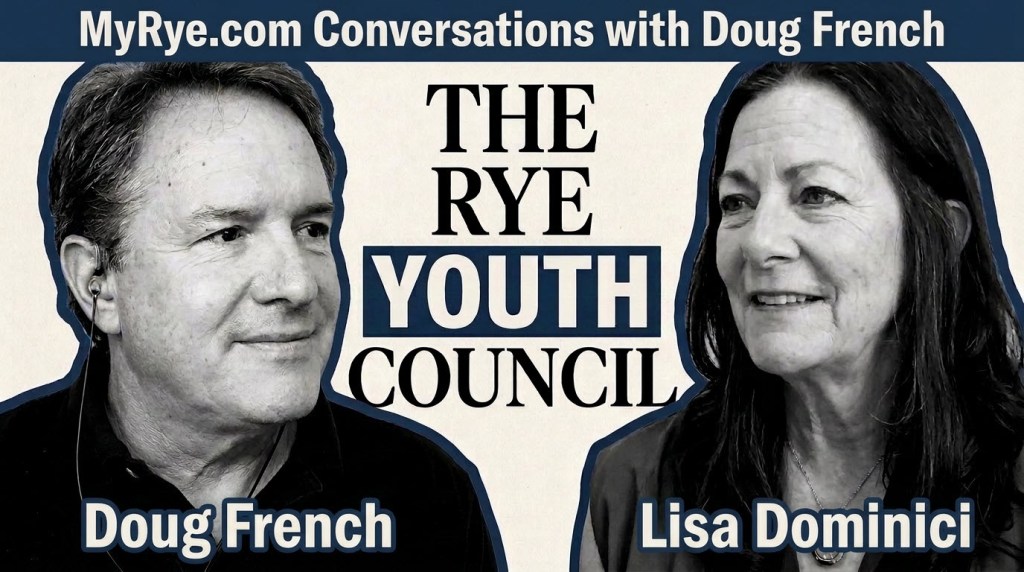
MyRye.com is now in the podcasting business with a weekly podcast hosted by former Rye Mayor Doug French. Available on all major podcasting platforms, MyRye.com Conversations with Doug French will tackle the larger and sometimes intractable issues impacting the City of Rye through interviews with local, county and state officials and business leaders.
In Episode 25 of Season 1, French speaks with Lisa Dominici, executive director of the Rye Youth Council about how the Rye Youth Council supports young people across a continuum from prevention and skill-building to clinical counseling. Dominici, a certified youth and teen mental health first aid instructor, speaks about what parents should notice, how to respond, and how community programs create a net of support around kids.
In this conversation, Dominici explains how social emotional learning, resilience, and mental health fit together, why mental health should be treated like physical health, and how Rye Youth Council’s programs connect families to care, training, and school-based support.
This episode of MyRye.com Conversations with Doug French was produced by MyRye.com. Feedback and story ideas are welcome.
Main Topics Covered:
- Dominici explains the Rye Youth Council’s mission: building social-emotional skills, resilience, and mental well-being from early childhood through young adulthood.
- Social-emotional learning helps young people understand emotions, manage stress, build relationships, make responsible decisions, and ask for help.
- Dominici distinguishes mental health from mental illness, framing both mental and physical health as ongoing continuums.
- The Council’s counseling program, Restore, provides accessible individual mental-health support for young people and works closely with families.
- French and Dominici discuss how the organization measures impact through both personal outcomes and growing participation in counseling and prevention programs.
- Dominici addresses the particular pressures facing students in high-achieving communities, including academic expectations, athletics, social media, and fear of disappointing others.
- Community connection, supportive adults, and a sense of “mattering” are presented as protective factors for young people.
- Youth and teen mental health first-aid training teaches adults and peers how to recognize warning signs, start supportive conversations, and connect someone to care.
- Dominici offers practical guidance for adults: notice sustained changes in mood, sleep, eating, grades, isolation, or coping—and approach young people with curiosity rather than judgment.
- Key programs highlighted include peer-led mental-health awareness, student-athlete wellness support, and the Grandfriend intergenerational program.
- French and Dominici emphasize collaboration among local schools, youth organizations, coaches, families, and community groups as the support network around young people.
- The conversation closes on the message that seeking support is a strength: Dominici’s central takeaway is that “help helps.”
Timestamps:
00:00 – Welcome to MyRye.com and the episode’s focus on youth mental health
01:29 – Defining social emotional learning, resilience, and mental well-being
02:29 – The five core competencies of SEL
04:58 – What resilience really means for young people
06:25 – Mental health as part of overall health, not the same as mental illness
09:26 – When prevention is not enough and clinical care becomes necessary
10:26 – Introducing Restore, the counseling program for ages 5 to 22
11:44 – How families can contact Restore and what intake looks like
13:44 – How many young people are served and who the program reaches
15:29 – What success looks like at the individual level
17:32 – Measuring organizational growth and counseling demand
20:29 – Why youth mental health pressure is both national and local
22:08 – High-achieving schools, hidden stress, and the stigma problem
24:39 – The idea of mattering and why community support matters
26:41 – What Youth Mental Health First Aid is and who it serves
29:06 – Teen Mental Health First Aid and the community training model
30:05 – Why early recognition matters and how common these challenges are
31:55 – What parents and adults should look for in a young person
36:06 – How to start a conversation without judgment
38:20 – The origin story of Restore and the counseling model
41:17 – Peer to Peer and school-based stigma reduction
43:46 – The student athlete mental health program
46:59 – The Grandfriend intergenerational program
48:15 – One-word answers on advice, concern, parents, youth, schools, and Rye Youth Council
51:21 – The meaning of “help helps” and the organization’s message of hope
52:45 – French’s closing question and Dominici’s recommendation for a future guest
Watch:
Full Transcript [edited for clarity]:
Speakers
- MyRye.com, Doug French
- Lisa Dominici, Rye Youth Council
MyRye.com, Doug French (00:12)
Welcome to the MyRye.com podcast conversations with Doug French. I’m your host, Doug French, former mayor of the City of Rye. This podcast is about the issues and the people that impact Rye, the Sound Shore, and the surrounding Westchester region. Our goal is to inform you about what’s happening, who’s deciding, why, and what’s next on the local issues that matter to you. We are here every week. This week in conversation.
Social, emotional learning, resilience, and mental well-being for our youth. We’ll cover what those words mean for parents, what an adult should notice, say, or not say, youth mental health first aid, and how Rye’s programs add up to a net around one young person. Following our conversation with RyeACT, joining us this week is Lisa Dominici, Executive Director of the Rye Youth Council. Lisa has led the RYC since.
2018
on its board and as a president. She is a certified instructor in youth mental health first aid and teen mental health first aid. Lisa, did I get that right? And welcome to MyRye.com.
Lisa Dominici, Rye Youth Council (01:17)
Thank you very much, Doug. You did get that right. I actually joined the board of the Rye Youth Council in twenty ten. That was a long time ago. And then stepped into this role in late twenty seventeen. and at the time thought I had been asked by the board to step in for a year and here I am, almost nine years later. So the rest is correct.
MyRye.com, Doug French (01:32)
That is great. And I think the RYC was founded in 1963, the year I was born. So that that’s a great, great track record for me to just keep tabs of 1963. So
Lisa Dominici, Rye Youth Council (01:42)
Yeah.
MyRye.com, Doug French (01:42)
let’s with our conversation starter. Let’s really describe the words in your mission. Your mission uses social emotional learning, resilience, mental well-being. In parent language, what do those words really mean and where does the program stop and start between clinical care and other services?
Lisa Dominici, Rye Youth Council (01:59)
Sure, thank you for that. so yes, we work across the continuum of a young person’s life from really early childhood through college. And so the continuum is from prevention and skills built building all the way to potential early identification of mental health challenges and clinical care if necessary. Our mission is to promote social and emotional learning, strengthen resilience, and support the mental health and well-being of young people in the greater Sound Shore community.
And so when we talk about social emotional learning, because that has been in the vernacular lately, but oftentimes it’s what does that actually mean? Social emotional learning helps kids develop the skills they need to live a healthy life. It’s like rocket fuel for healthy youth development. And in fact, oftentimes we start presentations with saying it’s like rocket fuel for healthy youth development. So it helps kids develop skills like understanding their emotions and managing.
stress and solving problems and making responsible decisions and asking for help and navigating that sort of thing so skills that kids use and need to to be healthy humans every single day. Rye Youth Council programs are grounded in the five core competencies of social emotional learning. Those five core competencies are self-awareness so that means like how do I name my feelings? How do I recognize my strengths, right? How do I understand my values?
The second core competency of SEL or social emotional learning is self-management. So that’s how do I stay calm? How do I persevere through tough challenges? How do I set goals for myself? These are all skills that are learned. The third competency is social awareness and social emotional learning. So that is like, how can I learn to show empathy and respect differences and consider other people’s perspectives, right? Or recognize unfairness and speak up. Fourth competency is relationship.
Skills.
So that’s how can I be an active listener? How can I communicate effectively? Resolve conflicts respectively, seek and offer help, and communicate clearly. And then the fifth competency is responsible decision making. And that really is like choose wisely, right? So how can I think before I act, consider the consequences of my actions, make safe choices, and stand up for what is right. So those are the five core competencies of social emotional learning, and every
Single one of our programs is developed to strengthen those core skills. And if you think about the spectrum even of those skills, they are really critical to being a healthy human, right? Being able to interact with others in a very healthy way and feel good, know yourself, feel good about yourself. So when students participate in the social emotional learning programs that we have, the skills are the same, but the way that they’re taught and learned vary greatly, obviously, from depending on age and development.
So the way we teach those skills in the elementary school are very different from the way we teach those skills in the middle school or the high school. Resilience, which is another part of our mission statement, doesn’t mean that a child never never struggles, right? When we talk about programs and services that build a child’s resilience, it’s helping them to have the skills, the relationships, and the support so that when they do experience a problem, they can move through that. They can get through those difficult challenges with healthy coping mechanisms.
And healthy responses versus unhealthy or risky responses or coping mechanisms, right? So building a young person’s resilience enables them to be able to deal with a difficult challenge in their life. And that challenge could be, you know, anything. It could be friendship issues. It could be a mental health challenge. It could be a parental divorce, right? It could, I mean, it’s a multitude of challenges that kids need to be, humans need to be resilient for. And that can be something that can be learned and strengthened.
So that is definitely a big part of our mission. And then the the third part of our mission, which is a big part of our focus, is supporting the mental health and well-being of young people in our community. And when we talk about mental health and well-being, we’re really talking about how a young person is functioning on a day-to-day basis, right? Emotionally, socially, at school, with friends, at home, or at work.
The World Health Organization, I’m gonna read this, defines mental health as a state of mental well-being that enables people to cope with the stressors of life, realize their abilities, learn well, work well, and contribute to their community. So that’s mental health, right? It’s the ability to like to cope with stress, to realize our abilities, to learn well, work well, and be a good citizen. So one one distinction I almost always make when talking to anyone who will listen to me, I always
Always share that.
When we talk about mental health, we’re not necessarily talking about mental illness. That’s a really big distinction. Just like when we talk about physical health, we’re not talking about physical illness. So especially when we talk with young people, with kids and teens and young adults, we share, we try to shift that mindset for them to understand that mental health and physical health are equal partners. And a human needs both to be healthy and to live their best lives. But they’re both along a continuum in our lives. So any point in time in our lives.
We may be mentally healthy or physically healthy or mentally unhealthy or physically unhealthy, and that’s a continuum, right? So I could be for physical health, I you know, there are some days where I just feel great and everything’s going well, other other days where I might have a cold, right? Or I might sprain my ankle or break my wrist, or maybe I develop a chronic health condition, right? Like diabetes or something like that from a physical health perspective. But in all of all along that continuum, I’m going to be talking to people about that and sharing when I’m not feeling well and going to
Seek care and help as soon as it gets beyond a cold. Even if I have a cough, if that cough is persistent, I’m going to the doctor, right? In mental health, there are days when all of us as humans might feel sad or mad or angry or upset, right? And those are normal, typical everyday emotions, but there are times in our lives when those might persist and last a little bit longer. And there are other times in our lives where they might really interfere, like really interfere with our ability to live our everyday life.
And it’s those times when it moves beyond that kind of a day or a week of just feeling down and sad or really angry that we need to get people to understand the importance of seeking care, seeking professional care, just like we would go to a medical doctor for our physical health. We want to go to a mental health clinician for our mental health. because the sooner we do, just like in physical health, the better our outcome will be. So it’s really a shift and a change in mindset. So that when we talk about mental health, we’re
We wanna talk about mental health just like we talk about physical health and be open and honest about it. Cause in turn, that will actually increase help seeking, right? And when anyone, but we focus on youth, when a young person talks to someone if they’re not feeling mentally well or gets help earlier, the the outcomes are better, right? It shrinks the time that they’re feeling bad and it it really gets them back to being able to live their best self in a in a much you know much faster, depending upon their severity.
And like physical health, the longer you might be feeling bad and don’t get professional care or talk to someone about it, it snowballs, it becomes bigger and bigger and bigger, potentially, right? So that’s a real that’s a reason too. So it’s really that where we’re we really talk to young people a lot about shifting that mindset and just understanding the importance of mental and physical health. And then there are times when a young person needs more than education, prevention, or a really supportive caring adult. And that’s when anxiety or depression.
depression
or grief or friend or friends or family issues or any other concern start really interfering with their daily life, Interfering with their schoolwork or their social life or and I’ll go into some of those kind of things to look out for in a little bit. But but they could really benefit from talking with a professional with talking with someone who’s been trained to help them move through these challenges. And that’s where Rye Youth Council Restore comes in. Restore is our clinical counsel
Service for young per people ages 5 through 22 that we launched very late in 2021, early 2022. And we provide weekly mental health counseling to young people all year long. And so, it’s our clinical counseling service is offered at a very low to no cost. And so we’ve removed that barrier of affordability and really accessibility because we’re located on the second floor of the YMCA, we’re central in town, we’re on bus lines and
train lines and and kids especially feel kind of like walking into the Y is normal. Walking into the why feels like something they they would do all the time. So it’s a little bit different even for them and in terms of seeking help and care and in in terms of like not walking into a medical building.
MyRye.com, Doug French (10:46)
That’s thank you for the context and the depth
Lisa Dominici, Rye Youth Council (10:48)
Sure.
MyRye.com, Doug French (10:48)
of the answer because that really it’s not the Rye Youth Council of years and years ago, right? This is really getting involved in those aspects.
And the way you put a context around it in between mental illness and mental health is is great context. how would a how would a person tap into the clinical side? Is there a phone number, an email? Just walk in? Yeah.
Lisa Dominici, Rye Youth Council (11:07)
Yeah, thank you for asking that.
all of the above. So our clinical services are offered to ages five through twenty-two, as I said. So a lot of those ages are are minors, right? most of most of our clients come to us through their parents or their guardians making an initial call. so the phone number for Restore is 914-222-0988. The email is restore at RyeYouthCouncil.org. Call or email, you’re connected with one of our clinical supervisors, and they talk to you. You know, they just talk a little bit about what’s going on.
MyRye.com, Doug French (11:37)
Mm.
Lisa Dominici, Rye Youth Council (11:37)
And then determine if it would be helpful for your child to come in and talk to someone. We have referrals all the time from school counselors. you know, when they identify a young person that needs kind of long a slightly longer term care, that would be beneficial outside of the school. And then a lot of word of mouth also. So we have a lot of parents whose kids have really benefited by talking to one of our clinicians, and then they they tell their friends. And that happens a lot with the younger children because a lot of the young kids come to see us.
Because they’re having, you know, emotional regulation problems, or they’re, not really understanding or dealing with their big emotions well, and so it causes conflict in the families, and they come and talk with us and they gain skills and strategies to recognize their feeling and talk, you know, understand how to move through it. But then we also work closely with the parents on helping them recognize where their child is in their kind of zone of regulation and the skills the parents can use to move them into a healthier kind of emotional state.
So when parents experience that with us, they often tell their friends because a lot of those issues are really common among young people. You can walk in, there can be high schoolers or college students or even young adults who are welcome to walk into our offices. We would talk with you and then, you know, schedule an appointment essentially. But it’s really accessible to people. we have
clients from the city of Rye, Port Chester, Rye Neck Rye Brook And we could easily go beyond that, but you know, we kind of purposefully promote in those areas just because of bandwidth and scale. We have a very small staff and so we don’t the last thing we want to do is promote our services if we can’t actually see a young person. And we haven’t had that happen yet, which is wonderful, but during the school year on any given week we have between 30 and 45 young kids who come into our office
after school and receive one-on-one private mental health counseling. And most of those young people are with us for a period of about anywhere from four to six months on a weekly basis.
MyRye.com, Doug French (13:30)
I know it’s an individual thing, but it sounds it would be like easier if somebody came in with a friend. Does that happen at at all?
Lisa Dominici, Rye Youth Council (13:36)
So it has happened and oftentimes a friend will connect. So we do a lot of work in some of the local schools and some and we develop relationships with the students and so sometimes a student will come with a friend to talk to one of us in the school and then we’ll increase their comfort level with just having a conversation. There’s no commitment to it real and a lot of times it’s really just talking. so that does help and we’ve actually had one thing we felt proud about that happened last year was a
young woman who is in college in New York State called us from school and her younger sister in high school had told her about Restore and she wanted to seek some care while she was at school and because she’s in New York State we could do telehealth with her because we do virtual meetings as well if you’re in within New York State.
MyRye.com, Doug French (14:21)
Okay,
so so you know, you have your organizational metrics, but how do you know success at an individual level? How do measure that that type of success?
Lisa Dominici, Rye Youth Council (14:29)
Yes.
So there are two they’re really two two different ways we view success. The first way, when we think of success, we really drill it down to an individual, an individual young person, older teen or young adult. And so success in that capacity can look like an elementary school student who has the language and the knowledge to identify when they’re starting to feel really, really, really angry. And they are able to use some of the skills or strategies that
They’ve learned from us to not erupt. To respond in a different way or use their words to let their parents know how they’re feeling so their parent can help them. That’s success to us. It might be a middle school student who has learned different ways to manage their day-to-day stress before it becomes overwhelming to them. Before it becomes more of not a crisis situation, but a situation where they’re they’re not capable of really moving through it. That’s success. a teenager who maybe was
Okay.
struggling silently. Like feeling really sad or feeling really anxious or maybe understanding that their eating habits have become really unhealthy and have gained the courage and the strength to tell an adult I’m not okay or I need help. Like that’s massive success for us. and or maybe a parent, so those students have gained those skills through the prevention and awareness programs that we run in the schools or some of the workshops we run in their classrooms.
Or it might be a parent who’s taken one of our youth mental health first aid courses who’s able to recognize when their teenager might be starting to exhibit signs or symptoms of mental health or substance use. And be able to understand that it might not be typical teenage behavior and actually have the tools to talk to the young person about and connect them to care. So those are all different ways from an individual perspective that we view success. Those are really hard to measure on a spreadsheet. And oftentimes when we are talking
To people about data, those data points are usually more anecdotal, Because we just share the stories. But we also, it’s really important for us to have look at organizational measures. So all of our programs and services have some form of data collection or measurement. That’s just we build that in, we’re very conscious of that. our counseling program has grown dramatically. So I mentioned that it launched in late 2021, early 2022, and that very first year we had we had 44 young people.
Seek mental health counseling from us. So that’s that means they came to us on a weekly basis for like six months is the average length of care that a young person is with us. That equated that year, that initial year to 462 individual sessions of care. So 462 times the young person was in our offices behind a closed door with one of our clinicians receiving help and supporting care. By 2025, so you know, three years later, that number has more than doubled. So last year in 2025, we had
115 young people receive care from us, and that equated to almost 900 individual sessions of care. So that is success to us. Like that is just that growth in the number of young people who are seeking care because we know that those numbers exist. The data show, the statistics show us the prevalence, but it means like more people are talking about it and more parents are understanding the need to connect their kids to care. For a problem small and bigger. Like they’re not waiting till there’s a real problem, if you will.
I don’t even like that word problem, but you know, a real struggle or a challenge. So that’s a success because we know that. And then we know through our data capture that we reach thousands of young people every single year through our social emotional learning workshops, our peer-to-peer depression awareness and suicide prevention programs we run in local high schools and other mental health programming. We run youth civic and leadership programs in and out of schools, like our intergenerational programs.
That we have run for years and years and years in collaboration with the Osborn, that connects high school students with senior citizens and other prevention efforts. So we have data around those in terms of number of participants and repeat, you know, repeat kind of experiences and things like that. So we measure both. We measure how many young people are we reaching? Are those young people becoming more connected, more knowledgeable, more willing to seek help and equipped to handle?
challenges.
MyRye.com, Doug French (18:38)
Okay. So
I’ve already dated myself by giving the year I was born, but I think life was much simpler, you know, when I went to school versus the pressures of today. So the rise in the number, I think it’s both. It could be more pressures today, but it’s also more people are aware of the services and tapping into services. So how do we rank nationally? Are we we above the norm, the average? Do any sense of that?
Lisa Dominici, Rye Youth Council (19:01)
so I think we’re typical. You know, the numbers are I think you’re Rye. Though I think the numbers most likely always existed, but they weren’t people didn’t know. I think when we were growing up, there is frankly this is a conversation that Nancy has, but if you look at you know, you were in high school in the 80s, Doug. if
MyRye.com, Doug French (19:19)
Yeah.
Lisa Dominici, Rye Youth Council (19:19)
you look at substance use along the continuum of like from the 60s to now, the highest point in time, the highest use was in the 80s. so I think there’s a lot, there was a lot of self-medication.
Going on because kids were struggling with challenges similar today, but they didn’t have the support and the means to deal with that. COVID, obviously, not obviously, COVID was a gift to us in a way because it put mental health in the forefront. You know, on every single newspaper, almost every single day, there was something about the youth mental health crisis and you know, adult mental health. So I think COVID really started the conversation, sparked the conversation and put it into the everyday.
So when we think about our population of young people, I think they’re dealing with the same national
issues or challenges that other teens deal with Depression, anxiety, loneliness, academic pressures, social pressures, social media, technology, uncertainty about the world, those are pretty those are ubiquitous, for teens today. And Rye isn’t immune to those national trends. Just because we’re a community with a lot of resources, it doesn’t mean that our teens aren’t affected by those same trends. But we do also live in a high achieving community.
And high achievement communities bring their own pressures. And so this is where I think we are a bit different. Expectations around academics and athletics and college and achievement. I mean, this is not surprising to anyone who lives in our community. And a young person can appear to be really okay and well adjusted when inside they might really, really be struggling. And there are a lot of reasons a young person would be scared to tell someone about that for worrying about being a failure, worrying about like
Letting their parents down, worrying about letting a coach down. Lots and lots of reasons. There’s a lot of stigma associated with mental illness. There’s research and data around high achieving schools. It’s one of the articles I wrote last year. That high achieving schools and all the schools in the Rice City School District are high achieving schools. It’s based upon, certain different kinds of data. SAT scores, ACT scores, percentage of high.
school college and that sort of thing. Students who attend high achieving schools are considered an at at an at-risk population, which is surprising. Because normally when we think of youth at an at as an at-risk population, we’re talking about underserved, unhoused, right? Food insecurities, that sort of thing. So they’re students who attend a high achieving school are considered at risk because they are the data have shown over the past like twenty years
They experience increased rates of anxiety depression, like five to six times the rates that students who don’t attend high achieving schools experience. So it’s really important for us to be aware of that. And we are, and our school district is, to help kids find the right balance in their academic and their athletic or their extracurricular life, to not tie the young person’s identities to their accomplishments, right? To their athletic or academic accomplishments.
. But the really good news in our community that is so well resourced is that many of the programs that we offer that so many of the amazing youth serving organizations in our community offer to young people really serve as protective factors and they negate many of these risks. So the fact that we have RyeACT and pRYEde and the Rye Free Reading Room and Rye Rec and I could Rye Nature Center, I mean there’s so, so, so many.
Really serve as a protective factor for our children. So the you know, we’re in this high-achieving community, but at the same time, there are a lot of support services. Another piece that really matters in negating that risk is something called mattering. it’s kind of relatively new, although there’s research around it. Mattering has been proven. it really is just this having a young to simplify.
It, a young person intrinsically understanding and believing that they matter. They matter to the adults around them, they matter to the community around them, despite what if you strip all their accolades and accommodations away, like their unique person matters, right? So that’s a really positive thing.
MyRye.com, Doug French (23:19)
terrific.
I’m gonna take let you take a quick pause and I just want to
Lisa Dominici, Rye Youth Council (23:22)
Okay.
MyRye.com, Doug French (23:22)
remind our audience if you have a topic or a person you want to hear on MyRye.com Conversations with Doug French, email me at French at MyRye.com or just tell me around town. We are here every week on Apple Podcasts, Spotify, iHeart, and YouTube. Every episode in all formats, plus the transcripts and local news are available at MyRye.com or direct to those platforms.
Mm-hmm.
And these conversations don’t expire just like the one we’re having today. please share, subscribe, and send a question for a past guest if you want. And we’ll bring that back in our after the conversation segment. Lisa, I’ve let you talk because your is just really informative
to the public, and that’s really why we started this podcast. I want to pivot now, let’s talk about a service you
I think it’s called your mental health first aid for adults. Can you speak
Lisa Dominici, Rye Youth Council (24:11)
Sure.
MyRye.com, Doug French (24:11)
about that?
Lisa Dominici, Rye Youth Council (24:12)
Yes, absolutely. I love talking about this. It is you know, it’s my why, it is my passion. So youth mental health in general. it’s so thank you for giving us this platform to to share this. Youth Mental Health First Aid is not our program. It is a nationally it’s an evidence based program that was developed in Australia actually by a an organization called the Council for Mental Wellbeing. It was brought to this country
many several years ago and mental health first aid has a few different iterations there is youth mental health first aid which is a certification course for adults and there’s teen mental health first aid which is a certification course for teens those are the two that we offer
Mental health first aid is like CPR for mental health, right? So it essentially trains whether you’re an adult or a teen, depending upon which course you’re taking. it trains a lay person, so someone who’s not a trained clinician to be able to recognize and respond to a young person who is exhibiting signs or symptoms of mental health or substance use challenges. it trains lay people how to respond to mental health crises, like suicide.
Suicidal ideation and a host of other mental health crises. It trains adults and teens how to approach the young person they’re concerned about, whether it’s a friend, a peer, or your child, how do you have that really difficult initial conversation that you’ve been noticing? And then it trains them how to connect them to an appropriate to appropriate professional care or appropriate self-care, depending upon what the challenge or the issue is. And so it’s just like in CPR, if someone were having.
A heart attack and we administer CPR doesn’t mean that we’re a cardiologist, right? so just it’s like that in mental health first aid, but it is it is life-saving knowledge, and I really, really wish that I had this knowledge when I my kids were teenagers because it would have helped, it absolutely would have helped our family, and it helps every family. So we really encourage any adult who interacts in any way, shape, or form, if you’re a grandparent or an aunt or an uncle or an educator or a clergy or a community member or parent to
to take the certification course.
Teen Mental Health First Aid was launched a few years ago. We are part of a grant through New York State Office of Mental Health and Mental Health Association New York State to provide Teen Mental Health First Aid in local high schools and to local organizations. So Rye Youth Council is part of that. And the beauty of that is that we can offer this certification course to teenagers ages 14 through 18 at no cost. And we can also bring youth mental health first aid into schools and communities and organizations at no cost. And I do a lot of this work with
Nancy Pasquale, with RyeACT we do a lot of the training together. A number of our staff here at Rye Youth Council are trained in youth mental health first aid and teen mental health first aid. And over the past several years, we we’ve certified we’ve certified probably over 300 adults, and in the past year, we have certified about 55 teens, and that those numbers will continue to grow. The program’s really important because.
epidemiology research shows there’s a there’s a a median delay of eleven years between the onset of symptoms and diagnosis, of a mental health disorders and conditions. And so if you think that that’s a median number of years, that’s a long time to be struggling or suffering with something, and it’s a long time for something to continue to bullet to snowball, right? one in six young people.
Ages six through 17 will develop a mental health challenge or disorder in any given year, like anxiety or depression or disordered eating, those are kind of the top three. 50% of all mental health illnesses are diagnosed by the age of 14, and 75% by the age of 24. So this is these are the young people, these are high schoolers, right? Age 14 is like a freshman in high school. So if that’s the average age, if that’s like the 50, you know, 50% of all diagnoses are occurring that age, then we better have people around.
Around who can recognize that, right? Who can recognize it and know what to do with that information? So we’ve worked really closely with the Rye City Schools District, with the Rye Country Day School. we’re talking right now with Port Chester School District, you know, to in a number of Ursuline, I mean a lot of different school districts, and we’ve we’ve run this in the community many, many times for the Council of Community Services in Port Chester, the Carver Center, their staff, the YMCA staff here. and and our dream, our dream is to build a critical
mass of adults and young people who are able to recognize when a young person is starting to exhibit those symptoms when it’s not your typical teenage behavior and and have that conversation to connect them to care. Because it’s really about connecting to care so that they can get the support and help they need so they have better outcomes and they don’t suffer for a long period of time.
MyRye.com, Doug French (28:56)
That’s really what community is all about, right? Is building on critical
mass. so you’ve trained hundreds of adults in this.
Lisa Dominici, Rye Youth Council (29:01)
Yeah.
MyRye.com, Doug French (29:01)
What about for the untrained? Are there things that practical advice that they should look for, say, not say, those types of things?
Lisa Dominici, Rye Youth Council (29:08)
yeah
Lots of things you shouldn’t say. One of the things
MyRye.com, Doug French (29:11)
Yeah.
Lisa Dominici, Rye Youth Council (29:11)
that we teach in mental health first aid is that language really matters, right? language really, really matters. And language has is a big part of the stigma that’s associated with mental illness, right? There’s a difference between like the stigma of mental illness and the stigma associated with it. and in this case it’s really associated with it. And stigma is the number one reason that a young person doesn’t seek care, doesn’t seek help, is stigma associated with mental health illness.
so
The key word for anyone who loves a young person, or this actually is is true for adults also, but the key word is change, to focus on change. so is there a change that you’re noticing in sleep and eating, you know, sleeping. Are they eating are they sleeping all the time? Are they not sleeping enough? Eating, are they eating too much? Are they eating too little? You know, friends, are they do are they not hanging out with the same friend group? Are they starting to isolate themselves and not go
Out socially, for example, grades. Are we seeing a change in the grades that a student is getting where they’ve always been a good student? All of a sudden now they’re starting to not hand homework in, right? Or starting to not do well on tests. mood, or you know, is there have they gone from a really energetic, you know, chippy young person to being, you know, kind of sad or down or just really irritable?
So mood, irritability, isolation is a big one. Are they starting to, you know, close themselves off and not participate in activities they’ve always loved to do or friends’ groups that they always have to do, and just basically their ability to cope? So those are all changes that we want to notice. One thing we point out when we teach mental health first aid is that those are all really common symptoms of teenage years. Also, so
they’re not.
Understanding that what they’re starting to see are mental health issues, but they’re just thinking their kids being a brat, you know, or like sleeping too much and they’re lazy. And so we we miss these symptoms a lot. and so parents and educators and friends, you know, we we focus so much on educating those three groups because they’re the people who spend the most time with teens and who know them, who see them the most, right? So, what we want to really look for in those all of those different kinds of symptoms.
I talked about is the duration and the intensity and how they interfere with everyday life. Every person is gonna be, you know, sleep in sometimes, or maybe not, you know, their stomach doesn’t feel like we want to watch for things that are lasting more than two weeks, right? So if your child all of a sudden is really down and crying a lot and this is going on for weeks at a time, you need to we encourage a parent to bring that young person to talk to somebody because chances are they might be developing.
Like, you know, some symptoms of depression. Or they might just have an issue that they’re having a really hard time working through and they need to talk to someone about it and help them work through, right? so it’s when we’re seeing persistency, we say more than two weeks with with certain chronic, with certain conditions, with others like anxiety, we really say if it lasts more than like three months. But that anxiety, you know, there’s a difference between being anxious and being and having anxiety. and so lots of people are anxious, right? And lots of people are anxious on a daily basis.
About things. I was anxious before this to podcast, but
MyRye.com, Doug French (32:14)
Yeah.
Lisa Dominici, Rye Youth Council (32:14)
it doesn’t mean I have anxiety, right? So when we really start feeling that way for like every day for long periods of time, I would go and talk to a mental health professional and try to understand why I’m feeling this way and how they can help me gain some skills and strategies to work through that. for so it’s it’s noticing those changes in the duration for parents of a young person. if you’re concerned about a young person, it’s really
You know, we want to try not to fix things immediately or jump to conclusions or judge, which are really easy for things for parents to do. and so we want to use language like I’ve noticed, and we talk to teens about this too. It’s simply just saying, if I say, you know, Doug, I I’ve noticed that you seem really down lately, what does that immediately tell you?
MyRye.com, Doug French (32:55)
that you’re observing what I’m doing, my behaviors?
Lisa Dominici, Rye Youth Council (32:57)
Yeah.
MyRye.com, Doug French (32:58)
Yeah. Yeah. Yeah.
Lisa Dominici, Rye Youth Council (32:58)
That I see you, right? That I see you.
And since I’ve said it to you, I care about you. So at the very base level, like that’s a really effective way to approach a conversation. So I’ve noticed you don’t seem like yourself lately. How are you doing? And so that gives a young person the ability to say, I’m good. I’ve just been having some friend stuff. I’m it’s it’s okay. Or maybe that opens the door to a better a bigger conversation, right? you and then if they say something, we want to respond with like, I’m really glad you told me and let’s work through this together, right? So we don’t want to say
like, well, you have nothing to be upset about or look look what you have all around you. You have so much stuff, like you know, what you don’t have the right to be sad or or or even like everyone feels that way sometimes. That that’s really dismissive to that young person who actually is feeling that way. So those are just that’s just like a little ingling of some of the things that we teach in this course, but we really teach how to have those tough conversations. So
I think the key thing for parents is to notice changes, to understand that you don’t need the perfect words when you talk to a young person, whether that’s your child or a niece or nephew or a neighbor’s child. You just need to notice, to ask, and then to listen to them and listen hopefully with listen non judgmentally, right? So we always talk to parents about if your child’s telling you something you really don’t want to hear, it’s very hard not to be like, you know, with your face, but that’s the last thing, you know, if we can, just try to do that inside. when we teach the course, we talk about being that.
duck on the pond where you know what what do you see when that duck’s on the pond it looks like it’s floating that you know nice and calmly and across but underneath the water its feet are going like this and that’s kind of how we try to impart like when you’re talking to someone about these tough issues like what’s a good way to approach that
MyRye.com, Doug French (34:34)
That was great.
And I think I want to pivot to our next section about just specific programs that you want to highlight that people should be aware of.
Lisa Dominici, Rye Youth Council (34:42)
Sure.
so definitely Rye Youth Council Restore. I mean I did talk about that, but
MyRye.com, Doug French (34:46)
Yeah.
Lisa Dominici, Rye Youth Council (34:46)
we are located on the second floor of the Rye YMCA. it’s a really interesting model that we have here at Rye Youth Council, and we started it by I’m gonna tell you a little story if that’s okay.
MyRye.com, Doug French (34:56)
Sure, sure.
Lisa Dominici, Rye Youth Council (34:58)
We much of what we do today, a lot of what we do in terms of the mental health support was really made possible through a sad loss in our community. And so in 2020, a family came to us whose daughter had died by suicide and they made a financial gift to the Rye Youth Council and worked really closely with us to identify different programs and services that we could launch in the community where their daughter grew up to help
prevent or just help kids you know get care and support but also to build their strengths and their resilience and and really instill some of those protective factors around kids. That gift from them allowed us to hire a licensed clinical social worker who we made sure had the right credentialing to be a clinical supervisor. And from that’s where Restore grew from. So we have a clinical counselor. Restore is the model is that we bring on right now a six clinicians a year who are
graduate students in mental health counseling or social work. They do their field practicum with us. So anyone in the country who is doing a graduate degree in mental health counseling or social work has to do many, many hours, like a year’s worth of in you know, in field, on-site training. And so Rye Youth Council became one of those sites. and we’re a sought-after internship, if you will, now because there is such direct clinical care that we provide. We provide the ability to work with young people in schools. We provide the ability to work with community partners like the Carver Center.
And so the clinical counselors provide this care to the young people and then they’re supervised each each client, if you will, each young person who’s our client. That clinician works with their clinical supervisor immediately after those sessions on one-on-one count, you know, the supervision. And so the model enables us to provide care to many more young people than we could if it were just our staff that we were funding. And it also enables us to help train to get more clinicians out into the field.
Because there’s still a lack of availability of available mental health counselors. Most mental health counselors in the area don’t have capacity, or they’re very, you know, expensive and a lot of them don’t take insurance. So it’s it’s really fitting a niche, it’s really fitting a need in our community. We always have one of our clinicians who’s Spanish speaking, and we have a number of clients who who are, you know, English is their second language. About a third of the young people who come to see us every year, Doug, receive their care at no cost. And it’s it’s very
Very low cost, anyway. It’s $30 a session or zero dollars a session, and there’s no questions asked at all. So we just provide that care. So
I you know, so i we’ve helped hundreds of young people now with clinical counseling and and we’re up to like almost three thousand individual sessions of care, I think, in total stats. So that’s a program that we really do want people to be aware of. and then we run well mental health first aid and team mental health first aid. So if you’re
MyRye.com, Doug French (37:44)
Rye.
Lisa Dominici, Rye Youth Council (37:45)
an administrator at a school or you have or you’re at an organization like the Carver Center and you’re interested in training your adults, we can come in and do that.
That.
If you run a youth group, we can run a teen program, a teen mental health first aid program for that youth group. So I want people in the New York area to be aware of that, that we can come and do those for you at no cost because that’s covered through that grant. We run a program in the middle, our middle school and high school, we support the program at Edgemont Junior Senior High School, and we’re talking to a couple other local high schools called Peer to Peer. Peer-to-peer also was brought to us through this family who gave us this initial grant. It’s an evidence-based program that was developed.
Developed by the University of Michigan Depression Center. And Michigan has been running peer-to-peer and local high schools in the Ann Arbor area for like the last 15 years. We started running it in Rye High School in 2021. We are now an agency partner for the University of Michigan, and we can bring and launch peer-to-peer in high schools in Westchester County. So we’ve been trained by Michigan and are an agency partner. And so it’s us in New York. There’s a group in Rhode Island and a group in Ohio. But other than that, it’s all in Michigan with Michigan still. So we’re proud to be in.
Agency partner of University of Michigan. we’re proud to be able to bring peer to peer. The core, it’s a student led program, which is very, very cool for middle schoolers or high schoolers. They attend a full day conference where we educate them about mental health. We teach them how to create peer education and peer awareness campaigns and how to talk to a friend and connect them to care. The core goals of peer to peer are to increase awareness around mental health and other depression, depressive illnesses, decrease the stigma associated with it. So, you know, in education.
Kids about the prevalence and how you know in an average typical classroom there are probably you know at least two kids who are struggling at that moment. Like just kind of normalize the talking about it and then increase help seeking and and that it’s measured with the pre-post survey so we know that we have the data from those programs, that we we know it moves the needle in terms of help seeking with in-school counselors and social workers, with getting kids to understand more signs and symptoms of things like depression, anxiety to understand.
Understand
that their friends aren’t going to think less of them if they tell a friend that they might be experiencing this sort of thing. So Peer to Peer is a wonderful
MyRye.com, Doug French (39:56)
right
Lisa Dominici, Rye Youth Council (39:57)
program, and we have the ability to bring that to local high schools as well. And then we, have a very cool program that we started about three years ago, and it’s a student athlete mental health program. And we started that after I attended a webinar that was put on by the Westchester County Office of Community Health in in collaboration with Columbia University, and they were talking about
This has been in the news lately. They’ve been talking they were talking at the time about how there is a big increase in anxiety and depression in collegiate athletes, and how those same athletes were less likely than non-athletes to ask for help. And they were seeing that trickle down into the high schools. And so I saw that webinar and I understand the community in which we live and how important athletics are to our community, and I understood that that would be a really important kind of program to bring. And so we hired an incredible
Woman named Sangeeta Bansal. She has a PhD in organizational business, but she has deep, deep, deep expertise in mindfulness and meditation and breath work and sports psychology and kind of that space is her sweet spot. And she every year works with athletic teams now in local high schools to teach them about mental health. There’s like a mental health 101 component, but a lot of what
She does in working with the athletes is teaching them skills and strategies to to kind of like hack their nervous systems to either calm themselves in really high, you know, kind of intensity situations or activate themselves when they’re feeling kind of down and they need to be activated, to give them strategies to focus, right? So we the clever thing about this program is because we deliver it to athletes and it’s about helping them improve their athletic performance, right?, through focus and and all of those things.
Things
we just talked about, mindset and visualization and all these different kinds of brain and nervous system hacks. We’re able to reach students who we might not necessarily reach through some of our other programs and clubs. But we’re so we’re going to where the students are. So we’re we have the ability to work with all of these different athletes, and now we’re giving them some of the tools and strategies. We talk about things like not tying your sport to the identity, you know, your identity to the sport. We’re we’re addressing head-on some of the issues we’re seeing at the
collegiate level and why these college athletes are why there’s some really bad data around these college athletes right now. So that’s a program we’re really proud of and we’d love to get more yeah.
MyRye.com, Doug French (42:13)
Yeah. And coaches make a big difference as well. We’ve got great coaches here in in the
surrounding area.
Lisa Dominici, Rye Youth Council (42:19)
It’s amazing
also when the coaches lean in when we’re doing those those sessions
MyRye.com, Doug French (42:23)
Yeah.
Lisa Dominici, Rye Youth Council (42:23)
with the teams that when the coaches are engaged, you just see how those players look up to those coaches and they carry a lot of weight. And so when a coach makes a young person understand that they want to be someone they come to, if they’re not feeling okay, that that makes a huge difference.
MyRye.com, Doug French (42:38)
Well,
one of my
favorite guests was Dino Gar and just his leadership and his understanding
Lisa Dominici, Rye Youth Council (42:42)
Yeah. Yeah.
MyRye.com, Doug French (42:43)
of the whole thing really makes a huge difference. what about Grand Friend? I had that on my list that the okay.
Lisa Dominici, Rye Youth Council (42:48)
yeah. So
gosh, I mean Grandfriend the Grandfriend program has had a few different names over the years, but that was
Rye Council has run that program since before I joined the board. So I think, you know, that was started many, many, many years ago by some of the really good people who brought this, the early years of this organization. And that’s an incredible intergenerational program. And we have run it with middle schoolers, but we’ve always run it with high schoolers. And we visit, we take a bus of high school students every month to the Osborn, and they meet with some of the older adults who live there in their independent living, and they have
incredible conversations about current events and travel and what life was like in Rye in early years and they build these relationships and they meet on a monthly basis and then throughout the year some of the students in that club gather and they, you know, they make holiday cards for the seniors and that sort of thing. But we’d love to also expand that into some of the other, you know, senior groups in the area.
MyRye.com, Doug French (43:45)
As I’ve done the senior topic, senior
living topic, that isolation and that whole side of it, and they would have so much to deliver back to the community. So all right well, great programs. let’s pivot to our one question, one-word answer segment and do the best you can.
Lisa Dominici, Rye Youth Council (44:00)
Okay.
MyRye.com, Doug French (44:03)
advice.
Lisa Dominici, Rye Youth Council (44:05)
Communication.
MyRye.com, Doug French (44:06)
Concern.
Lisa Dominici, Rye Youth Council (44:07)
Youth mental health.
MyRye.com, Doug French (44:08)
Parents.
Lisa Dominici, Rye Youth Council (44:09)
Support.
MyRye.com, Doug French (44:10)
Youth.
Lisa Dominici, Rye Youth Council (44:10)
advocates for change. I mean, they’re amazing. They’re our future. I mean, really, the young people, I it’s a lot of words.
MyRye.com, Doug French (44:18)
and you know, my takeaway w in my conversation with Nancy was a lot of this is the fact that their brains are still forming, right?
Lisa Dominici, Rye Youth Council (44:25)
yes.
MyRye.com, Doug French (44:25)
yes, it’s the external, I get that, but it’s also a lot of the internal and just as they develop and mature. So,
Lisa Dominici, Rye Youth Council (44:28)
Yeah. Uh-huh.
MyRye.com, Doug French (44:30)
the
Lisa Dominici, Rye Youth Council (44:30)
Yeah, that
frontal lobe not developing i is key and so they’re more prone to risky behavior, right? They’re more prone to not thinking about consequences, they’re more prone to all of those things that I mean they’re social emotional skills and you can learn them, but if your brain isn’t like telling you to slow down or you know, or pause, so yeah, that’s why, you know, that use use the word net in the beginning of this, but we really think about Rye Youth Council as a net. Well, really our community is the net, right? So community
MyRye.com, Doug French (44:56)
right
Lisa Dominici, Rye Youth Council (44:57)
is absolutely
we we want our goal is to create that community where kids have the skills, the relationships, and the support to be mentally healthy, make it more likely that they’ll get help before they need it, but to really create that net around them. So in our community, Nancy talked about the collaboration. One of our strategic imperatives, I mentioned this at City Council last week, but one of our strategic imperatives is when we’re developing a new program or service that when possible, collaborate with another youth
serving organization. So if we’re ever doing anything in the LGBTQ space, we call our friends at pRYEde and we do that in collaboration with pRYEde. And there’s a lot of that, a lot of collaboration between the youth-serving organizations, which strengthens that net.
MyRye.com, Doug French (45:41)
And
these days, you know, scale is the key, right? And it and with with AI and technology you’re able to scale your operations. So I love the fact that you’re talking to Rye Neck and Rye Country Day and Port Chester and Rye Brook. Exactly, exactly.
Lisa Dominici, Rye Youth Council (45:51)
Yeah, we’re the same community, you know? Yep.
MyRye.com, Doug French (45:54)
Alright, a couple more words. schools.
Lisa Dominici, Rye Youth Council (45:56)
Foundation.
MyRye.com, Doug French (45:57)
Rye Youth Council.
Lisa Dominici, Rye Youth Council (45:58)
trusted resource. Two
MyRye.com, Doug French (46:00)
And finally Rye.
Lisa Dominici, Rye Youth Council (46:03)
home. Special. it’s really special. It’s a it’s a special community.
MyRye.com, Doug French (46:05)
For everybody, for many people. Yeah. Well Lisa,
just the last what’s the behind you?
Lisa Dominici, Rye Youth Council (46:15)
this and we have one in our other office too, if you can see it. it
MyRye.com, Doug French (46:18)
Yeah.
Lisa Dominici, Rye Youth Council (46:19)
says all of these words say Rye Council Help Helps. And this was a big board that was a backdrop at one of our spring benefits. The flowers and the board were made by young people to decorate the the benefit, but the board was a backdrop. We were selling hats that said help helps. But the genesis of help helps, which is what every our big annual fundraiser is.
the help helps soiree or the help helps hoe down that came from our youth our teens in Rye High School who are part of our peer-to-peer group the first year one of the first years we were running the program they developed their first slogan they’ve now had a couple but the first was mental wellness is a process semicolon help helps and so we really want to drive that it’s kind of like you are not alone you know but help helps because it really really does
So this is just really every time I walk in here I feel inspired, I feel happy, I feel lite you know, it’s it’s you see, it’s just hopeful. Yeah.
MyRye.com, Doug French (47:16)
Yeah, that’s great. Well Lisa,
I it is amazing what you’ve done. it is a need in the community, all communities, and your expertise and insights are really, welcome for the for the community. So I really appreciate the time. is there a guest or topic you would like to see?
Lisa Dominici, Rye Youth Council (47:30)
So,
you know, I have watched s many of your podcasts. Dr. Murray mentioned Susan (Reid) Dullea She is the athletic director and I know athletics rule in this community, and sometimes
MyRye.com, Doug French (47:40)
Yeah. Yeah.
Lisa Dominici, Rye Youth Council (47:41)
that’s a challenge for me, but she is
a really important partner for Rye Youth Council. She actually was on our board for a period of time. she cares deeply and passionately about the mental health and wellness of her athletes. She puts that first and foremost. I really admire her for that because she understands the value of winning in this community, but maybe I shouldn’t say this out loud, but I feel like with her it’s secondary. It’s like the health and welfare of that young person to feel that they have a sense of belonging, that they’re supported.
is first and foremost and so I think she would be amazing ’cause, that’s important, especially when we’re talking about athletics. and she she’s really involved in the in the county and in the state in in in helping kind
MyRye.com, Doug French (48:24)
Okay.
Lisa Dominici, Rye Youth Council (48:24)
of focus on youth mental health and wellness.
MyRye.com, Doug French (48:26)
Great to great to know.
well Lisa, thank you again. and to our listeners, you can find full podcast, episode, transcripts, local news, and more at MyRye.com. Rye Youth Council is at ryeyouthcouncil.org, correct?
Lisa Dominici, Rye Youth Council (48:38)
Mm-hmm. Yep.
MyRye.com, Doug French (48:39)
please subscribe wherever you get your podcast, and please spread the word as we build our audience.
It’s exciting. thank you again for listening to
Lisa Dominici, Rye Youth Council (48:44)
exciting. Thank you.
MyRye.com, Doug French (48:46)
the MyRye.com podcast, Conversations with Doug French. we will see you next week. Thank you.
Lisa Dominici, Rye Youth Council (48:51)
Thank you, this has been fun.