

Holding Court is a series by retired Rye City Court Judge Joe Latwin. Latwin retired from the court in December 2022 after thirteen years of service to the City.
What topics do you want addressed by Judge Latwin? Tell us.
By Joe Latwin

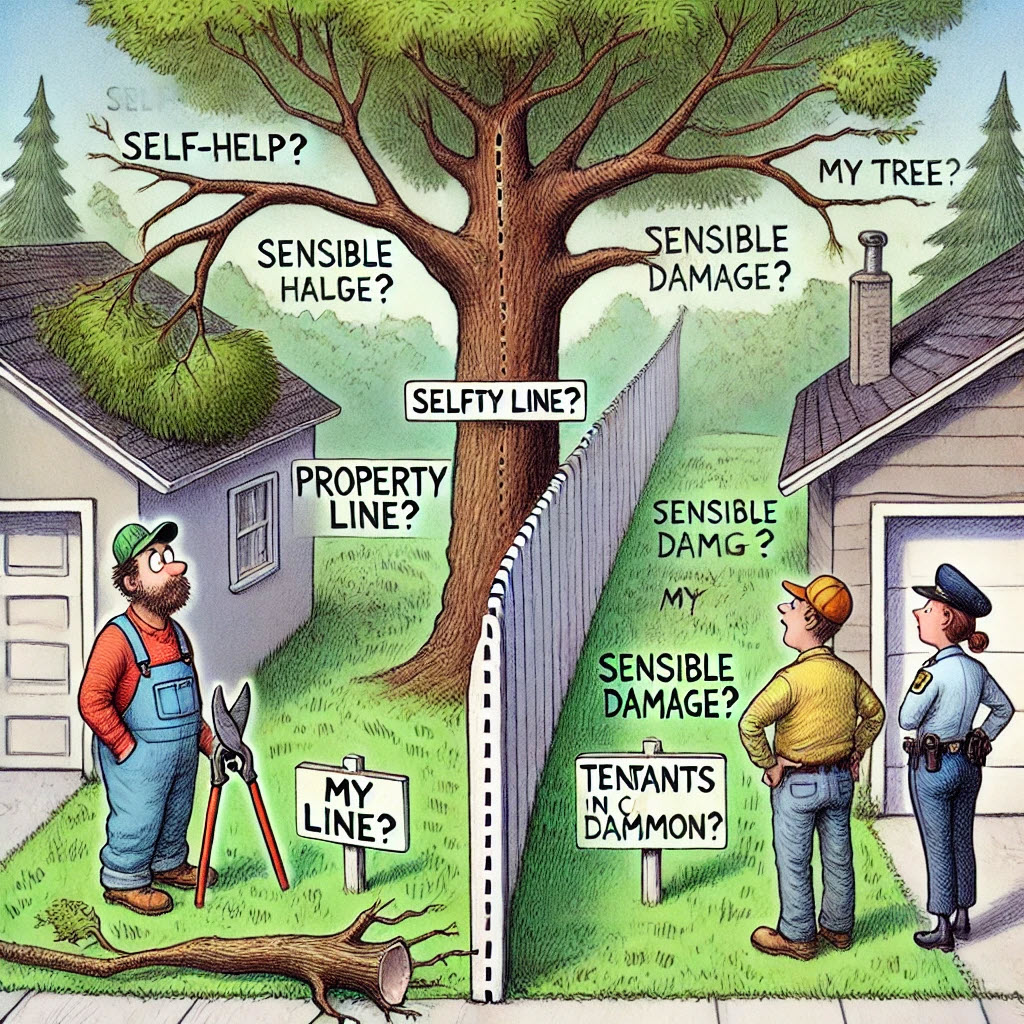
What are your rights and obligations if a tree overhangs or drops branches or leaves on your property? It is the long-standing rule in New York that a “tree is wholly the property of him upon whose land the trunk stands”. For the most part, trees are not mobile (except in the Lord of the Rings movies). The location of a tree can be fixed by a survey. If it is on your property, it is yours. If it’s on your neighbor’s property, it is theirs. If a tree, however, straddles the line between two properties, the owners of each property own the tree as tenants in common. Even if a tree were originally planted on one property and, over the years, grew “over the property line so that it stood on the land of both parties, that would render the parties tenants in common in the tree”.
Overhanging branches, accumulated fallen leaves, branches, and or buds, or cosmetic damage to a garage, or branches and leaves blocking the sun, without proof of actual injury to a person or that person’s property (which injury is known as “sensible damage”), are not enough to sustain a claim of private nuisance. But a lawsuit is not the only path! A property owner may resort to self-help in the first instance to remove overhanging (over his land) tree branches adversely affecting his land, so long as it does not kill the tree. There are several variations of the rules among the States.
The Massachusetts rule provides that in cases involving trees not noxious or poisonous in nature, an action for nuisance or trespass will not lie, and the sole remedy available to an adjoining property owner is that of self-help. This rule has been criticized due to the difficulty in identifying whether or not a tree is “not noxious or poisonous in nature.” In Massachusetts rule provides that in cases involving trees not noxious or poisonous in the sole remedy available to an adjoining property owner is that of self-help.
Some Midwest jurisdictions have adopted the rule that “imposes an obligation upon a tree owner when the encroaching vegetation is ‘artificial’ (i.e., planted or maintained by a person), but not when the encroaching vegetation is ‘natural. It is often difficult to establish what is artificial as opposed to natural and might require hiring an expert.
The Hawaii rule or the modified Virginia rule is that a landowner may always, at his own expense, cut away only to his property line above or below the surface of the ground any part of the adjoining owner’s trees or other plant life.
New York courts have found that to the extent overhanging branches or underground roots are determined to constitute a nuisance, self-help is not the only remedy available, and an action may be brought for damages and to abate such a nuisance. However, to sustain a cause of action for nuisance with regard to trees not noxious, poisonous, decayed, or dangerously unsound, a plaintiff must establish that the overhanging branches or encroaching roots are causing “sensible damage”—i.e., damage not simply nominal in form but rather damage “a sensible person if subjected to . . . would find injurious”.
These rules generally apply to tree roots too.
To avoid headaches and liability before you head out to Home Depot to buy a chain saw, you will probably need a current survey to determine upon whose land the tree trunk is situated and the point up to which the tree roots or branches extend onto your property, and an arborist to identify the tree it is. A better path: talk with your neighbor to see if you can agree what can be done, and who will bear the costs. As Robert Frost should have said “Good Tree Maintenance makes Good Neighbors.
