

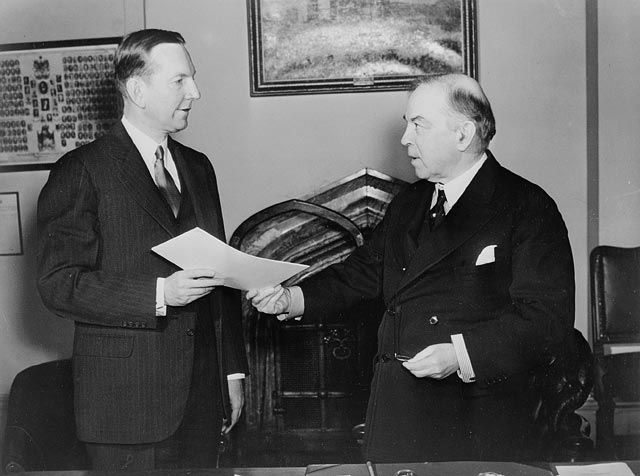
RyeGPT People of Note is a series highlighting individuals who have a connection to the City of Rye. In the series we ask OpenAI’s ChatGPT to prepare a biography and explain the individual’s connection to Rye.
We welcome your feedback on this series – the use of artificial intelligence, the accuracy and usefulness of each article and your assistance in understanding other pertinent insights related to the person’s connection to Rye.
You can add comments at the bottom of each article or you can send feedback via Tips & Letters.
Early Life and Roots in Rye, New York
Jay Pierrepont Moffat was born on January 7, 1896, in Rye, New York [some historical records note a birthdate of July 18, 1896]. He was the son of Reuben Burnham Moffat and Ellen Low (Pierrepont) Moffat, linking him to the notable Pierrepont and Jay families, whose roots in the region extended back generations.
Moffat grew up in Rye during a period when the city was both a cultural enclave for wealthy Manhattanites and a close-knit community of longtime historic families.
He attended Groton School, a prestigious preparatory boarding institution, and then continued his education at Harvard University, studying there for two years beginning in 1915.
Beginning a Career in Diplomacy
After college, Moffat embarked on a career with the U.S. Foreign Service, entering an institution that was expanding in response to America’s growing global role in the early 20th century.
From 1917 to 1919, he served as private secretary to the U.S. Ambassador to the Netherlands. From 1919 to 1921, he was secretary at the U.S. legation in Warsaw, Poland. From 1921 to 1923, he continued as secretary in Tokyo, Japan. These early postings gave Moffat on-the-ground experience in complex international environments following World War I.
Between 1925 and 1927, Moffat served in the White House as Ceremony Officer under President Calvin Coolidge, a role that involved caretaker duties for state functions and foreign dignitaries. In 1927, he married Lilla Cabot Grew, daughter of diplomat Joseph C. Grew.
Moffat continued rising through Foreign Service ranks. He held posts in Bern, Switzerland, and from 1935 to 1937 served as U.S. Consul General in Sydney, Australia. After returning to Washington, he became Chief of the State Department’s Western European Division (1937–1940), directing U.S. policy engagement with a continent edging toward full war.
Ambassador to Canada During World War II
In June 1940, President Franklin D. Roosevelt nominated Moffat as Envoy Extraordinary and Minister Plenipotentiary to Canada, succeeding James H. R. Cromwell. He presented his credentials in Ottawa on June 13, 1940.
In this role, Moffat became the senior U.S. diplomat in Canada at a critical juncture: the United States was still neutral but closely aligned with Canadian and British interests in World War II. His work helped sustain and expand diplomatic and military cooperation at a moment when North American defense strategy was rapidly evolving.
He was also accredited as Envoy to Luxembourg from 1941, maintaining relations with the Luxembourg government-in-exile from Ottawa after Nazi occupation of Luxembourg in 1940.
Death and Legacy
Moffat died in Ottawa on January 24, 1943, at age 46, after complications from surgery for phlebitis — an unexpected loss that The New York Times obituary described as lamentable even in wartime, noting his “usefulness to his country” and promising career cut short.
His death at post made him one of the early U.S. diplomatic casualties of World War II service. He was remembered in Washington and Ottawa as a consummate foreign service officer whose expertise ranged from European affairs to Commonwealth relations.