

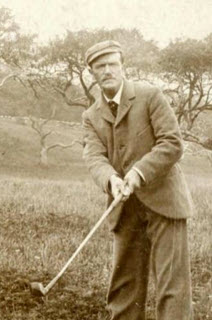
RyeGPT People of Note is a series highlighting individuals who have a connection to the City of Rye. In the series we ask OpenAI’s ChatGPT to prepare a biography and explain the individual’s connection to Rye.
We welcome your feedback on this series – the use of artificial intelligence, the accuracy and usefulness of each article and your assistance in understanding other pertinent insights related to the person’s connection to Rye.
You can add comments at the bottom of each article or you can send feedback via Tips & Letters.
Early Life and Career
William “Willie” Davis was born in February 1861 in Scotland, a country widely regarded as the birthplace of modern golf. He trained under accomplished professional Jack Morris at Royal Liverpool Golf Club in Hoylake, England, where he learned the essential skills of greenskeeping, clubmaking, and competitive play.
In 1881, Davis immigrated to North America, part of a wave of Scottish professionals who helped introduce and formalize the game in the New World. He began his career at the Montreal Golf Club, working as a greenskeeper and clubmaker. His early work there marked the beginning of a career that would help shape the foundation of professional golf in both Canada and the United States.
By 1889, Davis had moved to the United States, where he became increasingly influential in the growth of golf along the East Coast.
Competitive Play and Early U.S. Open
Davis was widely respected as a competitor during golf’s formative years in America. In 1895, he achieved one of his most notable victories, defeating two-time Open Champion Willie Park Jr. in a head-to-head match—an impressive accomplishment that underscored his standing among elite players of the era.
Later that same year, Davis competed in the inaugural U.S. Open, held on October 4, 1895, at Newport Country Club—a course with which he was associated in its early development. Facing a strong field that included eventual champion Horace Rawlins, Davis finished in fifth place. His performance placed him firmly among the top professionals helping to establish competitive golf in the United States.

Connection to Rye, New York
Davis’s most enduring local legacy came with his appointment in 1899 as the first professional at the Apawamis Club in Rye, New York.
At Apawamis, Davis played a central role in shaping both the course and the club’s early identity. He oversaw course design and maintenance while also serving as an instructor and mentor to younger golfers. Among those influenced by Davis was George Low, who would go on to become a prominent figure in American golf.
Davis also worked collaboratively with fellow professionals such as Maturin Ballou and Willie Norton to advocate for a formal championship for resident professionals. These efforts contributed to the eventual founding of the Eastern Professional Golfers Association, an important precursor to modern professional golf organizations.
Contributions to Golf Course Design
Beyond his work in Rye, Davis contributed to several of the earliest and most historically significant golf courses in the United States. He was involved with Shinnecock Hills Golf Club, where he helped lay out an early 12-hole course that later evolved into the renowned 18-hole championship layout known today.
He also collaborated with other pioneering professionals, including Willie Dunn and Willie Campbell. Together, these early figures helped establish standards for golf course design, club operations, and professional instruction in North America.
Later Life and Legacy
Davis’s life and career were cut short when he died of pneumonia on January 8, 1902, at just 40 years old. Despite his relatively brief career, his influence on American golf was substantial.
As a player, he competed at the highest level during the sport’s formative years. As a professional and instructor, he helped shape the next generation of golfers. And as a course designer and early advocate for organized competition, he contributed to the structural foundations of the modern game.
In Rye, his legacy remains closely tied to the history of the Apawamis Club, where he served as the club’s first professional and helped establish it as an important center of early American golf.