

Holding Court is a series by retired Rye City Court Judge Joe Latwin. Latwin retired from the court in December 2022 after thirteen years of service to the City.
What topics do you want addressed by Judge Latwin? Tell us.
By Joe Latwin

Some recent cases have caused me to rethink the way we select our representatives. Let’s start with the self-evident. We should choose our representatives through free and fair elections. The choices should not be pre-determined or rigged by any political party. Every eligible voter should be free to vote for the candidate of their choice. Access to the ballot should be as free and easy as possible.
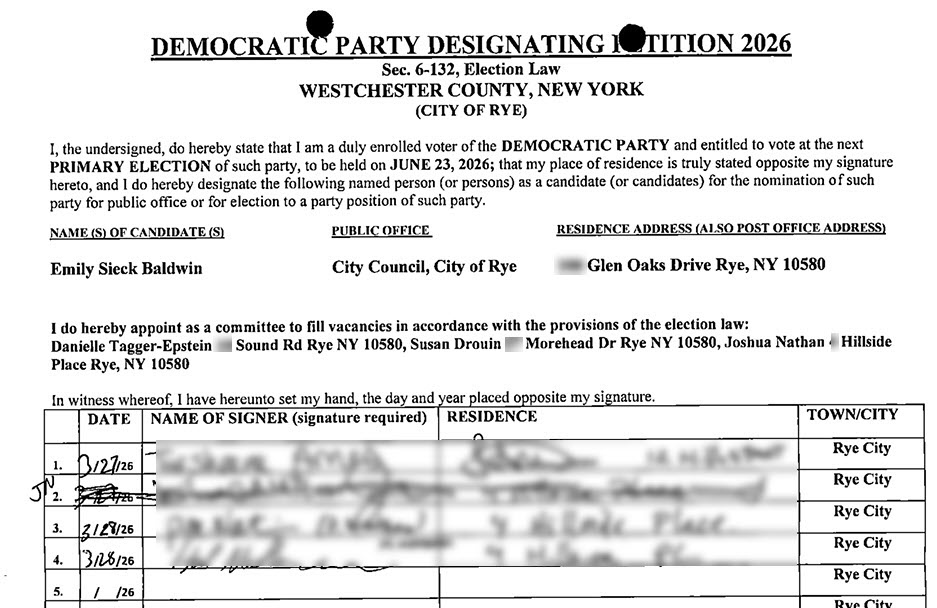
Who gets on the ballot from which we choose? In New York, candidates circulate nominating petitions for each elected office they seek. A certain number of signatures are required to be submitted based upon the position sought. Party workers, paid workers or sometimes the candidates themselves solicit signatures and swear as witnesses to the signatures. Two recent cases point out some of the flaws in this process. In most cases, the party workers will gather signatures on petitions for the party’s chosen candidate and no other petitions will be submitted. In that event, there will be no primary and the party’s candidate will be on the party’s line on the ballot on Election day.
In Rockland County, a candidate for Congress submitted petitions garnered by a campaign contractor with 127 allegedly bogus signatures. While 1,200 signatures were required, 2,100 signatures were submitted. The State Supreme Court judge refused to disqualify the petitions. In Mount Vernon, an Assembly candidate submitted 532 signatures where 340 were required. 38 signatures were determined to be improper. The judge (who is now a Rye resident) invalidated the petitions. In both cases the petitions were challenged by people supporting an opposing party or candidate.
State Legislators have introduced bills to require disqualification of a nominating petition with 25% or more fraudulent signatures. Good idea, but it does not address the underlying issue. The petition process itself is wasteful and in most cases, superfluous. It was put in place to show that a candidate can gain enough support and has the organization to run a credible campaign. These rules were really put in place by the political parties to discourage challengers and maintain party control by the party insiders by putting up barriers to outsiders. The parties usually have the organization and people to understand the complex rules governing nominating petitions while outsiders often do not. I suggest that in lieu of having to obtain signatures on nominating positions, established parties (those gaining a certain number of votes in the previous election) be allowed to designate a candidate to represent that party. If others want to run on that party’s line in an election, they are free to go through the petition process and run a primary challenge to the party’s designee. This will avoid the pettifoggery, wasteful and expensive court challenges, and reduce the need for fraud in obtaining signatures on petitions. I don’t see why there should be a tolerance of up to 25% fraud when the process is unnecessary in the first place. No amount of fraud should be tolerated, permitted or encouraged.
Nothing would prevent a party’s designated candidate from soliciting and submitting petitions. They might want to do that to get to meet people and get the people to support them.
I have seen petition challenges where signatures don’t match, addresses are wrong, numerous signatures are in the same handwriting, the name signed does not match the registered voter’s name, dates of signatures are out of order, more than one petition for a candidate for that office was signed, etc. Each of these challenges goes before the Board of Elections and then to a judge for determination of validity.
Let the voters decide.