

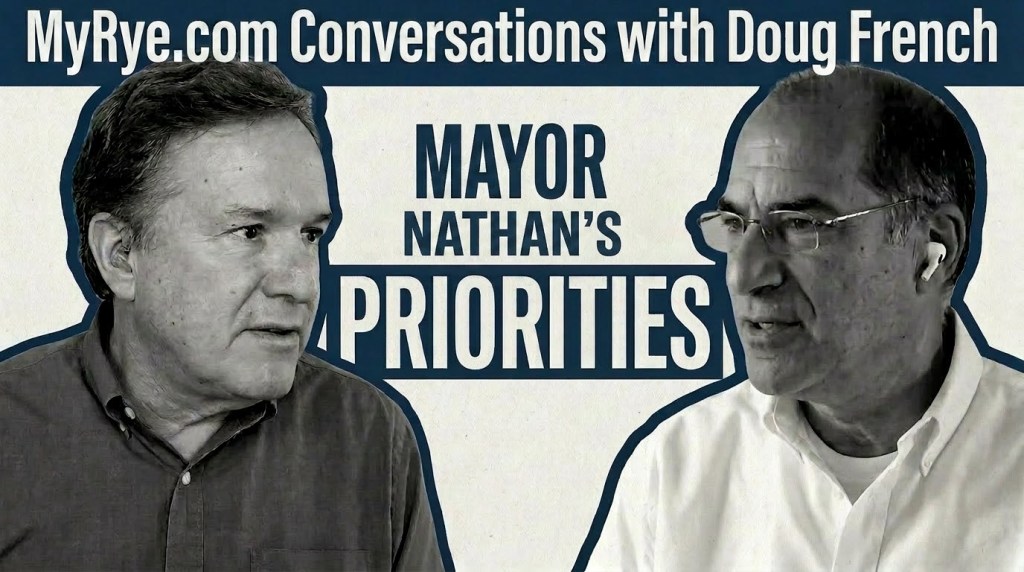
MyRye.com is entering the podcasting business with a new weekly podcast hosted by former Rye Mayor Doug French. Available on all major podcasting platforms, MyRye.com Conversations with Doug French will tackle the larger and sometimes intractable issues impacting the City of Rye through interviews with local, county and state officials and business leaders.
Our Episode 5 of Season 1, French speaks with Josh Nathan, Mayor of Rye, to explore Rye’s future including strategic planning, the comprehensive plan, community engagement, development projects, and flood mitigation efforts.
Main Topics Covered:
- The importance of community collaboration and inclusive planning in Rye
- Focus on comprehensive and neighborhood-centric development strategies
- Critical flood mitigation projects involving Blind Brook, Beaver Swamp, and surrounding municipalities
- Development opportunities including United Hospital, Rye Country Day, and Playland
- Embracing technology, sustainability, and recreation enhancements
- The role of citizen engagement and innovative outreach approaches
Timestamps:
00:00 – Introduction to Mayor Josh Nathan and Rye’s upcoming plans
00:26 – Reflecting on three months in office and team dynamics
01:41 – Leadership insights from school board to mayor
02:41 – The Dust Bunny leadership metaphor and transition planning
05:04 – Community members as future leaders and talent pool of Rye
06:53 – Focus on comprehensive planning and strategic traffic management
07:16 – Addressing housing demand and community concerns
08:44 – Managing density, traffic, and preserving Rye’s character
10:18 – Community engagement efforts for planning and flood mitigation
11:23 – Immediate floodplain issues and regional collaboration efforts
13:08 – Strategic flood mitigation projects and inter-municipal cooperation
15:48 – Upcoming action projects including infrastructure and riparian restoration
19:00 – Development oversight on United Hospital and neighborhood safety
20:48 – Neighborhood-specific development and preserving character
21:44 – Good, Bad, Ugly: Community challenges like deer, AI, and technology
23:43 – City and school coordination, communication improvements
24:54 – Sustainability efforts, recreational facilities, and public input plans
26:49 – Rye’s community spirit, Pet Peeves, and favorite activities
27:13 – Recommended guest and community voices for future discussions
28:20 – How to contact Mayor Nathan for ongoing dialogue
Issues discussed on various future episodes will include:
- Public safety
- Sustainability
- Long-term planning
- Development
- Open space and recreation
- Fiscal policy and budgeting
- Flooding
- Infrastructure
These topics concern issues that are often multijuristictional and must be addressed over many years. The show will not be focused on breaking news. We welcome your suggestions for guests, issues to be disccused, and feedback.
Doug French was the mayor of the City of Rye from 2010 to 2014, where he dealt with hurricanes, including Superstorm Sandy. He worked on finance issues impacting the city, downtown transformation, the Boston Post Road diet, pedestrian safety and sustainability initiatives, Rye Playland, and Rye Town Park. French also chaired the Rye Recreation Commission in the early 2000s and has been involved with Rye Little League, local scouting, the local Lions Club, and the local League of Women Voters. He currently serves on the Westchester County Board of Ethics. In his professional career, Doug has been a global marketing executive with leaders in the financial information sector including S&P, Thomson Reuters, + Wolters Kluwer.
Watch:
Full transcript:
Doug French: Welcome to the MyRye.com podcast, Conversations with Doug French. I am your host, Doug French, former mayor of the City of Rye. And this podcast is all about the issues and the people that impact Rye and our region. In today’s conversation, we have Josh Nathan, mayor of the City of Rye. And the topic is 2026. So Mr. Mayor, welcome to MyRye.com.
Josh Nathan: Thanks so much for having me. I think it’s just terrific that you guys are doing this.
Doug French: So I’d like to keep the focus on short term 2026 because we hope to have you back as a regular, assuming this goes okay, that you’ll come back. But if we focus just 2026, the things that you’re thinking about for 2026, one of the first questions I had was really with respect to what would Josh Nathan, the school board president, say now that you’ve been three months in office to Josh Nathan, mayor, and vice versa?
Josh Nathan: You know, I think I know what Josh Nathan School Board president is saying to Josh Nathan, the mayor every day, which is remember what a terrific team you had in those years leading the school board and do everything you can to encourage that same kind of team spirit among the Council. And also remember that they all have different ideas and different perspectives and the best thing you can do is help everyone synthesize them. And the great thing about Rye is all the answers are out there among the public. You just have to find them, listen, and the solutions are there. People have great ideas about how to solve things. People have great ideas about opportunities we should be seizing.
Doug French: In what about in your role now as mayor, what would you tell the school board president, Josh Nathan?
Josh Nathan: You know, I think I would look back and say, you know, some of the things that we did were really forward thinking and the payoff is amazing. And we see how the school population has grown and we laid the foundation for some great things. And then some of the things that I knew we weren’t focused on as urgent priorities, but I knew were going to be important. I think I would look back and say to me, those things will become important. They are, they became important. Someone did have to do that, which, and then there were some things that just took interesting turns and worked out really well. Things that we didn’t think could be done. They’ve done things that were so successful. actually, went beyond the school’s capacity to fully serve them. Like the crew team is now managed outside the schools, but services the schools. It all ties into a thing I knew then, and I know much more now, not just having been a little bit in this role, but just also, you know, it’s 15 years later. I’m a different person today. I mean, I’ve grown.
Doug French: Right? Exactly.
Josh Nathan: And that’s the time when you realize I’ve done all the things that I can do. The good ideas that I had that people agreed with, we’ve done. The things I didn’t think were important, we didn’t prioritize. Maybe they didn’t need to be, but at some point they do need to be. And that’s when you have to be thinking about who’s next, who’s going to focus on those things and making sure that you’re teeing them up. And it’s part of the way we put our Council together, I’ve actually had the pleasure of running with every single person on that Council. And we had a cross party endorsement, at least I participated in in 2023. So I’ve been part of campaigning with everyone on the Council. And one of the things I love about this Council is we represent people in their 30s, 40s, 50s, 60s and 70s. Those are very different perspectives in Rye And people are focused on things, some that wouldn’t come to mind for me, but I listen in and I’m looking at the folks who are going to be available. I’ll do my service and I’m looking at them as future leaders. And I’m looking at who’s engaging with us on boards and commissions and ad hoc volunteer things. Who’s stepping up around the community and doing amazing work.
Doug French: Yeah, great points. I mean, change is good, but there is a wealth of talent in this community and also good representation, as you mentioned. So what’s the one topic that you’re, or one issue that you’re spending most of your time, you know, your first couple of months in office?
Josh Nathan: There were really two areas of focus right off the bat. One was it’s a new Council and a new administration. All people with a lot of very relevant experience, but I’ve been on the Council first time as mayor. Council members stepping up and suddenly realizing that they’re the seasoned people and then three members of the Council brand new to being on the Council. Same with our City staff. Brian Shea was our assistant City manager, interim manager. Now he’s the manager. We’ve a number of people within the City have stepped up to more significant roles and more leadership roles within the City staff administration. all jelling around their management team. So the first month or so was really making sure that we created a really good esprit de corps among ourselves and the Council and among the staff, showing the staff that we’re there for them. We know that we are the policymakers, they’re the implementers. have to be acutely aware of where that line is. They know a lot. and can inform policy by sharing their expertise, letting them know that, please, we want to hear from you. We want you to come in and tell us what you’re thinking and making sure that those communications are open. So a lot of it was just creating that right spirit. And then the other thing far more substantive that we’re very much focused on, and it will be a theme all year, is comprehensive planning. And that is the core big thing. And yes, we did. the leaf blower legislation, it was sort of a tail end of a discussion. It was a good thing because as a Council and an administrative team, we all came together and said, here are the steps to passing a piece of legislation and here’s how public hearings go and here’s how discourse should work. But the big project ahead and the big focus of my time and energy is all keyed into comprehensive plan.
Doug French: So one of the questions is tied to, well, think demand for Rye has never been higher. Median household pricing is like $2 million. So the plan essentially, it’s going pretty well. So what are some of the gaps or areas that you think need to be refined or improved?
Josh Nathan: Mm-hmm. So in my personal view is, I think, People are concerned about how they can age in place. Is Rye going to provide the services for them as seniors? People are also thinking about people my age are looking at our kids who are in their 20s and saying, what is the pathway for them to move into Rye or a place like Rye? What is that going to take? We’re not the only community with tremendous demand on it with amazing resources and schools, but we are one of the very best. We have, you know, where things are ranked, we’re the safest community in the state of New York, we’re the one of the top two wealthiest suburbs in the nation. We have a school system that is, depending on the year, ranked always in the top 10 or 20. public school systems or 25, whatever it is, but in a group, in a great spot, our natural resources, our parkland, our beaches are amazing. So we excel at everything. There’s a lot of demand. And I think people are concerned about, how do people access that? Are people going to get priced out? Are people who live here going to be able to see a full life here? What’s that whole arc look like? Those are things I’m hearing about. costs around energy, focus on sustainability, focus on preserving the character of Rye. We are a bucolic hamlet. Around us, we see taller and taller buildings, more urbanization going on. And I’m hearing a lot of folks saying, we don’t want to be that. We want to be what we are. want to be the better, whatever the next version of this is. But the next version of this is not large buildings and little mini skyscrapers that we see growing up in other places. That may be fine for other places, but that’s not what Rye is about. But what I’m more focused on is hearing from people in Rye That’s sort of what I’ve been hearing. People are worried about density. People are worried about traffic and pedestrian safety, parking. These are… The pinch points, I think these are pinch points in this community that you experienced when you were mayor. The mayor’s in between this experience, the mayor’s before you experienced flooding is a massive concern. And we’re taking steps on that. That is very much related and in little comprehensive planning, but it is being handled in a separate track. And I’ll talk about that when you ask me, but in comprehensive planning, it’s really… The strategic work right now is about listening to the community. And we’re taking an engagement approach that is, I don’t know if it’s unprecedented, but it’s not the normal. We’ll have a committee of 12 people who are going to do a few outreach days and put it all together into a plan. We have posted on the City website an engagement form for every single person in Rye to be able to access and put their name in and raise their hand and say, I want to be involved. And they can be involved in as little as coming to one meeting, participating in one event, coming to three meetings, serving on a committee, serving on committees that are meeting monthly. We want every voice to have an opportunity to be heard because we know the plan will be better. We also know that that’s the nature of people in Rye. They’re not going to farm that out. They’re going to say, this plan is going to work because I’m going to have my hand in it. And they are. And there’s a seat at the table for everyone who’s on multiple committees. And we’ve enhanced the engagement process with our consultants so that they can actually handle a much bigger engagement upfront. And I’ll be talking more about that over the coming Council meetings as we roll that out more and more. But right now, raise your hand and get involved.
Doug French: it’s a great approach. Yeah, I think it’s a great approach because it’s gone in the days where you go in a back room and you just have the big reveal, you two years later, you want continuous improvement, continuous feedback. So let’s pivot over to flooding. When I think about flooding, I think about coastal, I think about Beaver Swamp, I think about Blind Brook. You and I have connected through the years on all of the work that you’ve done, right? Break it down for people. are the immediate things that they can expect or should be pushing on the local government and the surrounding governments to really get some progress on that front?
Josh Nathan: Sure. So the first thing that folks can appreciate is we have three floodplains in Rye. We think a lot about the Blind Brook and the impact on Indian Village and the downtown and along Milton Road. We also have a floodplain on Midland Avenue, and that’s fed by different source of flooding. And then we have Beaver Swamp Brook along and the Osborne in that part of town. And so when we realized that there’s three different floodplains, we always have to look at each one of them. There are common issues with them, but they’re also, each one has different ways of helping to mitigate flooding. And so we have to treat each one separately as well. That’s all, those are three riverine types of flooding. They’re also impacted by the tide system, can make riverine flooding worse. There is coastal flooding, not as urgent a matter. It’s the sound, we have seawalls, but that is important. We saw that with Hurricane Sandy. And then there is flooding caused by rain and that flooding is really, it’s the rain is the cause of the flooding, but the reason we’re flooding more now has to do with, there’s less and less pervious surface. A lot of that has to do with construction. So the real question is what can we do about it? There are things we can do in Rye and we’re focused on that. What kind of code improvements could we make? What kind of new building technology can we encourage in making sure that we’re doing everything in Rye that we can? Are we building smart in Rye? Are we renovating in a smart way? We’re fully developed. So it’s really about redevelopment. The other thing is if we’re really going to tackle riverine flooding, particularly Blindbrook and Beaver Swamp Brook, we have to work with our neighboring communities. What we’ve done just in the last few weeks is we’ve entered into a municipal collaboration with Harrison and the Mamaroneck Village. Rye Town Park is part of that because they own land. It’s part of all of these things. And we’ve also entered into another one, another municipal agreement with or It’s a resolution of cooperation, but it’s a big step, a big start with Rye Brook and Harrison around the Blind Brook. And with that, we’ve also gone and met with the county and said, look, we’re all uniting around these areas. We’ve also joined, rejoined LISWIC which has been reconstituted. think they were first enacted during your time as mayor.
Doug French: Yeah, Steve, maybe right before my time, but yeah, exactly.
Josh Nathan: Yeah, and so that’s come back and that has about 14 communities that are involved, but it is a it is a. It’s a platform for all of us to get together and share ideas. And then from that, set up smaller working groups around, well, this is what these communities need to work on together. And through that cooperation, the county has matching grant money to help support projects. And we can also lobby the state and the feds to help us solve things. At the top of Blind Brook is the airport. and SUNY, those are both contributors to the water issues along that floodplain or that watershed. Going to them together is a much more powerful dialogue than going up and not working together. And the county has been very responsive and we have new outreach with SUNY and we’ll be having meetings with them. So what the community can see is We will be addressing things in a few ways at once. One is through collaborations, working with our upstream neighbors, our downstream neighbors, leveraging the support that the county can bring in the table. We have some projects where there are grants coming in, where grants are being applied for that we have a good shot at up in Beaver Swamp Brook to remove a bridge that creates a backup. into Glen Oaks. So that would ease a lot of flooding there. And then there are further pinch points downstream. All that engineering analysis has been done. We were not grant eligible. We didn’t have enough points because we didn’t have a collaboration. We have a collaboration now. We look like a different recipient. Similar things will happen. The governor’s office is going to help us work with SUNY. The county is interested in engaging with us more directly about the airport. And so
Doug French: Okay.
Josh Nathan: In the coming months, the community can expect to see changes in how we’re functioning around that. They’ll also see discrete things happening in Rye. The Nature Center is starting its riparian restoration project that will ease flooding along the Blind Brook. The county has already allocated funding to replace two bridges along the Blind Brook. that will, I don’t know when that’s going to start, but it’s approved. It will one day start. It’s not just an idea or an application. So people will see things happening along the way. There are some little bridges that need to be dealt with as well. So there’ll be very real pragmatic things happening over the next couple of years. We will also get the analysis through the stream gauges from Blind Brook we should be getting that soon and that will help us manage the dam, which regulates the water flow. So I think that’s what people can see happening in that area.
Doug French: Yeah, getting the data.
Doug French: All right, so along those lines, let’s pivot to development a little bit. So we’ve got the United Hospital, we’ve got Rye Country Day School, we’ve got Playland, we’ve got residential. What are your overall thoughts on those projects or just development in general?
Josh Nathan: Mm-hmm. Well, I think there’s two things that we are looking at in terms of addressing development in general, and then I can speak a little bit about those projects. So, comprehensive planning will give us the strategic lens for dealing with a lot of questions that come up out of development. How do we put things in our code to address? flood mitigation, storm resiliency, energy neutrality, things that are really about a more sustainable community based on what’s available in terms of technology, what’s more cost efficient. That’ll have an impact on development. I think in a good way, it’s not about not. To me, it’s about redevelopment, people improving what they have and giving them the opportunity to do that. And I think we’ll see that things that were done, you know, 40 years ago in our code or 50 years ago in our code need to be rethought a little bit because the water’s rising, the place is more developed, new technologies are available. So that’s sort of general. The other thing that’s more concrete is just last night, the City Council authorized an RFP for design standards. which comes out of a mini planning effort for the downtown business district. And design standards and some new zoning considerations down there are really about preserving the character of Rye’s Central Business District and the historic district around it. And really giving landowners and developers Much more clarity about what we want to see and ways they can be successful. There are buildings that need renovation. We’ll give clarity on how to do that successfully. There’s an empty, there’s a couple of empty lots. There’s some empty buildings. I think with people seeing this is these new standards will be a helpful guide on a way forward. And that’s something that will not wait for comprehensive planning to be finished because we did the initial analysis in sort of a pre-plan. So we’re looking for that process to happen over the course of this calendar year. It’s a matter of months, not years, whereas comprehensive planning is a year and half. If it moves like clockwork, this is something that will happen this year. And I think that will…
Doug French: Right.
Josh Nathan: guide that downtown, some of the downtown development opportunities. Now, if we get to the big projects like United Hospital, what Rye needs to be doing is, first of all, understanding that that’s happening. This is not something we have to not look at. How do we fight it? It’s being dug out and built. We have to look at how many people are going to be there.
Doug French: Right.
Josh Nathan: How many cars are going to be there and where are they going to go? Well, we know they’re going to come to Rye. We know they’re going to come and dine in our restaurants and park on our streets and use our parking lots. And that’s great. That’s going to support an even more vibrant downtown that will help give reason to develop things well downtown. It’ll help the merchants and the restaurants. And we like that. But we have to plan for it. that’s something, fortunately, that project has a 10 year horizon on it.
Doug French: Right.
Josh Nathan: And so our planning will be focusing on how do we address that? And then you have neighborhoods right adjacent to the United Hospital Development, Ry Park. They’re concerned, they’re concerned about traffic and pedestrian safety in their neighborhood. And we want to make sure that we’re preserving their neighborhood. That’s one of the things that our comprehensive planning process is focused on, which is a very neighborhood-centric plan. The things that Rye Park care about. We’re going to make sure that we are focused on that, not having them sit at a table with the folks at Glen Oaks waiting their turn to talk about what’s important in Rye Park. No, you’re to have your own committee and we’re going to make sure we get that fully vetted and sorted out. And the Glen Oaks folks are going to talk about their issues and then that’ll come together and be synthesized. So we’re going to be very neighborhood focused. all about protecting neighborhoods because that’s how you experience Ryde, right? Where do I live? What’s my neighborhood about? And we’re be thinking about development in that regard. What’s appropriate for your neighborhood? What’s gonna make your neighborhood its next level of being? We have neighborhoods that have extraordinarily strong characters. You walk around Louden Woods, it’s like the Enchanted Forest. You wanna make sure that we’re encouraging that to continue. My neighborhood’s more beachy.
Doug French: Right.
Josh Nathan: We want to make sure that that is preserved. It’s not hard to do. It’s more about let’s recognize it, quantify it a little bit, make sure we capture it in our planning. So we want to think about when we’re talking about development, again, we’re really talking about redevelopment that we’re encouraging things that contribute to the character of different neighborhoods. And what’s great over in Loudon Woods might not be what we need to be talking about. over in Glen Oaks, which is a different kind of experience. So that’s how we’re thinking about it.
Doug French: Alright, so we… Yeah, no, it’s really good insight. So we’ve got about five minutes left. Maybe I’ll change it up a little bit. We’ll do like good, bad, ugly. Just I’m going to throw out an issue and you say good if you think we’ll make a progress, ugly if there’s a lot of issues still to be resolved with that or whatever. Good, bad, ugly. So deer.
Josh Nathan: Sure. Shit. Mm hmm. Sure. Dear, good, we’re doing the analysis we need to do. I don’t know where it’s going to come out, but we will have the information we need to make smart decisions.
Doug French: AI and technology.
Josh Nathan: I’ve not spent much time on it on the AI side. Technology, we are making progress in upgrading all of City Hall’s technology. And then I think we’ll be able to be in a position to have an AI conversation.
Doug French: financials
Josh Nathan: Excellent. We just reconstituted the finance committee. We have five fantastic qualified people helping with that. I’m excited for the work they’re going to do. They’re going to help us with budget analysis and staying well aware of where we are. They’re going to help us with the capital improvement budget. And they’re also going to help us with forecasting. We’ve not been doing forecasting in a public way, something I did on the school board. It was just second nature over there. We’re gonna make sure we’re always looking at the financial implications for taxpayers as we look ahead A dollar spent today means as budget implications for infinity, we need to be able to see what that means.
Doug French: Yeah.
Doug French: Yeah, I had resurrected that. There’s so much talent in this town that it is an excellent, excellent resource to leverage and help set policy. Yeah, cell phone coverage.
Josh Nathan: We have the best people. Cell phone coverage, that’s a great topic. If you’d asked me a month ago, I would have said, I’m thinking about it. The great news is we’re now thinking about it. We have meetings in the next two weeks with two different cell phone providers to discuss getting coverage across all of Rye. I don’t know where those meetings are going to lead directly, but we are marching towards that end.
Doug French: So that’s good.
Doug French: Okay, so good, bad, ugly. yeah. City and school coordination.
Josh Nathan: So good. That is something that we are resurrecting. We have just done for the first time a joint meeting, not just with the Rye City Schools, but with the Rye Neck Schools as well. We are thinking more broadly about what that coordination looks like. So there you go. You and I really laid some great groundwork for that when I was on the board and you were mayor. I want to get us back to that.
Doug French: I’m a former Rye Ecker, so. We did. We really did.
Doug French: communication and information.
Josh Nathan: Need to work on that. It is something that I know Brian Shea has a lot of talent in and it’s something he’s shared with me. Some of his thinking. We have seen some real progress in terms of communications, mostly coming out of the police department. We have a very good handle on it there. I expect we’ll see that expand into City Hall communications. Once the City Hall renovations are done, we’re a little hung up by the fact that everyone is out of sorts over there because we’re doing an HVAC renovation and people aren’t in their offices. So a work in progress.
Doug French: Yeah, yeah, understood.
Doug French: sustainability.
Josh Nathan: very much tied to comprehensive planning. think of comprehensive planning as sustainability elements.
Doug French: and recreation facilities.
Josh Nathan: We are focused, the next big focus is Gagliardo Park. So last night we authorized contracting with a vendor to improve our pickleball courts that we know there’s a tremendous amount of demand. So we’re focused on recreation. What I want to see, we don’t have it yet, is a rec plan. I think that will… either work in parallel with or come out of comprehensive planning. think it doesn’t really matter how, we just need to do it. But we need an overall rec plan. But Gagliardo is a focus.
Doug French: Yeah. Yeah, and any part of that rec plan should be coordination with places like the Y and the schools as well.
Josh Nathan: Yes, absolutely. And with Gagliardo, we’re going to be hosting a City Council workshop type meeting up at the field, probably in late May. Not sure when we’re working on dates when we can all be there and walk the field together with residents, with members of rec and with members of other people in the community and other organizations in the community. You’ve said we want to see that field improved. We don’t live there. We’re not part of the rec commission, but we care about it. Little League, for example, and softball. So we’re going to be having some kind of workshop event up there to really look at things. And I know that the staff has developed a few different ideas for what we can do. We’re also going to be meeting with the Thruway Authority because I’m very bothered by the sound barriers really ineffective now. And we need to address that. We need them to address it.
Doug French: That’s right.
Doug French: Okay, so before our very last segment, I want to just let our listeners know if you have a topic or a guest you want to hear on this podcast, the MyRye.com Podcast Conversations with Doug French, just email me at French at MyRye.com. So we’ll just end up with a couple of one word answers, Mr. Mayor. Why Rye?
Josh Nathan: Mm-hmm. Love it. Love it. The day I came here, it’s the most beautiful City on the Sound.
Doug French: your Rye pet peeve.
Josh Nathan: Ooh. I don’t know, I don’t have one. No, I’m gonna live a long time because of Piazza Pizza.
Doug French: Okay, I’ll come back to that. Your rye favorite food. Your rye favorite food. What’s go-to Rye activity?
Josh Nathan: sailing. Yeah.
Doug French: And do you have a topic or a guest that we should include?
Josh Nathan: I think you should talk to Hillary Garland over at the Rye Sustainability Foundation. They’re doing some amazing work. You should talk to all of my colleagues in the Council. You will hear six other very different but very collaborative perspectives on what I’ve been talking about. mean, they all see it. through their own lens, but we’re all working in the same direction. I think some of the folks who were at last night’s Square House meeting, some of the folks who served many years ago would make amazing guests. I think going back to the woman who chaired planning years ago, talked about still driving through Rye how amazing it is. I think she’d be a fantastic guest. And then having another conversation with Nick Everett. some of the people on the land use boards getting their perspective. And then. You know what is really interesting is if you go to Frank’s Barber Shop and you talk to Johnny, he sees everything going on. He’s been looking at Rye for years. And I go in there and he’ll share things about the downtown business district that are so insightful. Chat with him, see if he’ll do it.
Doug French: That’s great. That’s a great suggestion. So how can people best reach you?
Josh Nathan: nathan at ryeny.gov email. can also call me. I have a direct line just for this. I’m not afraid to give it out. 914-312-1353. Feel free to call or text.
Doug French: Well, Mr. Mayor, a lot of insight. Thank you for your time. And I want to thank all of our listening audience as well for listening to the MyRye.com Podcast, Conversations with Doug French. You can find more local news and a full episode transcripts at MyRye.com. If you found this conversation helpful, please follow or subscribe wherever you get your podcast. And Josh, as a friend and as a mayor, thank you. Great insights and thanks for joining us today.
Josh Nathan: Thank you. I so enjoyed your leadership of Rye and I hope to be able to accomplish things that are in the same level of quality and care that you were able to provide when you were leading this community. There are always surprises and you know it’s what you plan to do and then there’s what’s happened, what happens and it’s managing them both. If you can come out. Being able to say like we handled that well and we got a few things done and the community’s that much better off. We’ve done our job and you’re a great example of that. And I thank you for all that work. And I’m so glad you’re doing this.
Doug French: Great. Thank you. Thank you. And thanks to our listeners. We’ll see you next time on Conversations with Doug French.
