

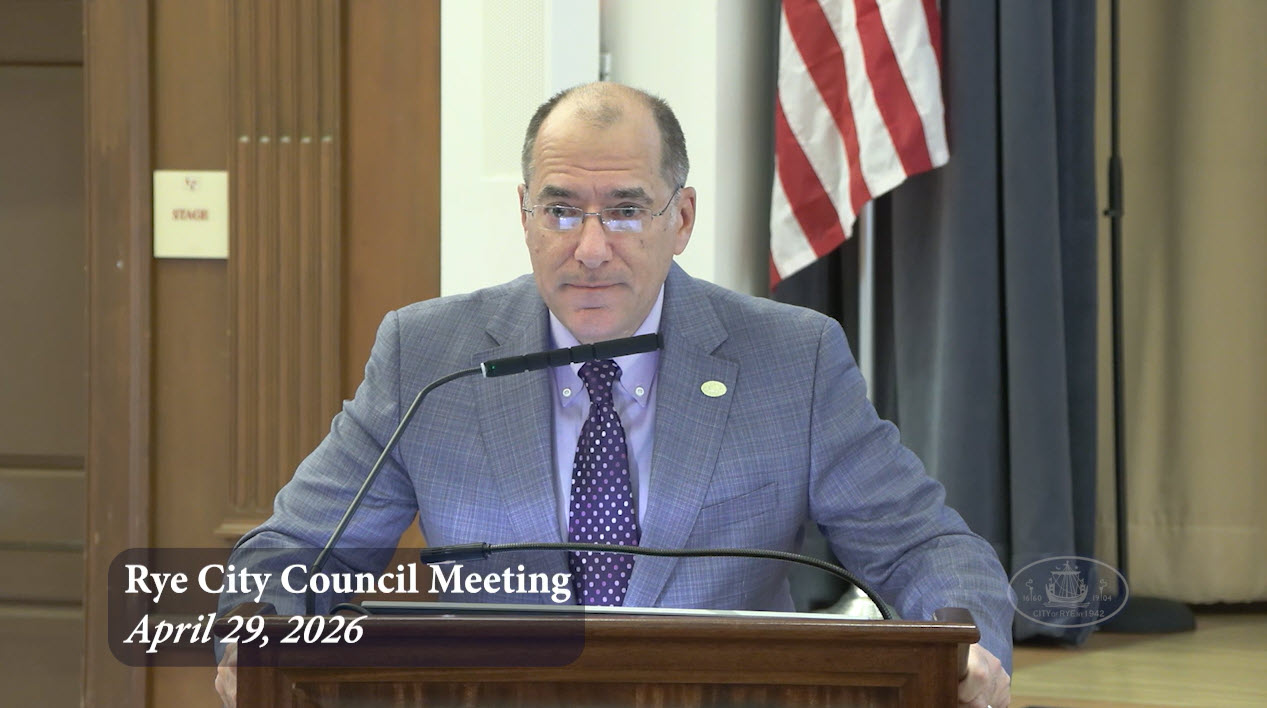
One hundred and eighteen days into his term, Rye Mayor Josh Nathan offered five pillars to explain his priorities during his annual State of the City address. He couched all five pillars underneath the theme and the tension between preservation and progress. Nathan delivered the address on the campus of the Osborn retirement home on Wednesday, April 29, 2026.
The five pillars–community engagement; neighborhood quality of life and public safety; fiscal resilience; combating flooding; and comprehensive planning with sustainability elements–are a good indication of what should be coming from the city over the next three and one half years. Nathan and his voting block control six of the seven seats on Rye City Council.
MyRye.com is offering a full transcript of the Mayor’s remarks as well as the captioned video below. For anyone looking to understand the City’s priorities, we also recommend reading our interview with Nathan from the election last fall: Q&A with Mayoral Candidate Josh Nathan
Watch:
Full transcript:
Good evening. We are living in exciting times in Rye. There is this beautiful tension in our commitment to preservation and to progress. As my colleagues and I knocked on doors last year and in ‘24 and in ‘23 and earlier than that, we kept hearing a certain theme: keep Rye Rye, but also improve it. Make it more sustainable. Preserve our shoreline gem, but accommodate new needs. Fix the things that don’t work, but don’t ruin what we know we are so lucky to have.
That is our North Star managing that tension between preservation and progress.
If we manage it well, we can ensure that Rye continues in the best sense of its legacy to fulfill its promise to all of us here today and those to come. It’s been a number of years since a mayor has given a formal State of the City address. Our charter indicates that it is optional and it’s an address to the council. You’ll see in the words up there the words may and address the council.
As the head of our local government, I consider it obligatory and I consider the audience to be our community at large as well as our council. In any case, I’m glad to be bringing this tradition back and I look forward to it being practiced for years and years to come. Let me thank you, the Osborn, for hosting us this evening. As many of you know, our city hall is being renovated and the council is literally chamberless. We’re grateful for your hospitality and we’re also grateful for your audience. We are a new government and a new administration. We’re made up of new people and more seasoned people in new roles.
While just 118 days in, I can tell you that the state of the city of Rye is strong and in good order, notwithstanding the challenges faced at the county and the state level. and now withstanding rising costs and current national and global affairs. In Rye, we are comparatively very, very fortunate. We are working off of a very solid foundation laid by those before us. We are supported by phenomenal volunteers working across 20 plus boards and commissions and across our many nonprofits supporting all aspects of life in Rye. And we have a tremendously talented and hardworking city staff running our operation.
In our first 118 days, our staff hit the ground running, unfazed by surprises and disruption. There were changes at the top with new hires and promotions. They were supporting a new council and developing a robust orientation program to ensure good, thoughtful and collaborative governance. They were keeping our city safe and functioning through two blizzards. They were saving the Stuyvesant Avenue owls from habitat destruction. They were dealing with the aftermath of a minor earthquake that destroyed a portion of the retaining wall along the Blind Brook at Locust Avenue. And then of course, the city HVAC system upgrade finally being implemented just in time to render City Hall officeless for our administration. The proof of our city’s strength and good order is all around us. Our services and facilities are well run. Big events like parades and opening days and road races come off without a hitch. Our processes run smoothly. We are positioned well to meet the challenges and opportunities we face in navigating our North Star of managing preservation and progress.
And tonight, I will highlight what this means across five areas of commitment. Commitment all seven of us made at one time or another. I know this because I had the pleasure of working with every single one of these folks in seeking office. I could not ask for a better team.
We will be looking at community engagement, neighborhood quality of life and public safety, fiscal resilience, combating flooding and comprehensive planning with sustainability elements.
Community engagement. Let me thank my council colleagues, our boards and commissions, and our staff for your commitment to a local government that prioritizes community engagement. We have taken steps to reinforce this value. Our new council agenda format brings the community in, spotlights good works, and supports meaningful discussion and discourse with the community and among the council. and the city staff. For the first time, we included the Rynek schools in our joint council board of education meeting. We brought back the Square House meeting where we welcomed our volunteers and past city officials to share their wisdom with us. We have begun the groundwork for comprehensive planning with an engagement plan designed for the breadth of communities insights, talents, and perspectives.
We launched the Living Landmarks Initiative under the auspices of the Landmarks Advisory Committee to share pride of place and people throughout Rye In the coming weeks, there will be public meetings about Gagliardo Park. a rec commission meeting, followed by a meeting later in the month at the neighborhood in the park. People can also participate online. And we have brought back council office hours. That’s a picture up there of the ambassador of Namibia who recently took us up on our office hours. So we have set the stage for active engagement essential to managing the mix of preservation and progress we all value. in making decisions.
We need to prioritize neighborhood quality of life because that is how all of us primarily experience Rye. Our home, our street, our neighborhood, the particular places we go. I think of the Osborn as its own neighborhood, a critical one in our city. Straight away, this council addressed the scourge of gas-powered leaf blowers, joining our neighboring communities and banning them. Peace and quiet returns on May 1st. I commend my colleagues for not wasting any time in taking this up, engaging in appropriate research and discourse, and being rightly decisive after 20 years of discussion.
I hope that our very largest institutions, who are exempt from the ban, start planning soon to transition to electric blowers so that we can enjoy a total ban. I know the city is making that transition now. Presently, the council and staff are looking to improve cellular service to the more than a third of Rye that has unacceptable coverage. This is both a quality of life and a safety issue. We’ve met with two service providers and are coordinating with Rye Town Park. My expectation is that we will have a staff recommendation for engaging an independent consultant as a number of our peer communities have done.
Additionally, the council and staff are looking at food scrap recycling options. A number of solutions have been identified. More to come in that during the balance of the year. And we have worked diligently to have an excellent working relationship with our Rye Town Park municipal partners. We’ve enhanced the city’s focus on neighborhood traffic and pedestrian safety. Active work includes the city’s work with the State Department of Transportation on Hornage Road, an intersection that needs improvement and is an area of concern for our Rye Neck residents. And our staff is reviewing Rye Park neighborhood traffic data and updated plans concerning the former United Hospital site in Port Chester and Rye Country Day School, because that’s extremely important for that area in our town.
Regarding public safety, we’ve had several key developments. We are the number one safest community in the state of New York. Thank you to our police and fire departments. To ensure we remain on top, we’ve approved one additional firefighter and one additional police officer to enhance our public safety staffing. We recently authorized purchase of a new pumper truck to replace engine 192. Our Swiftwater Rescue Team officially achieved Level 2 state accreditation.
And our Public Safety Commissioner has also launched an innovative drone program. Twelve personnel with FAA certification soon to be joined by seven additional personnel who are enrolled in training. We’ve had a total of 618 drone flights since last July, over 96 hours of total flight time. Flights during this pilot phase have already assisted with the fire department’s quick response to a contractor damaging a natural gas line. A safety watch at the Rye YMCA Derby, where I had the opportunity to fly one of the drones very briefly. A Port Chester police pursuit that ended at Boston Post Road and Cedar Street. The now well-known Swan Rescue at Tide Mill. And video supporting DPW cleanup after a winter storm fern. If these flights were performed by a helicopter, they’d be unaffordable at $14,000 per flight. This is a highly efficient enhancement to our public safety support, and I commend our police department and our fire department for taking the time to learn this technology and deploy it in Rye for everyone’s benefit.
This summer we’ll have a full discussion about our capital improvement plan. However, I will report that a host of projects, many of which have been stuck for years for any number of reasons, are now in various stages of quote unquote underway. The Forest Avenue sidewalks are finally advancing and should be shovel ready in the ground within a year. When I moved here we were talking about that sidewalk. That was 25 years ago. The Theo Fremd wall repairs are underway. I’ve been hearing about that for a very long time. The City Hall HVAC upgrade will hopefully be completed by the end of May.
The salt shed, which can be repurposed if we come to a time when we don’t need to store salt, and the associated redesigned Recycling Center are also underway. And most recently, pickleball court resurfacing will happen at some point. this next season. All of these are projects that are paid for out of a combination of grants, reserves and bond funds we already have allocated. It’s a tremendous amount of work for our city staff to manage them all and they’re all happening right now. As we look at our capital planning, we are also careful to coordinate with nonprofits that are on city land to ensure that they aren’t needing to apply philanthropic funds they raised to do work that this city can and should do itself.
Most recently, we have been working with the Milton Point Conservancy to schedule certain work on the land the city owns that supports the Bird Homestead restoration. So we recognize that It’s not just about tax dollars, it’s about all the dollars that all of us spend to live here, wherever those dollars may go. And it’s important for us to think holistically like that and be efficient. Our focus on neighborhood quality of life and public safety enables us to be highly responsive to residents. That’s why it’s a priority. And in doing so, we are driven by our North Star of managing our commitment to both preservation and progress. Whatever it means, in each neighborhood.
Of course, we’re nothing without fiscal resilience. In committing to fiscal resilience, we appreciate that affordability holds different meanings for different people in Rye. Our national ranking as a wealthy suburb and the average home price do not paint a true financial picture for almost anyone here. We are sensitive to the costs of our residents. that they incur from school, county and city taxes, assorted fees and the requests for philanthropy that are essential to supporting our local nonprofits and to making Rye such a special place.
In terms of our 2026 budget, we are off to a very good start. The big news is that we have rebuilt our unassigned fund balance to meet the council’s established policy of 10 % of budget. This will have a positive impact on our credit rating from the rating agencies and our fiscal stress designation from the state controller. Additionally, non-property tax revenue is currently trending well above budget. All in all, we’re in a good position and I should move on, but I won’t.
What is missing here are actual numbers. Because for years, it hasn’t been the practice that the council receive regular monthly or quarterly reports. Something I found surprising. I sit on a number of boards, I counsel boards, and this is something done everywhere. I’m certain your board does this. However, with the very willing and positive support of our city staff, that is going to change now. With regular reporting, we can lead an open and smart budget process where discussions start early and surprises are kept to a minimum. We tested this last year when we started planning for the library’s needs 10 months before the official budget season started. We were able to accommodate the library because we had plenty of time to consider it. We had plenty of time to look at a variety of options. We had plenty of time to look at other levers in our budget so that we could address a very critical need in this community. We should be able to do that with every decision we make and every issue that comes before us in real time. In addition, we have brought back the finance committee which had been active for many years. or had been inactive, sorry, had been inactive for many years.
Our newly constituted committee will advise the council and staff on budget analysis and planning, multi-year forecasts so we can all see the future implications of the choices before us, the financial analysis for specific opportunities and challenges, and continued planning of known major infrastructure and equipment expenses, something our prior city manager did an excellent job on. such as the paving and fleet plans. And our new city staff team is committed to expanding that across more needs in our city.
Regular financial reporting and an active finance committee is core to good fiscal stewardship. It’s how we find efficiencies so as to hold the line on tax growth and pay for important new initiatives. We need these tools for the city to properly manage against the fiscal pressures on the state and county that could impact us at any time. It was essential to the good work of our school district when I served on it many, years ago. And we were going through the great recession because we knew where we stood at any minute, because we literally knew where all the nickels were. We could plan and adjust and we could launch new initiatives and we could control costs.
Our commitment to a new fiscal program is a top priority for this year. We will have a solid reporting and engaged financial committee. To borrow a concept from one of our new finance committee members, we can have a vision for preservation and progress. However, we need good fiscal discipline to make it happen.
Now we turn to the existential threat to Rye. flooding. We are at proven risk from riverine, rainwater, and coastal flooding. We are most vulnerable across three primary floodplains, the Blind Brook, Beaver Swamp Brook, and along Midland Avenue. Hurricane Ida cost tens of millions of dollars in damage, and we had similar experiences with Hurricane Irene and Super Storm Sandy. These situations are not going away. The damage, the life safety risk, the turmoil, is all borne by us, residents, small businesses, and local nonprofits.
No one in Rye should be left homeless or economically wiped out by a storm. We must take on flood mitigation consistently and proactively, and we now are. We have updated our Hazard Mitigation Plan to advance science-based initiatives. Many were originally called for in the 2014 New York Rising Community Reconstruction Plan. for the city of Rye. And again, more recently called for in the Ramble engineering study that Rye commissioned in 2022. And again, and also called for in the SLR studies commissioned by the New York State Department of Environmental Conservation. We’re acting on those initiatives. We’re acting on those plans. We had prioritized flood and storm mitigation measures that we can do ourselves.
Here within the City of Rye, we will not accept this concept that it is an upstream problem and therefore we can ignore it. We must do what we can here. We are training two members of our building department staff to become certified floodplain managers. It is essential that we have the competency in-house so that we can consistently stay on top of the issues and the latest solutions. Our planning and engineering departments are working with the Rye Nature Center on its riparian restoration of the marshlands along the nature center’s portion of the Blind Brook. This includes the removal of an abandoned bridge and this will all help with Blind Brook flooding. This project is state funded and work will start over the next 12 months.
We have commenced a FEMA funded codes and ordinances review. When the review is completed, the council will be asked to consider code and ordinance changes. that require any new construction to be flood resilient in accordance with the latest and best practices. It is essential that we do so. We must stop building things that fill our basements and first floors with water. We must improve our buildings, our parking and road surfaces, our infrastructure and our landscapes in a way that mitigates flooding.
Let me compliment our Osborn hosts. You are working with the city now. to make sure that your capital project is done in a flood-sensitive manner. It has involved extensive engineering analysis. I’ve heard all about it, and I know it’s going on longer than you’d hoped, but we thank you for that. It’s critical to protecting homes in Glen Oaks and in Rye Gardens and all the areas affected by the Beaver Swamp Brook floodplain. Thank you for being good citizens.
This June, we are scheduling citizen preparedness training. There have been tragedies in the neighboring communities. Two people died in Rye Brook during Hurricane Ida. We must ensure that our residents are prepared. We are also working upstream and downstream.
We have formed new positive government relationships and alliances, something we had not been focused on before. In March and April, we entered into three inter-municipal cooperation agreements, one with Harrison, and Mamaroneck and Rye Town to address Beaver Swamp Brook flooding. One with Rye Brook and Harrison to address Blind Brook flooding. And one with the Long Island Sound Watershed Intermunicipal Cooperative, also known as LISWIC. So it’s to share data and collaborate with over a dozen of our neighbors. These arrangements not only enable better mitigation measures, but they make us eligible for state and county funds available only to collaborative projects. We can’t go it alone and neither can our neighbors. So we’re working together.
We’re working with the governor’s office to advance Blind Brook upstream mitigation projects that are essential to life safety and preservation of property in Rye, Rye Brook and Harrison. Those conversations have just started. That’s a lot in the works, a lot for our city staff to manage and there’s more we still need to do. Still pressing is our need for funding to replace the Locust Avenue bridge. and the seawall on both sides of the Blind Brook, which is partially collapsed into the Brook, as I mentioned earlier. And it threatens the library, the YMCA, and the central business district just upstream. We have $5 million in grants, but we need $10 to $12 million for that project. I’ve given a lot of our time to flood mitigation tonight. It is the existential priority for Rye. We must allow it to be part of our decision making. We must support our staff and their work on it. We must remain vigilant and consistent in keeping this a priority. We cannot forget it. The flood waters recede, memories fade. We have to keep working on it. They will come back. When it comes to flooding, progress is absolutely essential to preservation.
Now comprehensive planning. We’ve all been talking about this. There’ve been several efforts to get it started. And this council is committed to developing a comprehensive plan that respects Rye’s heritage and leads us into a climate smart future. This is a major priority, something we have all been talking about, something we have all said we are committed to. Some may ask why is comprehensive planning so important? This is where that tension of preservation and progress really comes into play.
Planning is the lens by which all land use, city program, and fiscal decisions are made. Some have asked, why isn’t the 1985 plan good enough? It is 40 years old, 25 years out of date by its own definition. It doesn’t work for today. It was a development plan to support single-family housing. It’s done. We are fully developed. We are in an era of redevelopment. We need to think differently. The environment and the climate have changed. The demands on Rye have changed. Technology has changed. Flooding has changed. Right now, it’s like we are using a landline and trying to get mobile smartphone capability out of it. We can’t do that. It is statutorily essential to have a new plan if we are going to develop a new land use code.
Our phenomenal land use boards, the BAR, the ZBA, the Planning Commission, the Landmarks Committee, and the CCAC are all governed based on an outdated plan with outdated objectives. If we want preservation, we need to have a plan that allows us and them to govern for that. If we want progress in the 21st century, we need to have a plan that allows us and them. To govern for that, we have to decide what that means. That’s what this process is about.
And here are the next steps. We’ve hired AKRF and the Pace Land Use Law Center to lead the effort, and they’ve been doing foundational work for the past few weeks. We have commenced recruiting volunteers for our engagement committees, the critical part of the process. Over 150 people have stepped forward. That’s fantastic. As of today, they have received a short survey questionnaire so that we can ensure residents who step forward are aligned with the areas and opportunities that best fit their interests and their availability to work with us. For anyone still interested in participating, you can still sign up and complete the survey on the city’s website at ryeny.gov.
We are taking a nonlinear approach to planning. We are not waiting to complete the entire plan before advancing major policy changes that are essential. Several initiatives are underway concurrently that we know will dovetail with the plan, that we know are called for, regardless of the plan. These include the Central Business District design standards called for by our 2025 Central Business District report. The work of representatives in our community, our volunteer land use boards and our city staff. That work was a precursor to planning. We were doing a natural resources inventory. It’s a critical record and analysis of our resources and features, their condition, their needs and the threats to preserving them. We need to do that no matter what. The flood mitigation code and ordinance review and other appropriate flood initiatives.
We’re not going to wait to do things we know we have to do. A cell service plan. don’t think there’s any plan that will tell us we don’t need cell service. The Gagliardo Park Design and Implementation Plan. That is a park that is completely isolated from Rye to other parks. It is in a neighborhood that does not have access to other parks. So we know that we need to invest in that park. Brian and I are meeting with the New York Thruway Authority to address the sound barrier issue, namely the lack of a safe sound barrier, making the park partly unusable. and definitely unsafe for little ears Comprehensive planning is our number one priority. It is the way we get from valuing preservation and progress to making both of those concepts real and actionable and Rye today, tomorrow, and for years to come.
So what does a picture of success look like just for this year, just for 2026? As a quick recap, here are the key elements. Our fiscal reporting, committee analysis and oversight will be fully implemented and begin informing our budget and long range planning work. We expect that to function like a well-oiled machine by year end. It will take work, it will take our committee time, it will take our staff time, but by the end of the year, that will be fully functioning the way it ought to be. Comprehensive planning will be well underway, including the engagement with topic-focused and neighborhood committees, critical to engaging those 150 or more people who’ve raised their hands and anyone else who wants to join. As I said, we won’t wait for comprehensive planning to be completed before moving ahead with work that we know needs to get done. This year, we will have design standards for the central business district to consider. We will have a plan to consider for addressing cell service. to the third of Rye that has poor coverage. We will have a plan to consider for rehabilitating Gagliardo Park. Only with a plan can we start to figure out how to do it and how to pay for it. We don’t have a plan. We just have a concern right now. And of course, we will have flood mitigation code and ordinance revisions to consider. That project is required to be completed by the end of the summer, and there should be things coming to the council in the fall.
So I thank you for listening. I thank our incredible city staff. We’ve given you a tremendous amount of work to do. Every day they see me, they know more work is coming. I’m sorry. I’ll try to stay away for a little bit so you can do all of these things. Thank you to our outstanding Board and Commission volunteers. There’s literally an army of volunteers in Rye who make this city run.
They partner with each other, they partner with the city, they partner with individuals. There are a countless number of people. Since I’ve been here, I don’t know that I’ve ever met anyone who wasn’t at one time or another involved in volunteering in some way.
And last, let me thank our great city council. You have a terrific group of people, all of us rowing in the same direction. We may not agree on everything, but we will have thoughtful discourse. We will fight to get our ideas heard and to be understood. We will work towards consensus. That doesn’t mean seven votes, but it means we won’t rest until we feel that everyone understands what they’re voting on, that all the important things have been considered, that people have time to understand the implications of what’s before them. And with that, we’ve had a great 118 days. have three and three quarter years to go. I’m happy to entertain any questions.
[Publisher’s note: We have made small edits to the transcript for the sake of clarity.]
