

Holding Court is a column by retired Rye City Court Judge Joe Latwin. Latwin retired from the court in December 2022 after thirteen years of service to the City. Latwin appeared on Episode 8 of Season 1 of our podcast MyRye.com Conversations with Doug French. Listen to learn more about Latwin and the Rye City Courts.
What topics do you want addressed by Judge Latwin? Tell us.

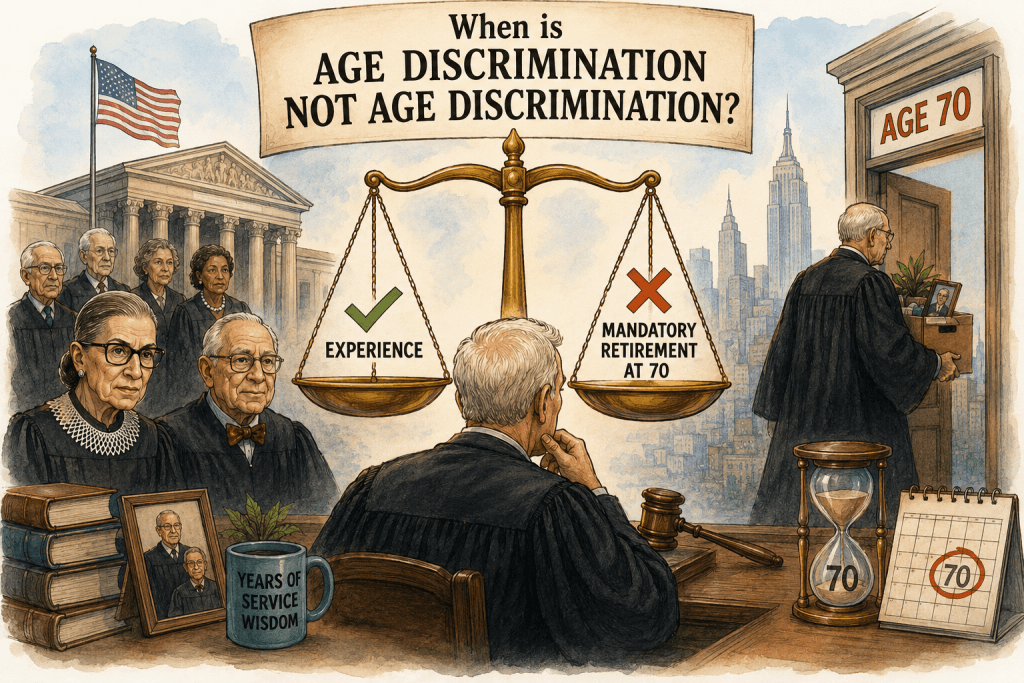
When is age discrimination not age discrimination?
Article 6 of the New York State Constitution makes most State judges ineligible to serve after the end of the year during which they turn 70. There is a section of the Judiciary law that applies that rule to City Court judges. That is why I am retired as a judge, having turned 10 in dog years in 2022. When the ball came down in Times Square, I was out of a job, even though I had 6 years left on my term.
When I was president of the New York State Association of City Court Judges (all the cool judges were members), I argued several times before the Legislature that this was a stupid rule. I pointed out that there was no age limit for Legislators – nor for Town or Village judges. In fact, I counted twenty over the age of 80! If octogenarians were physically and or mentally sharp enough to make laws, why wouldn’t older judges be able to understand and apply those laws? I also directed attention to older federal judges, like Supreme Court Justice Ruth Bader Ginsburg, then in her 80s and District Court Judge Edward Weinstein who served well into his 90s. When the age 70 law for City Court judges was enacted, the average life expectancy was 48. All the wisdom of age and years of experience were trashed. There were [bad] arguments for the age limit. When the issue came up in the late 1990s, some wanted to keep the age limit to encourage turnover of judges, many of which saw this as a means to get rid of old, white judges. That worm has turned. Since then, many women became judges and they are or already have reached 70. One example was the Chief Judge of the Rochester City Court, not only a good judge, but a woman of color forced out because of age.
Last year, New York adopted an Equal Rights Amendment to the Constitution. That Amendment prohibited discrimination based upon age (among numerous other classifications). Several Supreme Court judges sued to prevent them from being removed from office claiming the Equal Rights Amendment abrogated the earlier Constitutional provision setting the 70 age limit. You can’t say you can’t discriminate on the basis of age and then discriminate on the basis of age.
Recently, the case was argued before the Court of Appeals. (Curiously, the age limit would apply to all of the judges on the Court of Appeals.) The plaintiff-judges argued that the Equal Rights Amendment could not be reconciled with the age limit; and if the Legislature and the voters wanted to exempt judges from the age discrimination prohibition in the ERA, it could have explicitly done so, but it didn’t. The Attorney General’s Office defended the appeal arguing that repeal of the age limit was not intended. The judges on the Court of Appeals discussed whether there could be an implied repeal – something disfavored, and whether the Legislators or the voters knew or had any understanding that the age limit would survive.
Another judge-age case was brought by City Court judges where the ERA conflicts with a statute rather than a later Constitutional provision.
A decision from the Court of Appeals is expected in about a month. If you say you can’t discriminate on the basis of age, can you mandate that 70-year-olds can’t serve? When is age discrimination not age discrimination?