

Holding Court is a column by retired Rye City Court Judge Joe Latwin. Latwin retired from the court in December 2022 after thirteen years of service to the City. Latwin appeared on Episode 8 of Season 1 of our podcast MyRye.com Conversations with Doug French. Listen to learn more about Latwin and the Rye City Courts.
What topics do you want addressed by Judge Latwin? Tell us.
Bail
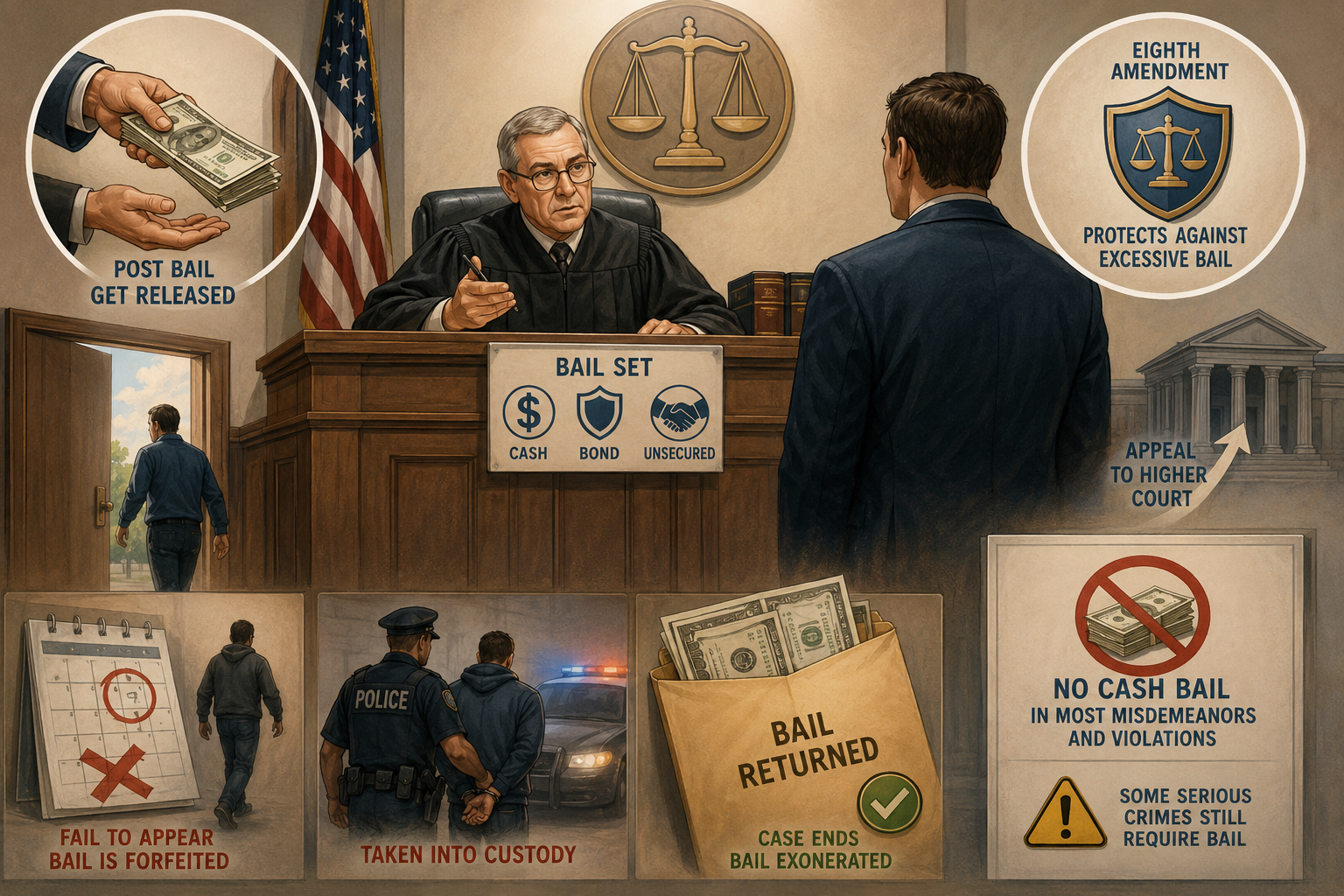
A court fixes bail when, having acquired control over the person of an accused, it designates a sum of money and stipulates that, if bail in such amount is posted on behalf of the principal and approved, it will permit him to be at liberty during the pendency of the criminal action or proceeding involved. Bail is usually fixed upon the arraignment of the accused, when the accused is first brought before a court.
Setting bail is not necessary if the accused is not to be held in custody. A court may release the accused on his own recognizance permitting the accused to be at liberty during the pendency of the criminal action or proceeding involved upon condition that the accused will appear whenever his attendance may be required and will at all times render himself amenable to the orders and processes of the court. The Eighth Amendment (Amendment VIII) to the United States Constitution protects against imposing excessive bail. What constitutes excessive bail initially rests with the arraigning judge, but is subject to review by later presiding judges or reviewing courts. For instance, for someone arraigned in Rye City Court, the Rye judge may set bail where appropriate. If the accused believes the bail set in Rye is excessive, they may go before a County Court judge and seek a reduction in the bail.
Bail may consist of (a) cash bail; (b) an insurance company bail bond; (c) a secured surety bond; (d) a secured appearance bond; (e) a partially secured surety bond; (f) a partially secured appearance bond; (g) an unsecured surety bond; or (h) an unsecured appearance bond. Three alternative types of bail are required to be set. These usually take the form of a cash bail, a secured bail bond (usually ten times the amount of the cash bail, since bonds usually cost a tenth of the cash amount), or an unsecured or partially secure bond in an amount greater than the cash bond.
When a defendant fails to appear in court or comply with court orders without a valid excuse bail is forfeited and the defendant is usually taken into custody. The courts now obtain a defendant’s contact information at the earliest opportunity and notice is given to the defendant of upcoming court dates making it difficult to claim “I forgot” as an excuse for not showing up. At the end of the case, bail may be exonerated and returned to the person who posted the bail, less certain fees.
As a result of the “No Cash Bail” laws passed a few years ago, no bail can be set in most misdemeanor and violation cases. There are a few felonies in which bail cannot be set. When the Legislature passed the no cash bail law, it was sloppy and left out some significant crimes for which bail was necessary.
There have been a number of horror stories. I knew an upstate judge who had to release a defendant that had just stolen from a telephone company store but was not charged with an offense and had to be released. The defendant left the Court and went right back to the store to finish stealing what he had been just before being caught. I had a case where a defendant was charged with stealing a car and had to be released. He left the Court and stole one of our police officer’s cars. When he got caught and arrested, he was again released without bail and tried to steal a police K9 unit car with the dog inside until he was informed that the dog in the vehicle was less than playful.