

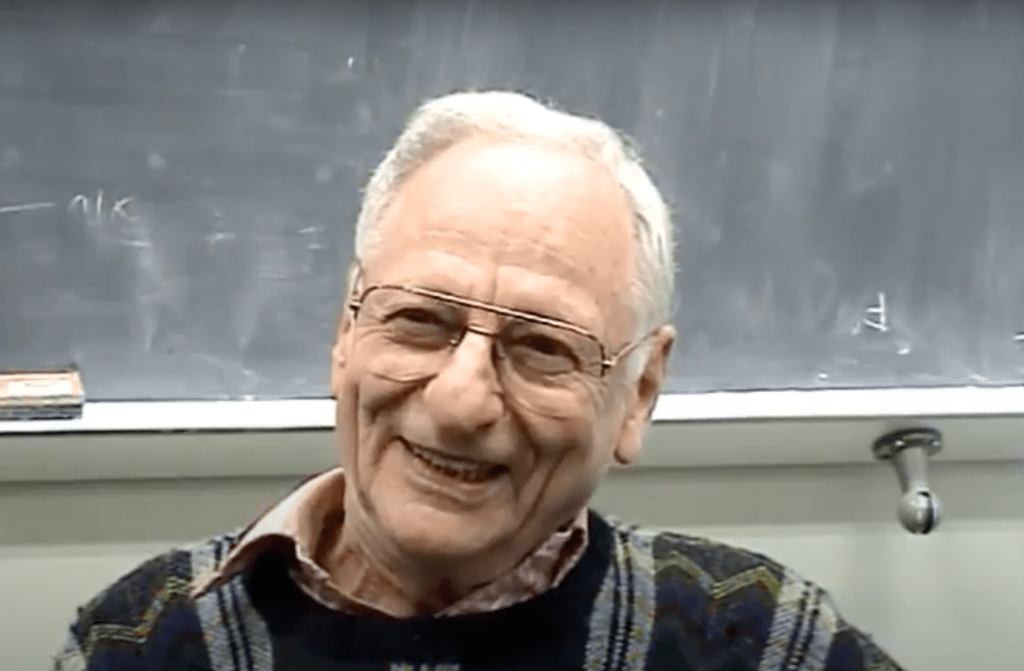
RyeGPT People of Note is a series highlighting individuals who have a connection to the City of Rye. In the series we ask OpenAI’s ChatGPT to prepare a biography and explain the individual’s connection to Rye.
We welcome your feedback on this series – the use of artificial intelligence, the accuracy and usefulness of each article and your assistance in understanding other pertinent insights related to the person’s connection to Rye.
You can add comments at the bottom of each article or you can send feedback via Tips & Letters.
Alan Hoffman (1924–2021) was an influential American mathematician best known for his foundational work in linear algebra, combinatorics, and graph theory. A prolific scholar and longtime researcher at IBM, Hoffman contributed to the development of optimization theory and mathematical programming during a time when these fields were rapidly shaping computer science and operations research.
Early Life and Academic Background
Alan Jerome Hoffman was born on May 30, 1924, in New York City. He completed his undergraduate studies at Columbia University and went on to earn a Ph.D. in mathematics from Harvard University in 1950. His doctoral advisor was Garrett Birkhoff, one of the most prominent American mathematicians of the 20th century.
Hoffman’s mathematical career took off during the post-World War II era, a time when applied mathematics was becoming increasingly crucial to both industry and government. His work combined deep theoretical insights with practical applications, especially in the areas of matrix theory and discrete mathematics.
Career at IBM and Contributions to Mathematics
In 1952, Hoffman joined IBM’s newly formed research division, which would later become the renowned IBM Watson Research Center. There, he remained for the rest of his professional career. His work at IBM not only advanced pure mathematics but also had wide-reaching implications for computer science, data analysis, and optimization algorithms.
Hoffman co-developed the Hoffman-Wielandt theorem, an important result in matrix theory, and made notable contributions to the Hoffman bound in spectral graph theory. He was also an early pioneer in studying the properties of adjacency matrices and their eigenvalues, a line of inquiry that continues to influence modern network theory and machine learning.
In recognition of his contributions, Hoffman was elected to the National Academy of Sciences and served as editor of several mathematical journals, including Linear Algebra and Its Applications.
Connection to Rye, New York
Alan Hoffman spent his last years at The Osborn retirement home in Rye, New York.
Hoffman passed away on January 18, 2021, at the age of 96. His legacy endures not only through the many theorems that bear his name but also in the continued relevance of his ideas in fields ranging from quantum computing to logistics.
