


RyeGPT People of Note is a series highlighting individuals who have a connection to the City of Rye. In the series we ask OpenAI’s ChatGPT to prepare a biography and explain the individual’s connection to Rye.
We welcome your feedback on this series – the use of artificial intelligence, the accuracy and usefulness of each article and your assistance in understanding other pertinent insights related to the person’s connection to Rye.
You can add comments at the bottom of each article or you can send feedback via Tips & Letters.
Debora Shuger is an esteemed scholar of early modern English literature and religion, widely recognized for her pioneering contributions to the study of political theology, censorship, and devotional writing in Renaissance England. A distinguished professor and prolific author, Shuger’s academic career has earned her fellowships at the National Humanities Center, the Guggenheim Foundation, and election to the American Academy of Arts and Sciences.
Early Life and Education
Born on December 15, 1953, Shuger first resided in Stuyvesant Town, Manhattan, before her family moved to Rye, New York, when she was still under one year old. She lived in Rye until third grade, at which point her family relocated to Armonk, New York.
She began her higher education at Carleton College, and after becoming married, she moved with her husband to Vanderbilt University, earning her B.A. (summa cum laude, 1975), M.A. (1978), and M.A.T. (1978). She completed her Ph.D. at Stanford University in 1983.
Academic Career and Contributions
Shuger taught at the University of Michigan and the University of Arkansas before joining UCLA’s Department of English, where she has been since 1989. There, she holds the rank of distinguished professor.
Her scholarly interests are wide-ranging: Tudor-Stuart devotional poetry and prose, theology and biblical exegesis, legal history, political thought, rhetoric, life writing (including biographies and diaries), as well as gender, sexuality, colonialism, classics, Shakespeare, and more.
She contributed an essay on early Stuart religious literature to The Cambridge History of Early Modern English Literature (2002).
Among her most influential works are:
- The Renaissance Bible: Scholarship, Sacrifice, and Subjectivity (1994), which explores how early modern thinkers interpreted scripture as a profoundly personal and political act;
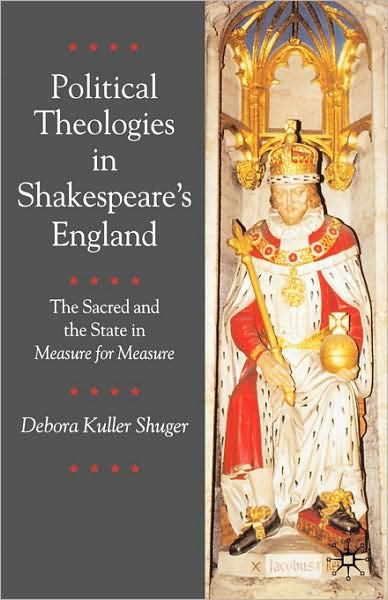
- Political Theologies in Shakespeare’s England: The Sacred and the State in Measure for Measure (2001), a major contribution to the field of early modern political theology;
- Censorship and Cultural Sensibility: The Regulation of Language in Tudor-Stuart England (2006), a widely cited text that reshaped understanding of how censorship functioned in early modern England not just as repression but as a form of moral pedagogy.
Shuger’s work is marked by a rare combination of close textual reading, historical depth, and philosophical insight. She is especially respected for her ability to read complex theological texts with the same rigor and imagination as literary ones—offering fresh interpretations of early modern minds shaped by both divine and political authority.
Legacy and Influence
Debora Shuger has been widely recognized for her contributions to the humanities. In addition to her election to the American Academy of Arts and Sciences, she has held fellowships from the Mellon Foundation, the Huntington Library, and the American Council of Learned Societies. Her students and colleagues praise her for her clarity of thought, her interdisciplinary brilliance, and her commitment to serious scholarship.
Whether decoding Shakespeare, unpacking the Book of Common Prayer, or examining the legal and linguistic frameworks of early modern England, Shuger continues to challenge and inspire scholars across disciplines.