

With the Rye City Council election around the corner on Tuesday, November 4, 2025, MyRye.com is publishing a series of issue focused articles highlighting the views of our candidates running for mayor and for city council.
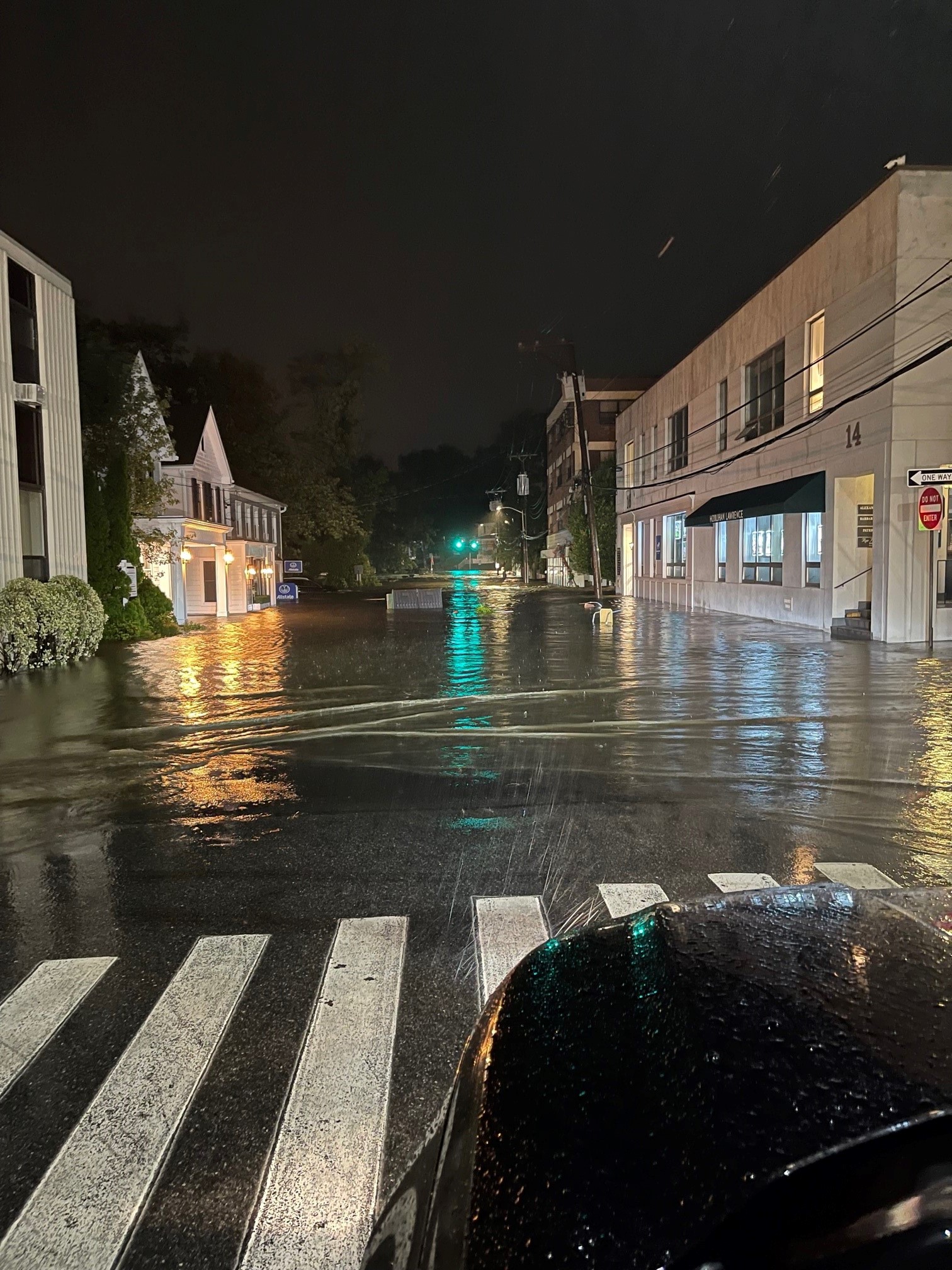
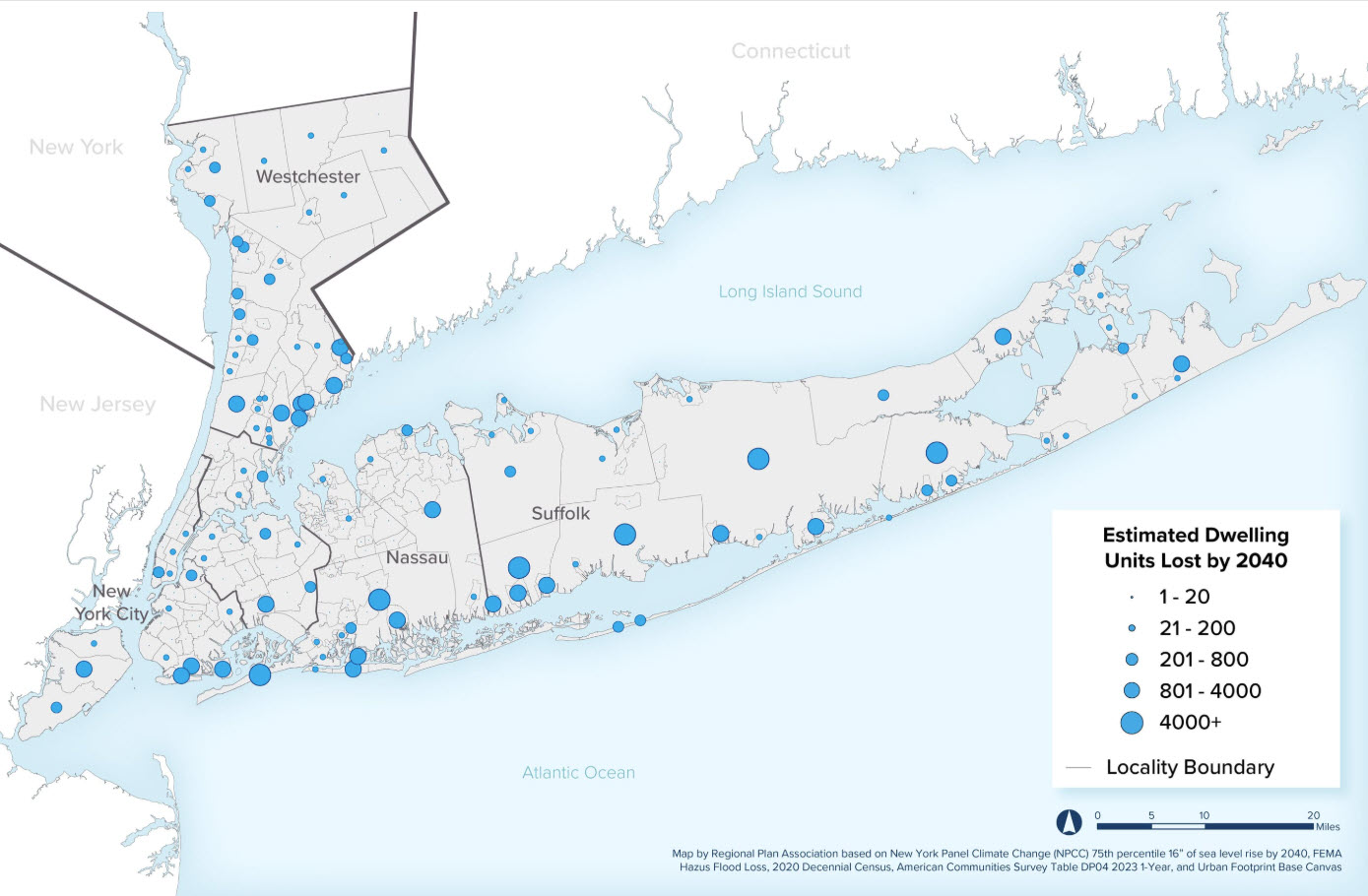
Today we are highlighting the issue of flooding in Rye, perennial problem that many believe is simply getting worse. Earlier this year the Regional Plan Association (RPA), a 100+ year old not-for-profit regional planning organization, said the City of Rye could lose up to 1,900 homes due to flooding by the year 2040.
The mayoral candidate views on flooding in Rye:
MyRye.com: What are the three flood mitigation measures the City should undertake with the greatest cost/benefit?
Bill Henderson (GOP):
- On the Blind Brook, the upstream SUNY Berms project appears to be the most promising project to decrease / slow the flow of water downstream during significant weather events;
- Also on the Blind Brook, expanding the Upper and Lower Bowman Ponds appears to be the second most promising project that also has the potential of holding back water during significant weather events;
- Focus on resiliency projects and emergency response. These are things we can do ourselves here in Rye to mitigate the effects of extreme flooding and corresponding danger to human life, both along the brooks and in other areas.
Rick McCabe (Ind.):
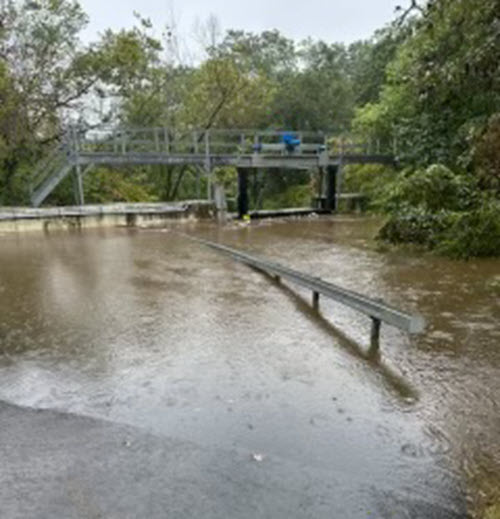
- The continued funding for collecting data from the gauges in Blind Brook is key for maximizing the effectiveness of the Bowman Dam Sluice Gate.
- It’s clear that enhanced mitigation upstream closer to the airport would benefit Rye and the other downstream communities. We need to stay focused on those efforts with Westchester County.
- Remain laser focused on securing grants from all available sources including county, state and federal/Army Corps of Engineers.
Josh Nathan (Dem):
- Storm Water and Sewage. Continue our improvement work on the City’s storm water and sewage system. This is something our Department of Public Works has been doing, and we must continue to support it. It yields tangible positive results.
- Address opportunities we have in Rye. Continue to work with our engineering consultants on what can be done in Rye that isn’t contingent on the agreement of other communities. The Report by the Governor’s Office of Storm Recovery NYRCR Planning Committee for Rye identified over a dozen flood mitigation/storm response projects that are within Rye City or are controlled by Rye City. The work on the sluice gate must continue. The upstream mitigation efforts should continue notwithstanding contingencies we don’t control. Our engineers, who were involved in the NYRCR report, have provided a limited update of that analysis as it pertains to the Blind Brook floodplain. The analysis should also be updated with respect to the other two flood plains, Beaver Brook Swamp and Midland Avenue. We need to actively prioritize our projects and coordinate with residents and other stakeholders, e.g., the Nature Center, the Rye Y, and the Library.
- Comprehensive Planning. We need to engage in comprehensive planning (our 1985 Master Plan expired in 2000 according to its time horizon) with great attention to flood mitigation and storm resiliency. While there is no single solution, there are many coordinated actions that can improve our situation with respect to flood and storm water (as well as power outages, heat, wind, and other issues).
MyRye.com: What are some of the ways the City can realistically expect to pay for some of the more expensive flood mitigation projects (including infrastructure)?
Bill Henderson (GOP):
- Federal Funding – through the Building Resilient Infrastructure and Communities (BRICS) program and perhaps other federal programs;
- NY State Funding – through the NY State Division of Homeland Security and Emergency Services (DHSES) and perhaps other NY State programs;
- Capital planning for smaller local projects we can pay for and do ourselves.
Rick McCabe (Ind.):
- We’re not going to be able to do all of this work alone. Our ongoing partnership with county, state and federal agencies will remain central to our success mitigating risk. Funding such as the state dollars dedicated to the Oakland Beach Avenue and Playland Parkway bridges are good examples as a starting point.
Josh Nathan (Dem):
- State and federal grants. We have been successful in working with State and Federal officials to obtain grants for flood mitigation and storm resiliency, e.g., the $3 million NYRCR grant to Rye among others. We must continue that work. It’s a constantly changing landscape and we have excellent staff and relationships with elected officials to help us stay on top of it.
- The County. We should continue to work directly with the County; the prior City Manager and I worked with County Legislator Catherine Parker to secure $250,000 in grant funds from the County in 2023 and most recently the County announced $20 million to replace the Playland Parkway bridge and the Oakland Beach Avenue bridge.
- Collaborate with neighboring communities. We need to work closely with our neighboring communities. The County actively facilitates projects that run across municipalities.
MyRye.com: What are a few of the most effective but least expensive measures the City can take in regards to flood mitigation?
Bill Henderson (GOP):
- Get the algorithms exercise finished and install computer programming of the Sluice Gate at the Upper Bowman Pond;
- Local resilience and storm system improvement projects;
- Local Flood emergency response planning.
Rick McCabe (Ind.):
- Our partnership and influence with other affected communities, the county and state is the most cost-effective effort. Dollars may have to follow to implement solutions, but cooperation is free.
Josh Nathan (Dem):
- Comprehensive planning. This is an opportunity to make flood mitigation and storm resilience a strategic priority in a forward-looking manner. It’s a low cost spend because (i) we are doing it anyway, (ii) we’ve already set aside the funds, and (iii) there are state grant funds to assist with it. In recent years, other Westchester communities have used comprehensive planning as a critical tool to find and support a myriad of solutions to their flood mitigation needs. Rye is overdue for this kind of overall strategic thinking. I can’t wait for us to get started on it.
- Code review. A review of our building code with a lens on updating it across the board with best practices for storm resiliency and flood mitigation is a very low-cost measure. This should be a part of comprehensive planning.
- Collaboration with neighboring communities on policy and development issues. The formal cooperation with Mamaroneck and work with the Harrison community concerning the Grant Avenue Project adjacent to Beaver Brook Swamp is a good example of how critical this is. That project threatened Rye, Harrison, and Mamaroneck neighborhoods. Working together, elected officials, staff, and community members were able to fend off the threat. I believe Rye’s out of pocket was well under ten thousand dollars.
- Work with the County and utilities. We should partner with the County in working with the utility companies on storm resiliency and flood mitigation measures. The utilities spend a lot of our money on infrastructure, let’s make sure it’s being spent smartly for Rye. There should be no cost beyond some staff time, which already gets drawn into addressing these projects.
- Capital Improvement Plan. We should be looking at storm resiliency and flood mitigation measures as part of every infrastructure project and use that as a factor in prioritizing these projects. This is money we are already planning on spending. Highlighting storm resiliency and flood mitigation (like sustainability) can assist with grant eligibility.
Read all our candidate interviews:
GOP Slate – Henderson / All in for Rye
- Q&A with Mayoral Candidate Bill Henderson
- Q&A with City Council Candidate James Fee
- Q&A with City Council Candidate Robin Thrush Jovanovich
- Q&A with City Council Candidate Maria Tufvesson Shuck
Independent Rick McCabe / McCabe for Mayor:
Democratic Slate – Nathan, Anderson, Kesavan & Ward for Rye:
- Q&A with Mayoral Candidate Josh Nathan
- Q&A with City Council Candidate Marion Anderson
- Q&A with City Council Candidate Amy Kesavan
- Q&A with City Council Candidate James Ward
