

Holding Court is a series by retired Rye City Court Judge Joe Latwin. Latwin retired from the court in December 2022 after thirteen years of service to the City.
What topics do you want addressed by Judge Latwin? Tell us.
By Joe Latwin

In April 2009, 22-year-old Roderick Collier physically assaulted and raped a 16-year-old female acquaintance. He pled guilty to one count of sexual misconduct, an offense requiring him to register as a under the Sex Offender Registration Act (SORA). At the time of his plea, the court informed defendant that he would be required to pay a $1,000 sex offender fee, but did not certify defendant as a sex offender or inform him of his obligation to register under SORA (Correction Law §§ 168-d [1] [a]; 168-f).
Defendant was given a one-year prison term and was released without supervision in December 2009 after serving approximately eight months of his sentence. Despite his conviction, Mr. Collier was not notified of his SORA registration requirements for approximately six years after his plea. After a SORA proceeding, Mr. Collier was designated a level one sex offender, and was required to register as a Sex Offender for 20 years from the date of his release. Mr. Collier claimed the delay between his plea and his SORA hearing violated his due process rights.
SORA was enacted in 1995 “to protect the public from the danger of sexual recidivism posed by individuals who commit certain sex offenses” by requiring them “to register with law enforcement officials and authorizing the dissemination of certain information about those individuals to vulnerable populations and the public”.
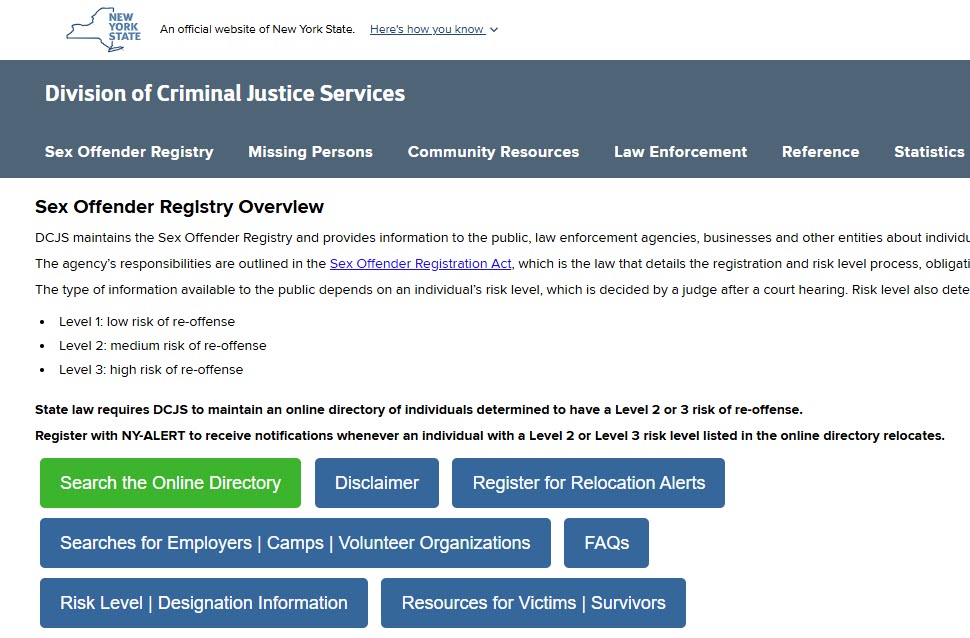
If you want to see who is on the registry, go to Search The Official New York State Sex Offender Registry – NY DCJS.
A defendant’s registration and notification obligations correspond to a designated risk level within a three-tiered classification scheme—”levels one, two, and three in ascending order of risk”—that seeks to capture the offender’s risk of reoffending. Usually, upon conviction, the Court will schedule and hold a SORA hearing to determine the level of classification of the offender. The Court is required to assess:
- (a) criminal history factors indicative of high risk of repeat offense, including:
- (i) whether the sex offender has a mental abnormality or personality disorder that makes him or her likely to engage in predatory sexually violent offenses;
- (ii) whether the sex offender’s conduct was found to be characterized by repetitive and compulsive behavior, associated with drugs or alcohol;
- (iii) whether the sex offender served the maximum term;
- (iv) whether the sex offender committed the felony sex offense against a child;
- (v) the age of the sex offender at the time of the commission of the first sex offense;
- (b) other criminal history factors to be considered in determining risk, including:
- (i) the relationship between such sex offender and the victim;
- (ii) whether the offense involved the use of a weapon, violence or infliction of serious bodily injury;
- (iii) the number, date and nature of prior offenses;
- (c) conditions of release that minimize risk or re-offense, including but not limited to whether the sex offender is under supervision; receiving counseling, therapy or treatment; or residing in a home situation that provides guidance and supervision;
- (d) physical conditions that minimize risk of re-offense, including but not limited to advanced age or debilitating illness;
- (e) whether psychological or psychiatric profiles indicate a risk of recidivism;
- (f) the sex offender’s response to treatment;
- (g) recent behavior, including behavior while confined;
- (h) recent threats or gestures against persons or expressions of intent to commit additional offenses; and
- (i) review of any victim impact statement.
Each of these considerations has a point value assigned to it. The number of points assessed determines the level of offender.
The Court of Appeals found that the six-year delay did not violate Mr. Collier’s due process rights. To establish a violation, a defendant must make a showing that the delay prejudiced his ability to present his or her case to the SORA court. The failure of the court to act did not relieve a sex offender of obligation to register.
VIDEO, below: Child Sexual Predators: The Familiar Stranger by the New York Network, a service of The State University of New York, in conjunction with the New York State Division of Criminal Justice Services (DCJS) and its Office of Sex Offender Management. This statutorily required video is designed to educate parents on the topic of sexual abuse. It includes interviews with individuals convicted of sex offenses against children; interviews with three survivors of childhood sexual abuse; and a demonstration by an FBI Special Agent who details the dangers of online chat rooms.