

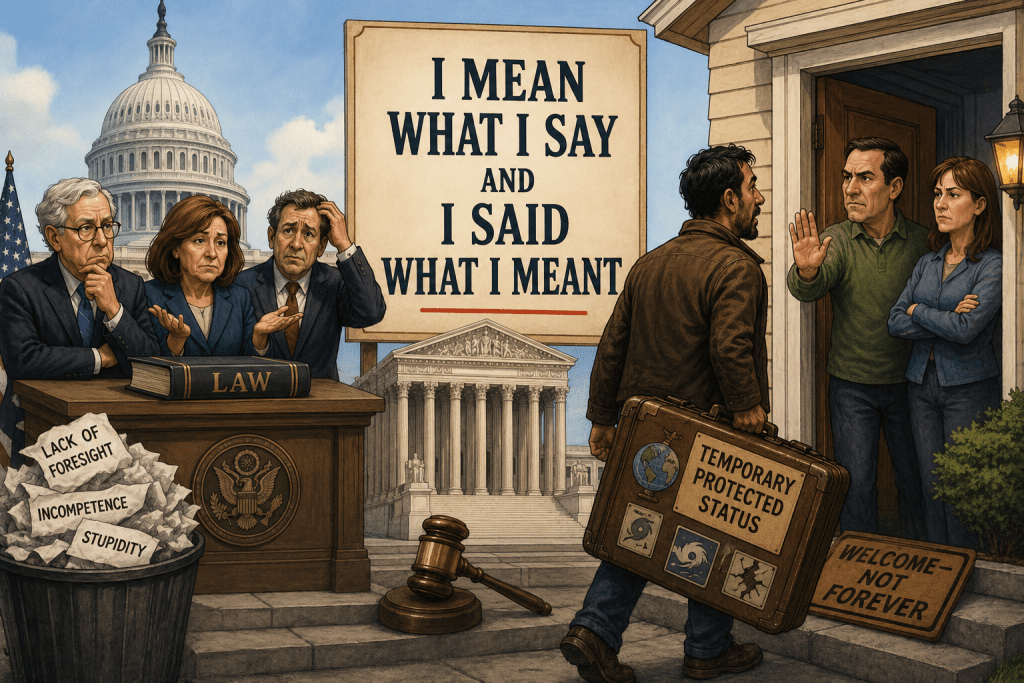
Holding Court is a column by retired Rye City Court Judge Joe Latwin. Latwin retired from the court in December 2022 after thirteen years of service to the City. Latwin appeared on Episode 8 of Season 1 of our podcast MyRye.com Conversations with Doug French. Listen to learn more about Latwin and the Rye City Courts.
What topics do you want addressed by Judge Latwin? Tell us.
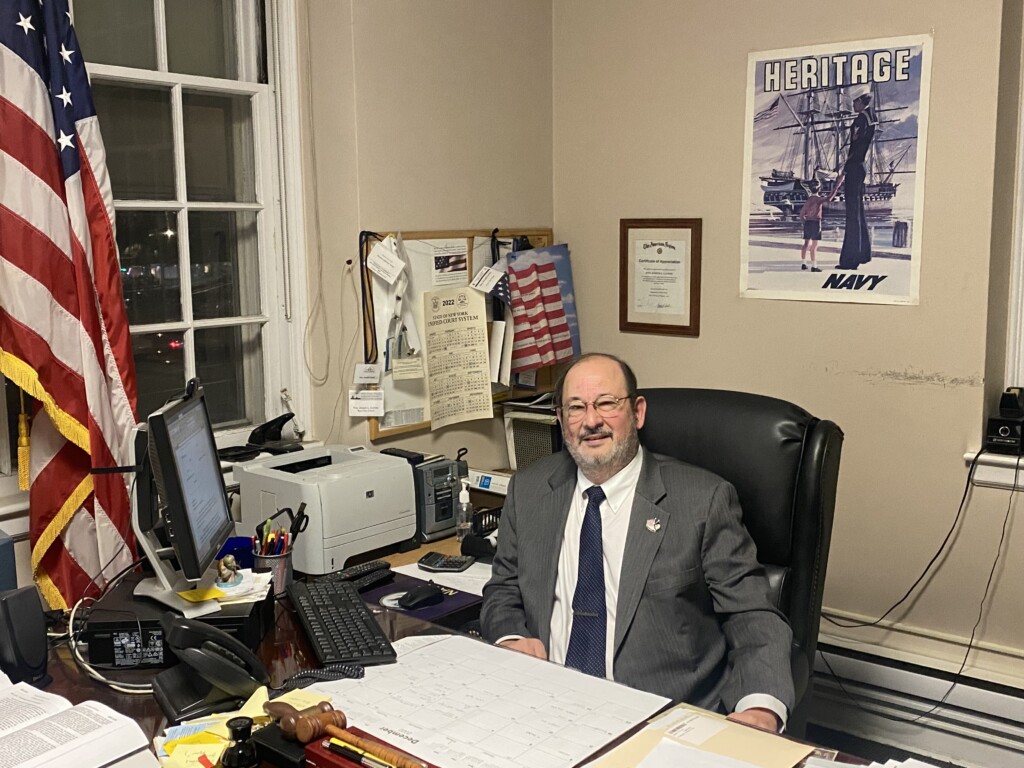
I mean what I say and I said what I meant
Sorry Dr. Seuss. Words have meaning. I frequently complain that Congress, either by lack of foresight, laziness, incompetence, or plain stupidity, passes laws that do not remedy, let alone address issues, leaving resolution of the issues to the Courts. Then Congress complains about the rulings of the Courts where Congress said one thing or omitted to say something.
The Supreme Court decided just such a case recently. Congress created Temporary Protected Status (“TPS”) in 1990 to provide short-term humanitarian relief for aliens who cannot safely return to their home countries due to events such as armed conflict or natural disaster. Before Congress created TPS, aliens had 30 days to depart voluntarily, but the government claimed discretionary authority to extend that deadline indefinitely. The grant and termination of humanitarian relief was purely a matter of executive discretion, and Courts concluded that the Executive’s decision to withhold such relief was an unreviewable exercise of prosecutorial discretion.
Under the statute, responsibility for TPS decisions rests with the Secretary of Homeland Security and provides that the Secretary “may designate” a country for TPS “after consultation with appropriate agencies of the Government” if certain conditions are met, including (1) ongoing armed conflict within the state and, due to such conflict, such that return of aliens would pose a serious threat to their personal safety; (2) there was a natural disaster resulting temporary, disruption of living conditions; (3) extraordinary and temporary conditions that prevent aliens from returning in safety, unless the Secretary finds that permitting the aliens to remain temporarily is contrary to the national interest. The statute requires the government to terminate a country’s TPS designation if the Secretary determines that the country “no longer continues to meet the conditions for designation. The statute itself says TPS designation decisions are not subject to judicial review. The relevant provision bars “judicial review of any determination of the [Secretary of Homeland Security] with respect to the designation, or termination or extension of a designation, of a foreign state.”
Although designed to afford “temporary” relief, TPS designations in practice have often lasted for decades, i.e., Somalia since1991, Nicaragua since 1999, Honduras and El Salvador since 2001. Syria received a TPS designation in 2012 because of “the repressive regime of Bashar al-Assad. In September 2025, the Secretary of Homeland Security provided public notice that Syria’s TPS designation would terminate the Assad regime having been removed. Haiti received a TPS designation in 2010 after a devastating earthquake. In November 2025, Haiti’s TPS designation was terminated. Syrian and Haitian nationals asserting claims under the Administrative Procedure Act (APA) to stop the termination.
The Supreme Court held that the TPS statute’s judicial-review bar applies to all non-constitutional claims. Under the Constitution, Congress has the power to fix the jurisdiction of the federal courts. Having done so in the Immigration and Naturalization Act by denying review of TPS determinations, Congress has plainly and clearly spoken in the statute.
Why did Congress do this? It didn’t say. Was it lack of foresight? Perhaps. Was it incompetence by not saying “temporary” could be permanent? Was it part of a plan to provide temporary relief quickly in exigent circumstances? Probably. In any event, people temporarily admitted to the United States should be grateful for the opportunity to have the protection of our country in times of trouble. But, times of trouble eventually end. However, a guest by invitation to stay for a weekend visit does not get a right to stay in your house forever, especially if the plain language of the law says otherwise.