

Holding Court is a column by retired Rye City Court Judge Joe Latwin. Latwin retired from the court in December 2022 after thirteen years of service to the City. Latwin appeared on Episode 8 of Season 1 of our podcast MyRye.com Conversations with Doug French. Listen to learn more about Latwin and the Rye City Courts.
What topics do you want addressed by Judge Latwin? Tell us.
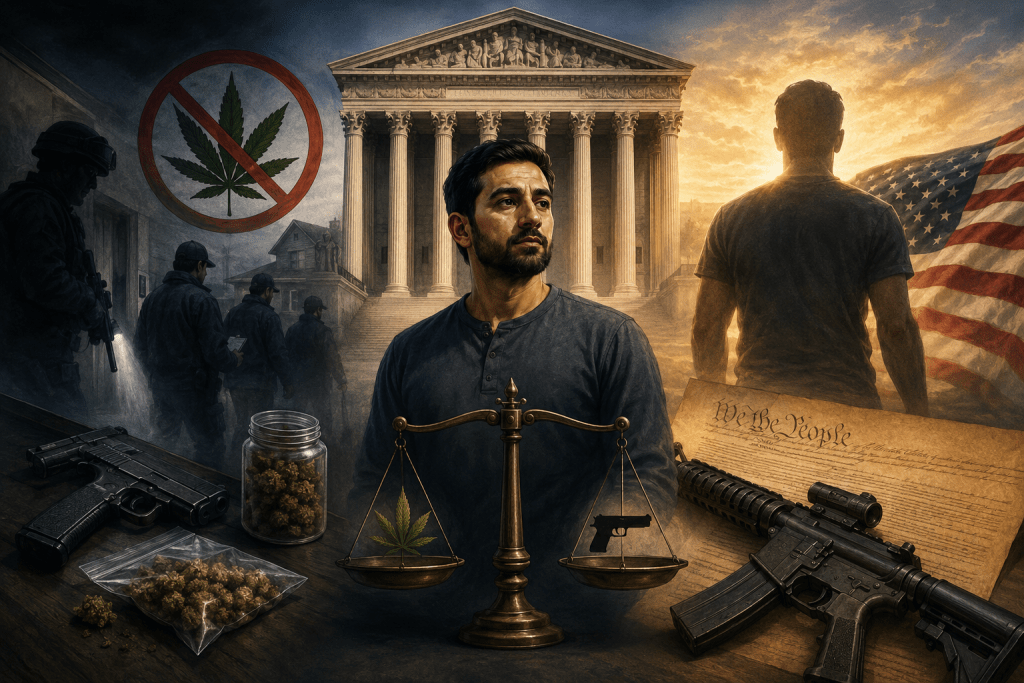
The 2nd Amendment says there is a right to bear arms. A federal law prohibits drug addicts and marijuana users from obtaining a gun.
Ali Hemani is a dual citizen of the United States and Pakistan was born in Texas and spent most of his life living in the Dallas area. Suspecting Mr. Hemani of terrorism-related activities, the government conducted a search of the family home. Mr. Hemani surrendered a gun he kept in the house and pointed agents to some marijuana on the property. He voluntarily told law enforcement agents that he used marijuana about every other day. The government later prosecuted Mr. Hemani under 18 USC §922(g)(3) for knowingly possessing a gun in his home while being an unlawful user of a controlled substance. That statute prohibits various categories of people from possessing guns, including individuals convicted of crimes “punishable by imprisonment for a term exceeding one year,” fugitives from justice, and those convicted of domestic violence crimes. Mr. Hemani’s case concerned another provision that barring anyone who is an “unlawful user of” or “addicted to” a “controlled substance” and making it a crime punishable by up to 15 years in federal prison, and disarmament for life. The definition of “controlled substance,” relies on the Controlled Substances Act (CSA) that was enacted to protect “the health and general welfare of the American people”. It sets forth five schedules of “controlled substances” subject to varying degrees of regulation. They range from Schedule I drugs with a high potential for abuse and no currently accepted medical uses (like heroin) to Schedule V drugs with the lowest potential for abuse and many accepted medical uses (like Tylenol with codeine). By incorporating the CSA definition of the term “controlled substance,” 18 U. S. C. §922(g)(3) makes it illegal for anyone who unlawfully uses any drug found on any of the CSA’s schedules to possess a firearm for any reason, upon threat of imprisonment and permanent disarmament. Marijuana was listed on Schedule I—a schedule reserved for drugs with “a high potential for abuse” with “no currently accepted medical use.” Mr. Hemani moved to dismiss the indictment, arguing that the government’s effort to enforce §922(g)(3) against him violated the Second Amendment. The district court granted his motion, and the Fifth Circuit affirmed. The government asked the Supreme Court to review the case.
Last week, the Supreme Court ruled on the case. It found the Second Amendment protects the right of “all Americans” to keep and bear firearms for self-defense, though like most individual rights it has its limits. If the Amendment’s terms cover the conduct in question, the Constitution “presumptively” protects it. To overcome that presumption, the government bears the burden of showing its regulatory efforts are “consistent with the Nation’s historical tradition of firearm regulation.” The government construed §922(g)(3) to automatically ban an individual from possessing a gun from the moment he becomes an unlawful user of any controlled substance and remains in effect until he ceases being one, regardless of what controlled substance an individual uses, in what amounts, whether his drug use has ever made him a danger to himself or others, why he keeps a gun, or how safely he does so.
First the government argued that the usage of drugs was historically analogous to prohibitions placed on habitual drunkards. The Court noted “historical laws targeted habitual drunkards not merely because they regularly used intoxicants, but because their drinking rendered them practically incapacitated and incapable of managing their affairs. On the other hand, Section 922(g)(3)’s reliance on the Controlled Substances Act—a statute adopted to protect “the health and general welfare of the American people,” 21 U S C §801(2), and under which drugs can be added to schedules for reasons having little or nothing to do with their potential to induce violence. The Department of Justice recently directed federal prosecutors to curtail enforcement efforts against marijuana users since most States have legalized marijuana use to some degree, and the government recently moved some marijuana products from Schedule I to Schedule III. Affording the government “broad power to designate any group as dangerous and thereby disqualify its members from having a gun” would risk allowing it to “quickly swallow” the Second Amendment.
The statute automatically divests an individual of his constitutional right to bear arms the moment he becomes an unlawful user and until he ends his drug use—all without any pre-deprivation due process.
The Court cautioned that its ruling was a narrow one. It did not address efforts to ban addicts, or those presently intoxicated, from possessing a firearm. It did not address other prophylactic laws Congress might adopt after determining that users of a particular drug pose a special risk of misusing firearms. It did not address the provision disarming individuals convicted of felonies (often including drug-related ones). It did not address whether the government could bring a prosecution accompanied by individualized proof that the defendant’s use of marijuana (or any other drug) renders him a danger to himself or others, or proof that a certain drug always renders its users dangerous because of its potency or for some other reason.
We should not feel that comfortable since regular marijuana users may now not only obtain firearms, but they are pretty much free to drive and use marijuana. Are we going to pot?