

Overview:
The Supreme Court ruled that Louisiana's redistricting plan, which created a second majority-minority district, violated the Equal Protection Clause of the Fourteenth Amendment and the Voting Rights Act. The court found that the state's intentional creation of a second majority-minority district was a racial gerrymander that was not necessary to avoid imminent and serious risks to human safety or to remedy specific instances of past discrimination. The court emphasized that the Voting Rights Act does not guarantee equal outcomes, and that the state's underlying goal was racial, which triggered strict scrutiny.
Holding Court is a column by retired Rye City Court Judge Joe Latwin. Latwin retired from the court in December 2022 after thirteen years of service to the City. Latwin appeared on Episode 8 of Season 1 of our podcast MyRye.com Conversations with Doug French. Listen to learn more about Latwin and the Rye City Courts.
What topics do you want addressed by Judge Latwin? Tell us.

Read Part 1 on redistricting from last week’s column.
How may Congressional districts be defined or not defined? A recent U.S. Supreme Court case explained – not for racial purposes.
Generally, districts should have a roughly equal number of residents, be compact, contiguous, and respect political subdivisions or communities. They should follow to the extent possible geographical and political boundaries – parts of a district should not be separated by rivers or mountain ranges and should, where the numbers permit, adjoining towns. The Fifteenth Amendment provides that the “right of citizens of the United States to vote shall not be denied or abridged by the United States or by any State on account of race, color, or previous condition of servitude.” Of course, all of this must comport with fitting the permitted number of districts as apportioned by law into the State. Section 2 of the Fifteenth Amendment authorizes Congress to enact “appropriate legislation” to enforce the Amendment’s protections, and in 1965 Congress invoked that power to enact the Voting Rights Act. In 1980, the Supreme Court concluded that “facially neutral voting practices violate §2 only if motivated by a discriminatory purpose.” In 1982, shortly after that case, Congress sought to abrogate the decision by amending §2. The amendment requires consideration of the “totality of circumstances” in each case and demands proof that the “political processes leading to nomination or election in the State or political subdivision are not equally open to participation” by members of a protected class “in that its members have less opportunity than other members of the electorate to participate in the political process and to elect representatives of their choice.” This led to some Courts mandating the creation of minority-majority controlled districts where minority could elect a minority person.
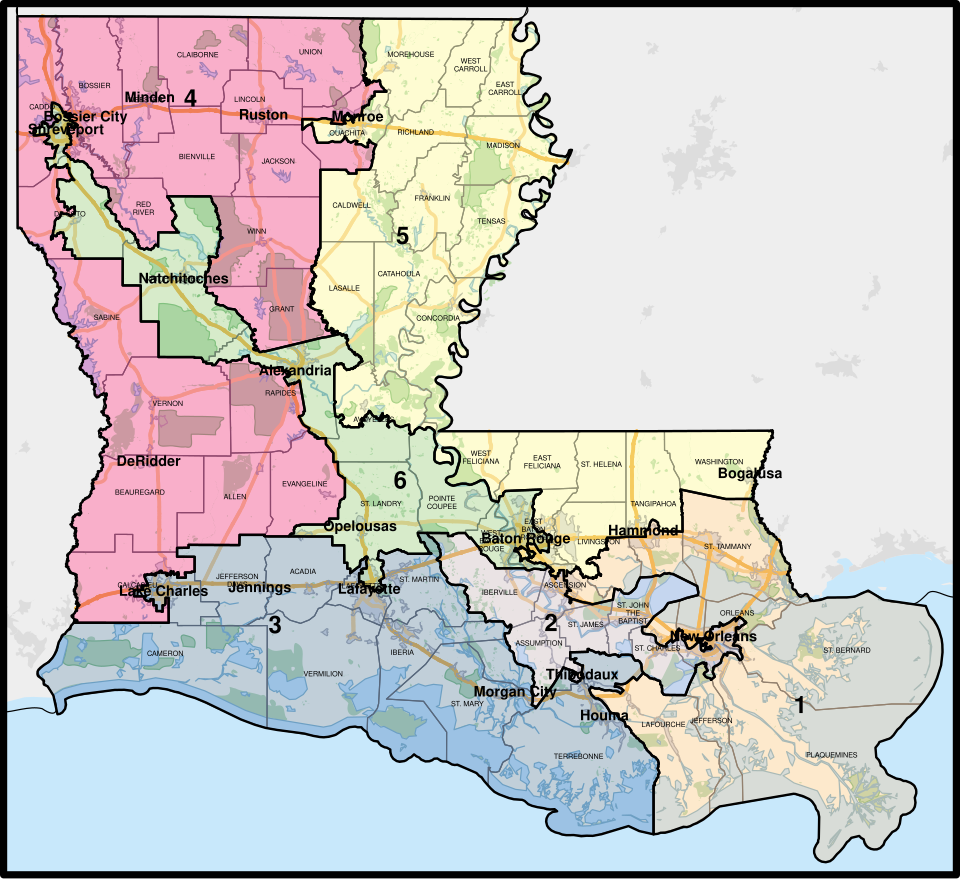
In the recent case, as a result of the 2020 census, Louisiana would have the same number of seats that it had previously been allocated, but due to shifts in population, the State needed to recalibrate its districts. The previous apportionment had only one district in which black voters were a majority of the voting-age population. It was described as “bat-shaped” and included much of New Orleans. Louisiana was sued for violating the Voting Rights Act by “’packing’ large numbers of Black voters into a single majority-Black congressional district and dispersing the remaining Black voters among the other five districts in the State. The lower court mandated new maps with a second majority black district. Louisiana created new maps with an additional majority minority district. To attain a majority-black voting-age population, the new district connects black populations from Baton Rouge and Lafayette (in the southcentral region of the State) with the black population in Shreveport (in the far northwest of the State). This case followed.
The plaintiffs claimed the “second majority-minority district . . . stretches some 250 miles from Shreveport in the north west of the state to Baton Rouge in southeast Louisiana, slicing through metropolitan areas to scoop up pockets of predominantly Black populations from Shreveport, Alexandria, Lafayette, and Baton Rouge,” The lower court concluded that the map effected a racial gerrymander that “violates the Equal Protection Clause.” On appeal to the Supreme Court, the issue was “Whether the State’s intentional creation of a second majority-minority congressional district violates the Fourteenth or Fifteenth Amendments to the U. S. Constitution.”
The Court found that the Constitution almost never permits the government to discriminate on the basis of race. It identified “only two compelling interests” that can satisfy that standard; “avoiding imminent and serious risks to human safety in prisons, such as a race riot”; and “remediating specific, identified instances of past discrimination that violated the Constitution or a statute.” The Government has no compelling interest in generally remediating “past discrimination in a particular industry or region” or “the effects of societal discrimination.” Distinctions between citizens solely because of their ancestry are by their very nature odious to a free people whose institutions are founded upon the doctrine of equality. In redistricting, “where the State assumes from a group of voters’ race that they ‘think alike, share the same political interests, and will prefer the same candidates at the polls,’ it engages in racial stereotyping at odds with equal protection mandates. A districting map may run afoul of §2 of the Voting Rights Act if it “results in a denial or abridgement” of the right to vote “on account of race or color. The test is: are the political processes leading to nomination or election not equally open to participation by members of a racial group of voters “in that [they] have less opportunity than other members of the electorate to . . . elect representatives of their choice. Everyone gets to vote the same as every other voter. The Voting Rights Act does not guarantee equal outcomes. It does not intrude on States’ prerogative to draw districts based on nonracial factors. The Act imposes liability only when the evidence supports a strong inference that the State intentionally drew its districts to afford minority voters less opportunity because of their race.
The Supreme Court also found that in considering the constitutionality of a districting scheme, courts must treat partisan advantage like any other race-neutral aim: a constitutionally permissible criterion that States may rely on as desired.
Louisiana’s enactment of the district map triggered strict scrutiny because the State’s underlying goal was racial. The State configured the newly created minority district to achieve a black voting-age population over 50% because it knew that if it failed to do so, the lower court would very likely find its map unlawful and order the use maps, which would have imperiled one of the influential incumbents the legislature sought to protect. The State’s intentional compliance with the court’s demands constituted an “express acknowledgment that race played a role in the drawing of district lines.” As being entirely racially motivated, the Court found the maps violated the Constitution.
One way I have found to measure discrimination is to substitute the non-minority classification with the majority classification. Would it have been proper to create majority-majority district to ensure a majority candidate would be elected? I would say no. Good for the goose?