

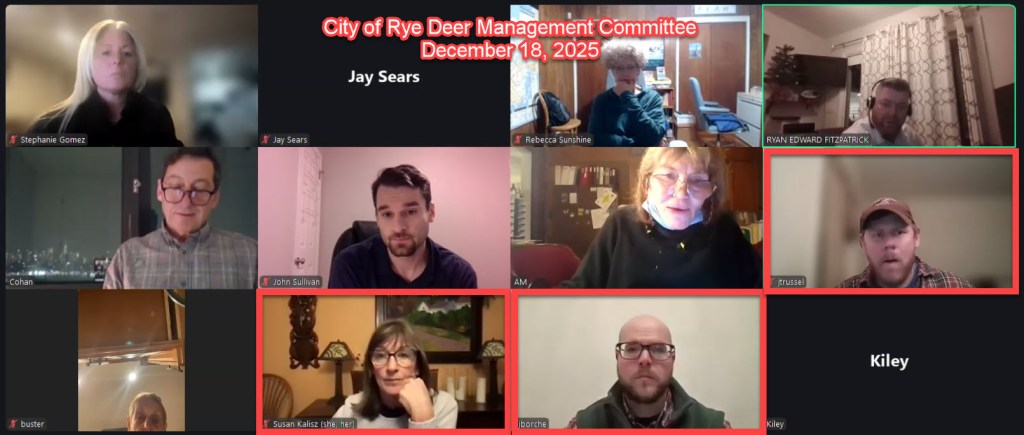
The City’s Deer Management Committee (DMC) met on Thursday, continuing to bring in science and environmental experts to determine if there is an over population of white tailed deer and related control options for the City. The DMC is tasked with determining if there is a problem and to develop recommendations for management. Recommendations will eventually be brought to the new city council for approvals.Building on a November meeting that hosted a Cornell University professor and expert on deer overpopulation and forest health, the DMC hosted additional authorities at its meeting this week – evolutionary ecologist and professor Dr. Susan Kalisz whose studies include deer impacts on native plants and two representatives from the New York State Department of Environmental Conservation (NYSDEC) to discuss various control options.
[Note: video of the public meeting is available below.]

Evolutionary Ecologist on Measuring Deer Impacts
“Our ecosystems get unbalanced, because we are losing diversity, because deer can basically browse it into oblivion, and also it takes away the capacity of the overstory trees to regenerate,” said Kalisz, introducing her research.
She covered increases to erosion and flooding, Lyme disease, property damage, food loss – all driven by overpopulation of deer.
“The herbaceous understory in most forests that aren’t really heavily impacted, they have way more diversity than the overstory so typically, there would be maybe five to 10 species of overstory trees in a forest. There can be 50, 100, 150 species of understory species,” explained Kalisz.
So it’s much more diverse, and that biodiversity supports the insects, the mammals, the birds, all the species that use the understory species as food, as forage, as housing, as hiding places.”
All of this gets disrupted when deer are over abundant.
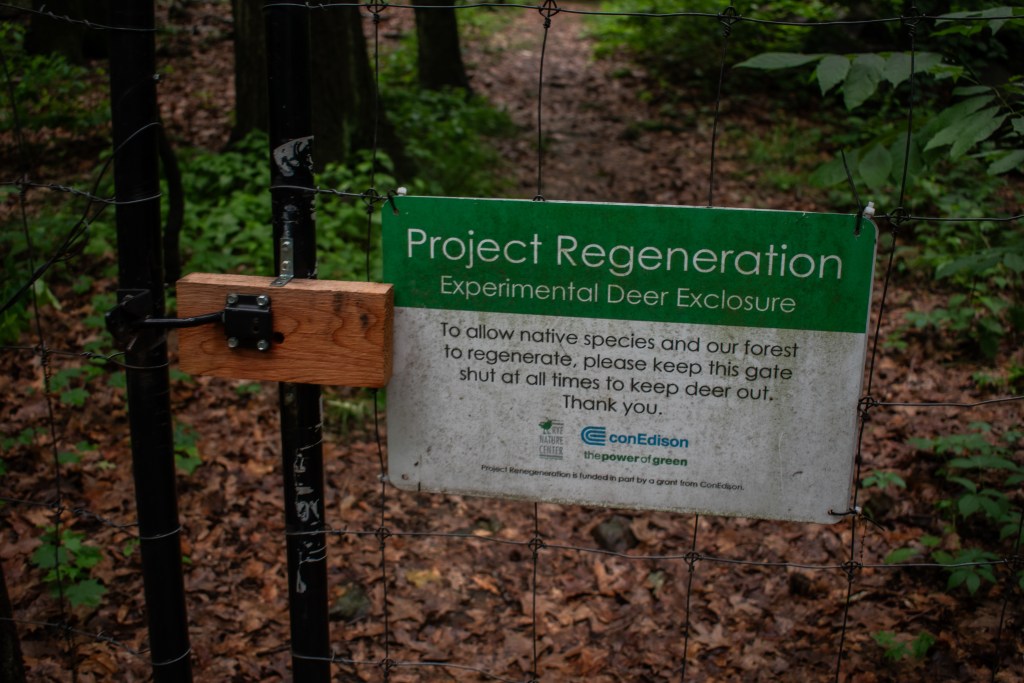
Similar to the Cornell professor brought in by the DMC, Kalisz explained having fenced deer exclusion areas can help determine impacts – acting as a control versus open areas subject to deer browse. She said her research always focused on the effect of the deer population versus the overall count of animals.
It should be noted there are two large deer exclosure areas in the Rye Nature Center (including a two acre area that has been fenced for over ten years) and small exclosure areas in the Rye Marshlands.
“If the Nature Center has set up these exclosures, they’ve been monitoring them, and it’s part of your community, you don’t need to do it again,” said Kalisz.
NYSDEC – Permissions & Options for Rye
Should it be determined there are forest health and other impacts from deer overpopulation, the DMC invited the NYSDEC to present various programs, options, lessons from other communities and what is needed as far as permissions.
The NYSDEC, with very few exceptions, will not issue permits for deer sterilization. They said sterilization is expensive and ineffective, especially for “open systems” such as the City of Rye where deer move freely.
The remaining options are lethal means either through the DEC Deer Management Assistance Program (DMAP) program that provides additional deer tags that can be provided to hunters or a deer cull under a deer damage permit.
“Under a deer damage permit, the department does have the authority to authorize both archery equipment during the hunting season, but we also have the ability to authorize the use of shotguns in Westchester County,” said the NYSDEC’s E.J. Borchardt.
[Other people in the region have used] both a controlled hunting program, so they use hunters, and the hunters use their normal deer season tags to both to take deer during the deer season, and then they supplement that after the deer season with a cull.”
Borchardt said a deer damage permit allows the widest range of activity for population control. “They can set up bait piles, so you’re bringing deer to one area, and it can be a controlled and safe area, and then either use crossbows or shotguns with slugs to take the deer in that method,” continued Borchardt.
Doe tags (tags for taking female deer) in NYSDEC region 3S (this includes Rye) are unlimited, so the DMAP program that allows for additional tags largely does the same thing (so is duplicative).
Deer Management Plan
For a damage permit, the NYSDEC requires a deer management plan including background on the problem, objectives and how the community is planning to measure success.
“Depending on what the impacts of interest are, it could be setting up plots for forest regeneration and looking at seedling development over time, create an exclusionary plot and a control plot and see the difference between the two over time,” said Borchardt in the public meeting.
Rye would be the first municipality in the Hudson Valley to have a culling program under the NYSDEC. He referenced a ten year old program at Vassar College in Poughkeepsie. The college contracts with the USDA Animal and Plant Health Inspection Service (wildlife damage management). They come in each year, set bait stations and use sharp shooters to take 20-25 deer each year. Deer can be processed and food donated to pantries serving those in need.
Borchardt’s supervisor at NYSDEC, Jonathan “JR” Russell, affirmed that if Rye determines it needs to have a control program, it would need to go beyond recreational hunting and consider a cull.
“In these types of situations, it’s hard to reduce the numbers to something we’re comfortable with through only the use of recreational hunters with archery equipment. Reality is it’s not the most effective way to remove a large number of deer,” said Russell.
There’s a lot of information out there that just shows that we got a lot of deer in Westchester, and residents are experiencing some significant impacts from that.”
The DMC is in the early stages of its research to develop the recommendations it will present to the City.
Full meeting video:

Well with all the deer I’ve seen for past 3 months in different areas of rye along with turkeys, possums, raccoons,and famous coyote that no one mentions about anymore none of these natured creatures killed ,had an accident, attacked,or robbed anyone in Rye. They may be numerous but so are other species also including mankind So just watch out from them like they are kids running in the roadway and pause a bit for them to move on.