


RyeGPT People of Note is a series highlighting individuals who have a connection to the City of Rye. In the series we ask OpenAI’s ChatGPT to prepare a biography and explain the individual’s connection to Rye.
We welcome your feedback on this series – the use of artificial intelligence, the accuracy and usefulness of each article and your assistance in understanding other pertinent insights related to the person’s connection to Rye.
You can add comments at the bottom of each article or you can send feedback via Tips & Letters.
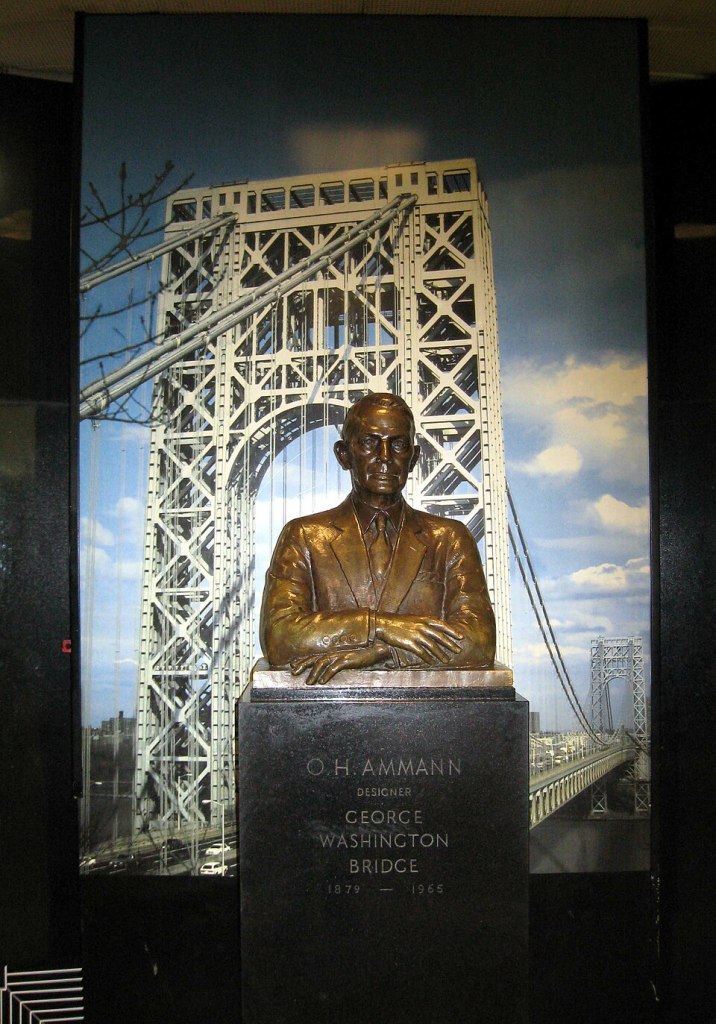
Othmar Ammann (1879–1965) was a Swiss-American structural engineer who revolutionized modern bridge design and helped shape New York City’s skyline with some of the most iconic and enduring bridges in the world. His contributions to civil engineering remain unmatched, and his quiet residence in Rye, New York, served as a retreat during one of the most impactful engineering careers in American history.
Early Life and Education
Born on March 26, 1879, in Feuerthalen, Switzerland, Othmar Hermann Ammann showed early promise in mathematics and engineering. He studied at the Federal Polytechnic Institute in Zurich (now ETH Zurich), where he graduated in 1902. Just two years later, Ammann immigrated to the United States, where he began working as a structural engineer during a transformative era in American infrastructure. He became a US citizen in 1924.
Engineering Mastery and Legacy
Ammann’s career took off in New York City, where his genius for combining efficiency, elegance, and cost-effectiveness found its most dramatic expression in long-span suspension bridges. He is best known for designing:
- George Washington Bridge (1931) – a record-breaking marvel that dramatically lowered costs while doubling projected traffic capacity.
- Triborough Bridge (1936) – a complex system connecting Manhattan, the Bronx, and Queens.
- Bronx–Whitestone Bridge (1939)
- Throgs Neck Bridge (1961)
- Verrazzano-Narrows Bridge (1964) – the longest suspension bridge in the world at the time of its completion.
Ammann worked closely with city planner Robert Moses and became chief engineer of the Port of New York Authority. He founded his own firm, Ammann & Whitney, in 1946.

Awards and Recognition
Ammann was the recipient of numerous accolades, including the National Medal of Science, the National Academy of Sciences Award in Engineering, and honorary doctorates. His structural principles continue to inform bridge design worldwide, and his works remain in daily use by millions.
Connection to Rye, New York
While Ammann’s bridges loomed over the city, his personal life remained grounded in the quiet suburbs of Westchester County. In the 1930s, Ammann purchased a home in Rye, New York, where he lived for many years.
Later Life and Legacy
Ammann continued to consult and write well into his 80s. His final major project, the Verrazzano-Narrows Bridge, opened in 1964 when he was 85 years old. He died on September 22, 1965, at the age of 86, in Rye.
Othmar Ammann is buried in Sleepy Hollow Cemetery, but his legacy lives on every time a car crosses the Hudson or East River.