

Holding Court is a series by retired Rye City Court Judge Joe Latwin. Latwin retired from the court in December 2022 after thirteen years of service to the City.
What topics do you want addressed by Judge Latwin? Tell us.
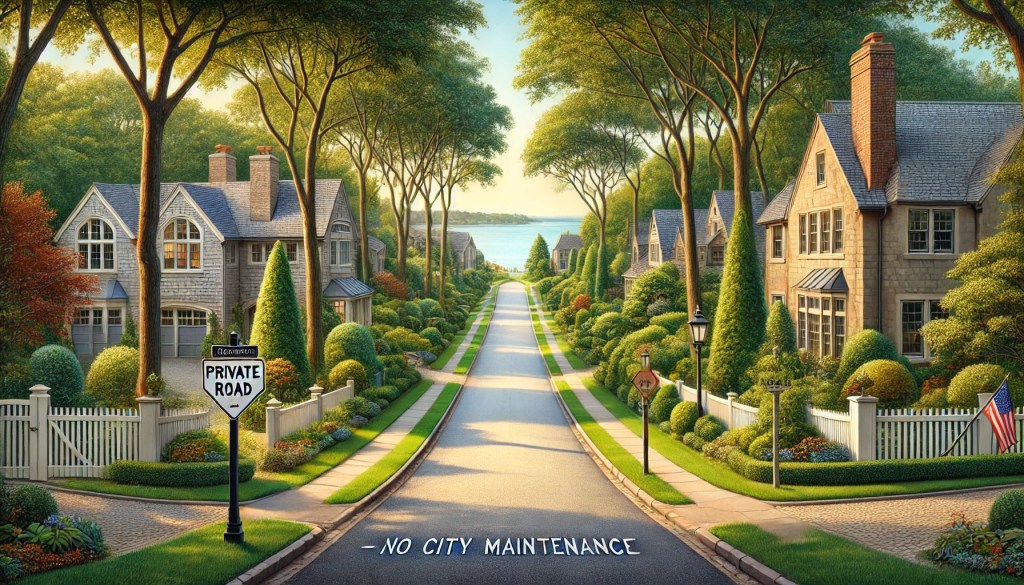
This week, we are on the topic of roads once again. See our recent articles: Holding Court: Private Roads and The 83 Private Roads in Rye, New York.
By Joe Latwin

Street smarts. Comments on recent articles on streets have paved the way and shown a roadmap for more.
Highways (streets) are established by dedication, prescription, or direct action of a local government. The State Constitution prohibits the State Legislature from laying out or opening a highway. A landowner cannot create a street without some public cooperation. He or she can layout a proposed street, grade it, and offer it for public use, but it doesn’t become a public street until it is accepted by the municipality. This usually happens in the subdivision process where the laying out of a street on the subdivision plat is considered a continuing offer dedication. Rye won’t accept the dedication of a street until the proposed street is up to City standards – with lighting, fire hydrants, curbs, drainage, base and top coat paving, etc.
A highway is a statutory term relating to the pathway for vehicle traffic. A street is a type of highway but is not limited to the traveled way but might also include sidewalks. A sidewalk is a walkway along the margin of a street designed for the use by pedestrians. A curb is generally the dividing line between the part of the street intended for vehicular traffic and the part intended for pedestrian use. A curb also functions to carry storm water away from the street (since most roads are crowned) and provide a barrier from the stormwater going onto adjoining property. Between the curb and the sidewalk might be a parkway – often a grass strip a few feet wide. Yes, you drive on a parkway and park in a driveway!
Most streets are encompassed in a right of way beyond the mapped street itself. A paved street must be within a mapped street. The minimum paved width of a street is 24 feet. Generally, streets must have the right-of-way of 50 feet in residential districts. The right-of-way is measured from the center line of the street and sometimes the paved street does not match where the mapped street is set forth on the City maps. Assuming a paved street laid out and paved in the precise center of the right-of-way, two equal 13 feet of rights of way would exist on each side of a 24-foot-wide street. Without measuring from the official map, you cannot be sure that the paved street is centered or where the center line of the mapped street actually is.
The right to use a public highway for purposes other than travel can only be given by the proper public authority. Since trees provide shade on the roadway, they are a proper use of the right-of-way. On the other hand, placing of rocks in the right of way to prohibit the public from driving or parking within the right of way would constitute an improper use of the right of way. There are certain improper uses of the right of way that may be desirable. For instance, when I represented the Town of Harrison, I reviewed several requests to use the right of way, such as by planting shrubbery, placement of a mailbox, or the installation of gates. I would recommend approval of these incursions into the right of way with the conditions that the property owner pay for the installation and removal of these items when deemed necessary by the Town and to hold the Town harmless from any claim made because of the Town’s permission to allow the encroachment in the right of way.
Once a highway becomes useless, a municipality can discontinue a street. Also, a highway that has not been opened or worked, or used as a highway has not been traveled within six years of when it was dedicated ceases to be a highway.
